

Starting a business in 2026 offers exciting possibilities, but it also presents challenges. Every day, thousands of entrepreneurs around the world are launching new startups.
But how many of them actually succeed? This article provides you with the latest data on success rates, funding, and common reasons for failure, so you can better understand the startup landscape.
Let’s dive into the numbers that every entrepreneur should know.
Startup Statistics: Global Startup Landscape in 2026

The startup ecosystem is thriving and growing rapidly. In 2026, over 150 million startups are active globally, and new startups are being launched at an incredible pace.
Key Numbers:
- Over 150 million startups exist worldwide in 2026.
- 50 million new startups launch every year, equating to 137,000 new businesses starting every single day.
- In the U.S. alone, 5.2 million business applications were filed in 2026.
These numbers show that entrepreneurship is alive and well, with people starting businesses at an unprecedented rate.
Let’s look at how startups are distributed across countries.
Startups by Country (2026 Data)
The United States remains the dominant force in the startup world, but other countries are also experiencing rapid growth.
| Country | Number of Startups | Notable Feature |
|---|---|---|
| United States | 84,624 | Highest globally, Silicon Valley hub |
| India | 621,448 | Second largest startup ecosystem |
| United Kingdom | 7,742 | Strong fintech presence |
| China | 313 unicorns | Leads in unicorn companies |
| Israel | 27 unicorns | Highest per capita |
The U.S. continues to lead the world in terms of the number of startups, with Silicon Valley at the heart of this ecosystem.
However, countries like India have been experiencing impressive growth in recent years, with over 600,000 startups in 2026.
Daily Startup Activity
Each day brings new startups, funding rounds, and some failures. Here’s a breakdown of what happens daily in the startup world:
- 137,000 new startups launch.
- Thousands of startups receive funding.
- Unfortunately, many startups also fail each day.
This daily churn creates a dynamic environment in the startup ecosystem, with opportunities and risks emerging constantly.
Startup Success and Failure Rates
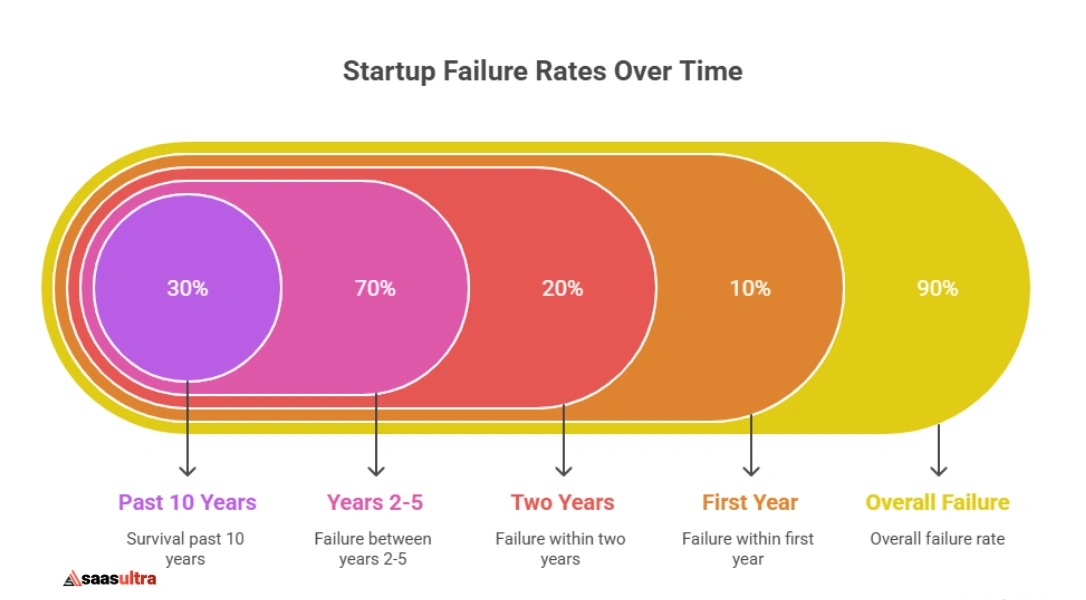
While starting a business can be rewarding, the statistics show that many startups face significant challenges. The data reveals the hard truth about startup failure rates.
Overall Failure Rates:
- 90% of startups eventually fail.
- 10% fail within the first year.
- 20% fail within two years.
- 70% fail between years 2-5.
- Only 30% survive past 10 years.
This data shows that while it’s tough, surviving the first few years is crucial for long-term success. The good news is that businesses that make it through the first five years tend to have a better chance of surviving in the long run.
Survival Timeline
| Time Period | Survival Rate | What This Means |
|---|---|---|
| After Year 1 | 80% survive | Most businesses make it past launch |
| After Year 2 | 70% survive | Early challenges eliminated |
| After Year 5 | 50% survive | Half of businesses remain active |
| After Year 10 | 30% survive | Long-term viability established |
| After Year 15 | 25% survive | Business stability confirmed |
Why Startups Fail: Top Reasons
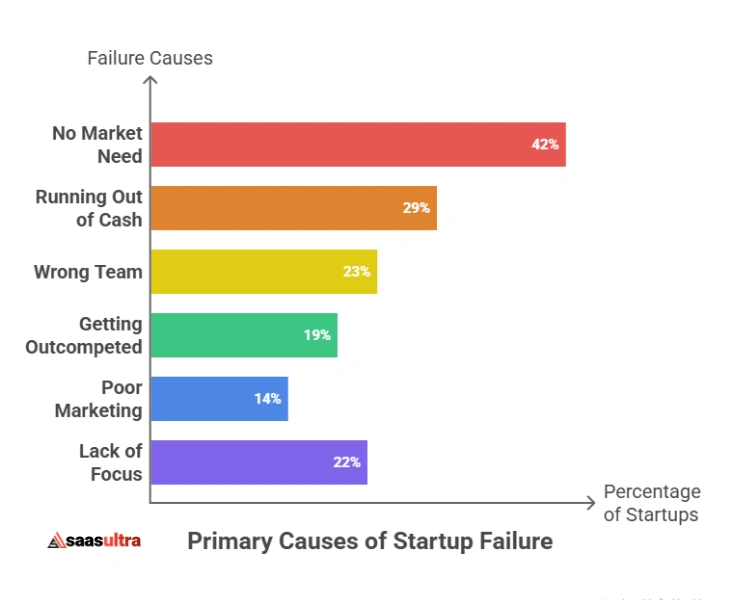
Understanding why startups fail is essential. Here are the top reasons for failure based on 2026 data:
| Primary Failure Causes | Percentage of Startups |
|---|---|
| No Market Need | 42% |
| Running Out of Cash | 29% |
| Wrong Team | 23% |
| Getting Outcompeted | 19% |
| Poor Marketing | 14% |
| Lack of Focus | 22% |
Detailed Reasons:
- No Market Need (42%): The product doesn’t solve real problems, or the target audience is too small.
- Running Out of Cash (29%): Poor financial management and missing revenue projections lead to financial issues.
- Wrong Team (23%): Lack of complementary skills, co-founder conflicts, or leadership problems are common pitfalls.
- Getting Outcompeted (19%): Failure to differentiate from competitors or pricing pressure can lead to failure.
- Poor Marketing (14%): Weak brand positioning and ineffective marketing channels hurt startups.
- Lack of Focus (22%): Trying to chase too many markets or adding too many features can dilute a startup’s focus.
Startup Funding Statistics 2026
Investment in startups continues to be strong, with venture capital funding increasing in 2026.
Global Funding Overview
- Global VC funding in Q1 2025 reached $113 billion, the highest since 2022.
- Average seed round: $2.2 million.
- Average Series A: $15-20 million.
- AI startups: $19 billion raised in Q3 2025 alone.
Funding by Stage (2026)
| Funding Stage | Average Amount | What You Get | Success Rate |
|---|---|---|---|
| Seed | $2.2 million | MVP development | Lower |
| Early-stage | $24.7 billion | Market validation | Moderate |
| Late-stage | $34.7 billion | Scale operations | Higher |
Startup Capital Sources
Where do most entrepreneurs get their funding?
| Source | Percentage of Founders Using |
|---|---|
| Self-funded (personal savings) | 78% |
| ROBS (Rollovers for Business Startups) | 53% |
| Personal investments | 20% |
| Raise over $250,000 | 18% |
Most entrepreneurs start with personal funds, and external funding often comes later.
Unicorn Statistics 2026

Unicorns are startups valued at over $1 billion. There are now 1,489 active unicorns globally, with the U.S. leading the pack.
Latest Unicorn Data:
- 1,489 active unicorns globally.
- Combined valuation: $5 trillion.
- U.S. has 1,047 unicorns (70% of total unicorns).
The probability of building a unicorn is very low—just 0.00006% or about 3 in 5 million companies.
Startup Costs and Economics
Starting a business can be expensive, but costs vary greatly depending on the industry. Here’s a breakdown of average startup costs in 2026.
Average Startup Costs 2026:
- Overall average: $3,000 – $12,000.
- Five-person team: $460,000 – $485,000 in the first year.
Startup Costs by Industry:
| Industry | Startup Cost | Key Expenses |
|---|---|---|
| Online business | $5,000 – $12,000 | Website, marketing |
| Restaurant | $175,500 – $750,500 | Location, equipment |
| Retail store | $50,000 – $175,000 | Inventory, rent |
| Service business | $12,000 – $50,000 | Tools, insurance |
| Tech startup | $40,000 – $100,000 | Development, talent |
| Manufacturing | $100,000 – $400,000 | Equipment, materials |
Industry-Specific Startup Statistics
Some industries are growing faster than others. Here are some key stats for specific sectors.
Fintech Startups:
- 30,000 fintech startups globally in 2024.
- 75% failure rate due to high competition.
- U.S. leads with over 10,000 fintech startups.
E-commerce Startups:
- Global e-commerce market exceeds $6.4 trillion.
- 70% of e-commerce startups fail within five years.
- Customer acquisition is challenging, with many startups failing within the first 120 days.
AI Startups:
- 90,000+ companies use AI globally.
- AI startups secured $19 billion in Q3 2025.
- 60% of entrepreneurs plan on using AI in their startups.
Real Estate Startups:
- Property tech is growing, expected to reach $88.37B by 2032.
- VC investment has decreased by 43% in the past year.
- Efficiency improvements from big data.
FAQs About Startup Statistics
1. What percentage of startups fail in their first year?
Approximately 10-20% of startups fail within their first year, but 70% fail between years 2-5. Surviving the first five years is crucial for long-term success.
2. How much money do I need to start a business in 2026?
The median actual startup cost is $12,000, much lower than the common perception of $28,000. Costs vary by industry, with online businesses generally requiring the least capital.
3. What are my chances of building a unicorn company?
The probability of building a $1 billion unicorn company is 0.00006%, with only 1% of startups reaching unicorn status. Most businesses focus on profitability rather than unicorn growth.
4. Why do most startups fail?
The top reasons for startup failure in 2026 include no market need (42%), running out of cash (29%), and wrong team (23%). Understanding these causes helps businesses plan better and avoid common pitfalls.
5. How has AI changed the startup landscape in 2026?
AI is revolutionizing startups, with 60% of aspiring entrepreneurs planning to use AI tools. AI helps startups build products faster, improve customer service, and reduce costs, leveling the playing field for smaller businesses.
Also Read:
- Personalization Statistics
- Blockchain Adoption Statistics
- Smartwatch Statistics
- Social Media Statistics
- Content Marketing Statistics
Conclusion
The startup ecosystem in 2026 is thriving, with millions of new businesses being launched every year.
While the statistics around failure rates and challenges are sobering, they also provide valuable lessons for entrepreneurs.
Understanding these insights is crucial for improving your chances of success.
Key takeaways:
- Over 150 million startups globally in 2026.
- 90% of startups eventually fail, but surviving past year five greatly increases your odds of success.
- The most common failure causes are no market need, lack of cash, and poor marketing.
- Startups generally require $12,000 to get started, but most founders underestimate the costs.
- The probability of reaching unicorn status is incredibly low, but building a profitable business is the ultimate goal.
- AI is transforming the startup landscape, and most entrepreneurs plan to use AI tools.
Incorporating these statistics into your startup strategy can help you navigate the challenges of entrepreneurship and increase your chances of long-term success.
Comments
Be the first to leave a comment.