

Every year someone declares email marketing dead. Every year the data says otherwise. In 2026, email reaches more humans than any social platform, returns more revenue per dollar than any paid channel, and — thanks to AI and automation — is converting better than ever before.
Whether you’re a solo founder building your first list or a CMO allocating a seven-figure budget, these 50+ email marketing statistics for 2026 will show you exactly where the channel stands, what’s changing, and where the biggest opportunities are hiding.
Let’s dig in.
The Big Picture: How Large Is Email Marketing in 2026?
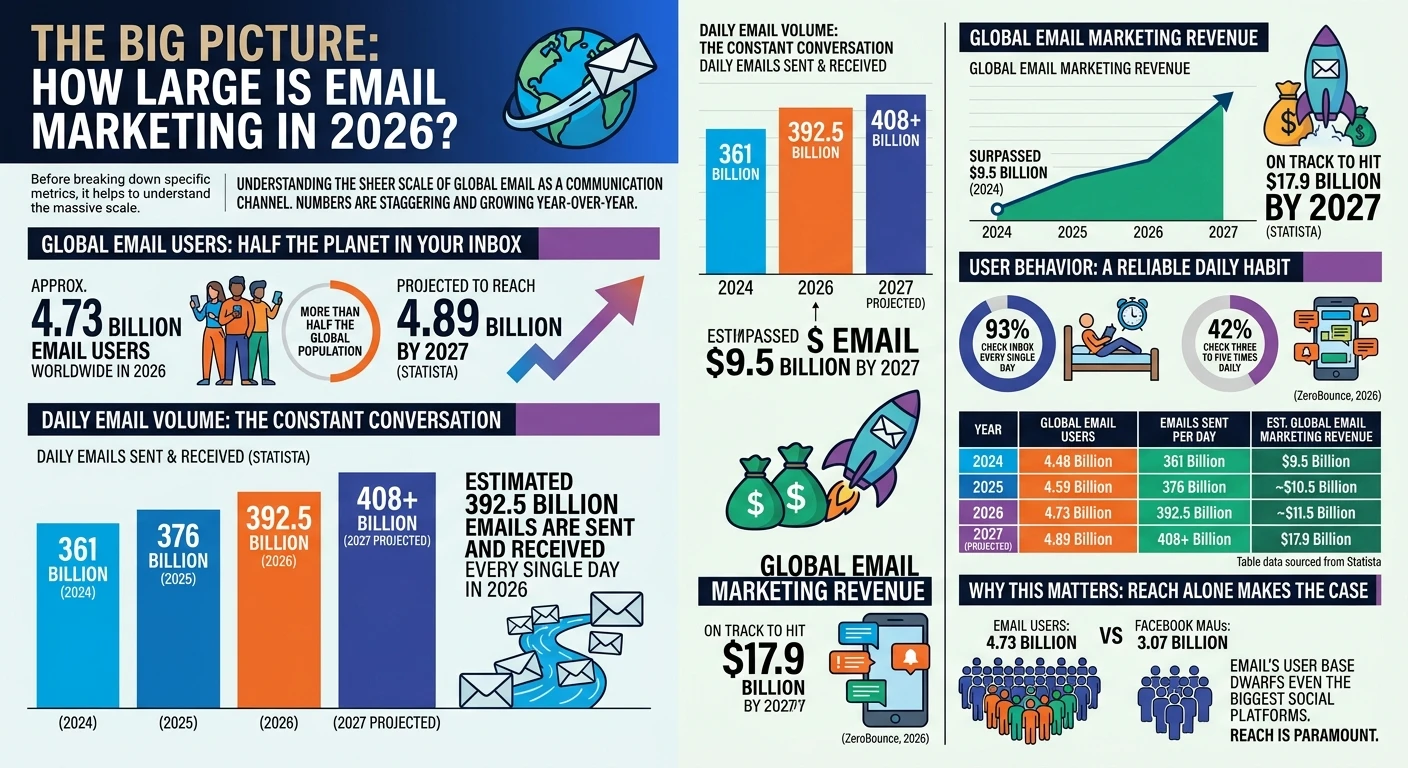
Before breaking down specific metrics, it helps to understand the sheer scale of email as a communication channel. The numbers are staggering, and they continue to grow year over year.
There are approximately 4.73 billion email users worldwide in 2026, a figure projected to reach 4.89 billion by 2027 (Statista). To put that in context, that’s more than half the global population — and comfortably larger than the user base of any social media platform. An estimated 392.5 billion emails are sent and received every single day in 2026, with the daily volume expected to surpass 408 billion by 2027 (Statista). Global email marketing revenue surpassed $9.5 billion in 2024 and is on track to hit $17.9 billion by 2027 (Statista). Meanwhile, 93% of email users say they check their inbox every single day, with 42% checking three to five times daily (ZeroBounce, 2026).
Year | Global Email Users | Emails Sent Per Day | Est. Global Email Marketing Revenue |
2024 | 4.48 Billion | 361 Billion | $9.5 Billion |
2025 | 4.59 Billion | 376 Billion | ~$10.5 Billion |
2026 | 4.73 Billion | 392.5 Billion | ~$11.5 Billion |
2027 (Projected) | 4.89 Billion | 408+ Billion | $17.9 Billion |
Why this matters: Email’s user base dwarfs even the biggest social platforms. Facebook has around 3.07 billion monthly active users. Email has 4.73 billion daily users. If you’re debating where to invest your marketing budget, reach alone makes the case.
Email Marketing ROI: Still the King of All Channels
ROI is the statistic that keeps email at the centre of every serious marketing budget. No other digital channel comes close.
Email marketing returns an average of $36 to $42 for every $1 spent, depending on the industry and source — a 3,600% to 4,200% ROI (Statista). Retail and ecommerce brands do even better, averaging $45 per dollar spent. Some U.S. ecommerce merchant cohorts report averages as high as $72 per dollar invested (MailMend, 2026). Nearly 1 in 5 companies achieve an email marketing ROI of 7,000% or more — that’s $70 back for every single dollar (EmailMonday, 2026). And 75% of marketers plan to maintain or increase their email marketing spending this year (HubSpot State of Marketing, 2026).
Compare that to social media, where the average ROI hovers around $6.50 per $1 spent, and the case for email becomes overwhelming. As one LinkedIn post that went viral in March 2026 put it: “Email Marketing in 2026: STILL the $36-to-$1 ROI King. Social algorithms change daily, ad costs skyrocket, but email quietly prints money.”
Open Rates, Click Rates, and What They Actually Mean in 2026
Open rates used to be the most trusted metric in email marketing. That changed when Apple introduced Mail Privacy Protection (MPP) in 2021, which pre-loads email content and inflates open rate numbers. In 2026, with Apple Mail holding roughly 50–60% of email client market share, a significant portion of reported “opens” are phantom signals — not actual humans reading your email.
That said, here are the current industry benchmarks:
Metric | 2026 Average | Notes |
Average Open Rate (All Industries) | 39–43% | Inflated by Apple MPP |
Average Click-Through Rate (CTR) | 2–3.5% | More reliable metric |
Average Click-to-Open Rate (CTOR) | 6.8–10.5% | Best engagement indicator |
Average Unsubscribe Rate | 0.1–0.26% | Increasing due to Gmail’s visible unsubscribe button |
Average Bounce Rate | 1.2% | Cross-industry average |
Conversion Rate (B2C) | 2.8% | HubSpot, 2026 |
Conversion Rate (B2B) | 2.4% | HubSpot, 2026 |
The real story isn’t open rates — it’s click-to-conversion rates, which grew by roughly 28% in 2024 and continue trending upward. This means that people who click are increasingly likely to buy. Marketers who segment well and send relevant content are being rewarded with stronger downstream performance than at any point in email marketing history.
Pro tip: If you’re still optimizing campaigns based primarily on open rates, you’re chasing a degraded signal. Shift your focus to clicks, conversions, and revenue per email sent. Those metrics reflect real subscriber behaviour, not proxy data distorted by privacy features.
Open Rates by Industry: Where Does Your Sector Stand?
Not all industries perform equally. Here’s how the major sectors compare in 2026, based on data aggregated from Klaviyo, ActiveCampaign, and Campaign Monitor:
Industry | Avg. Open Rate | Avg. Click Rate |
Non-Profit | 52.38% | 3.48% |
Media / Publishing | 43.16% | 2.1% |
Education | 42.68% | 2.9% |
Healthcare | 41.48% | 1.9% |
Software / SaaS | 36.20% | 6.67% |
Retail / Ecommerce | 33.1% | 1.83% |
Financial Services | 31.0% | 1.69% |
Food & Beverage | 30.5% | 2.4% |
Non-profits consistently lead in open rates because their audiences are mission-driven and emotionally invested. Software and SaaS, meanwhile, lead in click rates because recipients are typically evaluating solutions and are further down the decision funnel. These benchmarks are useful for orientation, but your own historical performance and trajectory matter far more than how you compare to an all-industry average.
Email Automation: 2% of Volume, 37% of Revenue
If there’s one statistic in this entire article that should change how you allocate your time, it’s this: automated emails represent just 2% of total email send volume but drive roughly 37% of all email-generated revenue (Omnisend, 2026). Automated messages generate over 320% more revenue than standard campaign sends.
Here’s why automation is so powerful:
Welcome emails achieve open rates above 60% — the highest of any email type
Abandoned cart emails have open rates north of 50%, roughly 15% higher than standard marketing emails
Sending three abandoned cart emails results in 69% more orders than sending just one (Oberlo)
Back-in-stock emails have the highest conversion rate of any automated email type
One in three people who click on an automated message end up making a purchase
The top 10% of email automated workflows generate $16.96 in revenue per recipient, compared to just $1.94 for average flows
The reason automation works so well is timing and relevance. These emails are triggered by actual subscriber behaviour — a signup, an abandoned cart, a browse session — so they arrive when the subscriber is already engaged. That’s a fundamentally different dynamic than batch-and-blast campaigns.
AI in Email Marketing: The 2026 Tipping Point
AI has moved past the experimentation phase in email marketing. Over 63% of marketers are now actively using AI in their email campaigns (Backlinko, 2026), and the results are measurable.
Campaigns powered by AI are driving 41% higher revenue than traditional approaches. By 2026, 89% of marketing experts expect up to 75% of email strategy operations to be AI-driven. Emails with AI-generated personalized content see a 29% higher open rate and a 41% higher click-through rate. And 51% of marketers now believe AI-powered email marketing is more effective than traditional methods (Statista).
The most impactful AI applications in email right now are send-time optimization (used by roughly two-thirds of AI-adopting marketers), subject line generation, audience segmentation, and hyper-personalization. According to a recent Reddit discussion on r/DigitalMarketing, one marketer analyzed 2,500+ subject lines and found that AI-assisted subject lines with 6–10 words and a personalized element consistently outperformed manual alternatives by 18–24% on open rates.
Mobile Email: The Non-Negotiable Standard
More than half of all email opens happen on mobile devices in 2026. Apple’s email client alone holds roughly 50% of email client market share, followed by Gmail at 27–29% and Outlook at 7–8%. One-third of all emails are opened specifically on an iPhone (Forbes, 2026). Among Gen Z users, 67% primarily check email on their smartphones (OptinMonster, 2026).
Despite this, nearly one in five email campaigns are still not optimized for mobile (SuperOffice). And here’s the cost of that neglect: 50% of users say they will immediately delete an email that doesn’t render properly on their phone. That’s half your mobile audience actively punishing a design choice you control. On the positive side, responsive email design increases unique mobile clicks by 15% (G2), and mobile emails have a 65% higher likelihood of driving recipients to your website.
Personalization & Segmentation: The Data Behind the Hype
Personalization isn’t a nice-to-have any more — it’s the expectation. The numbers make this abundantly clear.
Personalized subject lines generate 50% higher open rates. Personalized calls to action deliver 42% higher conversion rates than generic CTAs. 80% of consumers are more likely to purchase from brands that offer personalized experiences (HubSpot, 2026). And 63% of consumers say they will stop buying from brands that use poor personalization tactics. Yet only about half of marketers currently personalize their email content, which means there’s a massive performance gap waiting to be exploited by those who do.
Segmented email campaigns generate 30% more opens and 50% more click-throughs than unsegmented campaigns, according to HubSpot’s 2026 State of Marketing Report. 78% of marketers say email segmentation is their single most effective tactic. And 58% of email revenue is generated through segmented and personalized emails.
B2B vs. B2C: How Email Performs Across Business Models
Email is effective for both B2B and B2C, but the dynamics differ. 81% of B2B marketers say email is their most-used content distribution channel. B2B emails enjoy 23% higher click-to-open ratios than B2C emails, and B2B welcome emails achieve a 68.6% open rate. Meanwhile, B2C brands see a slightly higher overall conversion rate at 2.8% compared to B2B’s 2.4% (HubSpot, 2026). Interestingly, 77% of B2B buyers say they prefer to receive brand communications via email (MarketingProfs, 2026), making it the most preferred channel for business communication by a wide margin.
Deliverability & Privacy: The Hidden Battle
You can craft the perfect email, but none of it matters if it never reaches the inbox. The average email deliverability rate across major ESPs was tested at 83.1% in 2026, meaning roughly 1 in 6 emails never reach their intended recipient (EmailToolTester, 2026). Gmail averages about 95% deliverability, while Outlook and AOL have seen steeper drops due to stricter bulk sender enforcement.
On the privacy front, DMARC adoption has surged — domains with valid DMARC records among the top 1.8 million domains grew from 523,921 in 2023 to 937,931 in early 2026 (EasyDMARC). However, 70.9% of domains worldwide still have no effective DMARC protection. Gmail and Yahoo both now enforce strict requirements around SPF, DKIM, and DMARC authentication, easy-to-find unsubscribe options, and spam complaint thresholds below 0.3%.
What Real Marketers Are Saying: Insights from Reddit and X
The data is one thing. What practitioners experience in the trenches is another.
A popular thread on r/AskMarketing titled “Is email marketing still worth my time in 2026?” (January 2026) captured the sentiment perfectly. The top-voted reply stated: “Social media is better at discovery and top-of-funnel awareness, while email usually wins when it comes to conversions and repeat sales.” Another commenter shared that after shifting 40% of their social media ad budget to email automation, their revenue per customer increased by 28% within two quarters.
On r/Entrepreneur, a widely-discussed post (February 2026) noted: “Email isn’t dead — bad email is. The inbox isn’t dying. It’s getting pickier.” This observation aligns perfectly with the data: deliverability, personalization, and segmentation are what separate high-performing email programmes from mediocre ones.
On X (formerly Twitter), a viral post from a marketing agency founder in March 2026 summed up the ROI debate: “Email Marketing in 2026: STILL the $36-to-$1 ROI King. Social algorithms change daily, ad costs skyrocket, but email quietly prints money.” The post generated thousands of reposts and sparked a broader conversation about why marketers keep underinvesting in their highest-returning channel.
Generational Email Preferences: Gen Z Loves Email More Than You Think
One of the most surprising data points in 2026 is that younger generations are not abandoning email — they’re using it differently.
Generation | Use Email on Smartphone | Consider Email the Most Personal Brand Channel |
Gen Z | 67% | 60% |
Millennials | 59% | 64% |
Gen X | 53% | 72% |
Baby Boomers | 36% | 74% |
56% of Gen Z respondents say they use email to contact brands (WebFX, 2026), and 65% of Gen Z favour email for brand interactions (Jarrang, 2026). 58% of Gen Zers check their email multiple times a day. The narrative that young people don’t use email simply doesn’t hold up against the data. What is true is that Gen Z has less patience for irrelevant content — personalization and mobile optimization are non-negotiable for reaching them.
Email Frequency: How Much Is Too Much?
The number one reason people unsubscribe from email lists is receiving too many emails (Gartner, 2026). Over 56% of U.S. consumers will unsubscribe if they receive four or more marketing messages from the same company within 30 days (BusinessWire, 2024). Only 15% of users say they’d be comfortable receiving promotional emails daily. And the data shows that the highest open and click-through rates come from emails sent once per week to once per month — less really is more when it comes to frequency.
33% of marketers send weekly emails, and 26% send multiple times per month. Sending one well-crafted email per week has been shown to triple engagement compared to higher-frequency approaches.
Key Takeaways: What These Numbers Mean for Your 2026 Strategy
After analysing 50+ data points, the story is remarkably consistent. Email marketing in 2026 is not just alive — it’s the most reliable, highest-returning channel in the digital marketing ecosystem. The marketers who win are not the ones with the biggest lists or the most sends. They’re the ones who execute well across a handful of fundamentals.
Invest in automation first. It represents only 2% of send volume but drives 37% of revenue. Welcome sequences, abandoned cart flows, and back-in-stock alerts should be running 24/7 before you send a single campaign email.
Prioritise deliverability. With 1 in 6 emails never reaching the inbox, authentication (SPF, DKIM, DMARC), list hygiene, and complaint rate monitoring aren’t optional — they’re the foundation everything else sits on.
Personalise beyond the first name. Segmented campaigns see 30–50% better performance. Use purchase history, browsing behaviour, and engagement recency to send genuinely relevant content.
Design mobile-first. With over 55% of opens on mobile and half of all users deleting poorly rendered emails, responsive design isn’t a feature — it’s table stakes.
Let AI handle timing and testing. AI-powered send-time optimization and subject line generation are delivering measurable lifts of 29–41%. These tools are mature enough to trust and accessible enough for any team size.
The data doesn’t lie. Email marketing in 2026 is the highest-ROI channel, the most widely-used communication tool on the planet, and — for marketers willing to respect the inbox — the most reliable engine for growth you have access to.
FAQs
Email marketing continues to deliver one of the highest returns in digital marketing, with studies showing an average ROI of $36 to $42 for every $1 spent. This makes it consistently more cost-effective than paid social or display advertising.
Yes, email marketing remains highly effective in 2026, with over 4.7 billion global email users and open rates climbing thanks to better personalization and AI-driven segmentation. Data consistently shows email outperforms most other channels in both reach and conversion.
Over 380 billion emails are sent daily in 2026, with a significant portion being marketing and promotional messages. This volume reflects how deeply embedded email remains in both B2B and B2C communication strategies.
Marketers prioritize email because it offers direct access to a subscriber’s inbox without relying on algorithm changes or platform policy shifts that affect organic reach on social media. Email also provides richer analytics, stronger segmentation capabilities, and higher conversion rates for most industries.
The average email open rate across industries in 2026 sits between 38% and 45%, boosted significantly by Apple Mail Privacy Protection changes and improved subject line personalization techniques. Sectors like healthcare, education, and finance tend to see above-average open rates compared to retail or e-commerce.
Comments
Be the first to leave a comment.