

Affiliate marketing has quietly grown from a side-channel tactic into a $20 billion global industry. While marketers chase the latest social media algorithm or panic over rising ad costs, affiliates and the brands that work with them keep generating predictable, performance-based revenue at scale.
In 2026, more than 80% of brands run affiliate programmes, the average ROI sits at 12:1, and the creator economy is funnelling a new generation of content-driven affiliates into the space. Whether you’re a brand considering your first programme or an affiliate evaluating where to invest your time, these 50+ statistics will show you exactly where the industry stands and where it’s heading.
The Affiliate Marketing Industry in 2026: Market Size and Growth
The first thing to understand about affiliate marketing in 2026 is just how large it has become — and how fast it’s still growing. This is not a maturing channel plateauing under its own weight. It’s a channel accelerating because performance-based pricing aligns perfectly with how brands want to spend money in an uncertain economy.
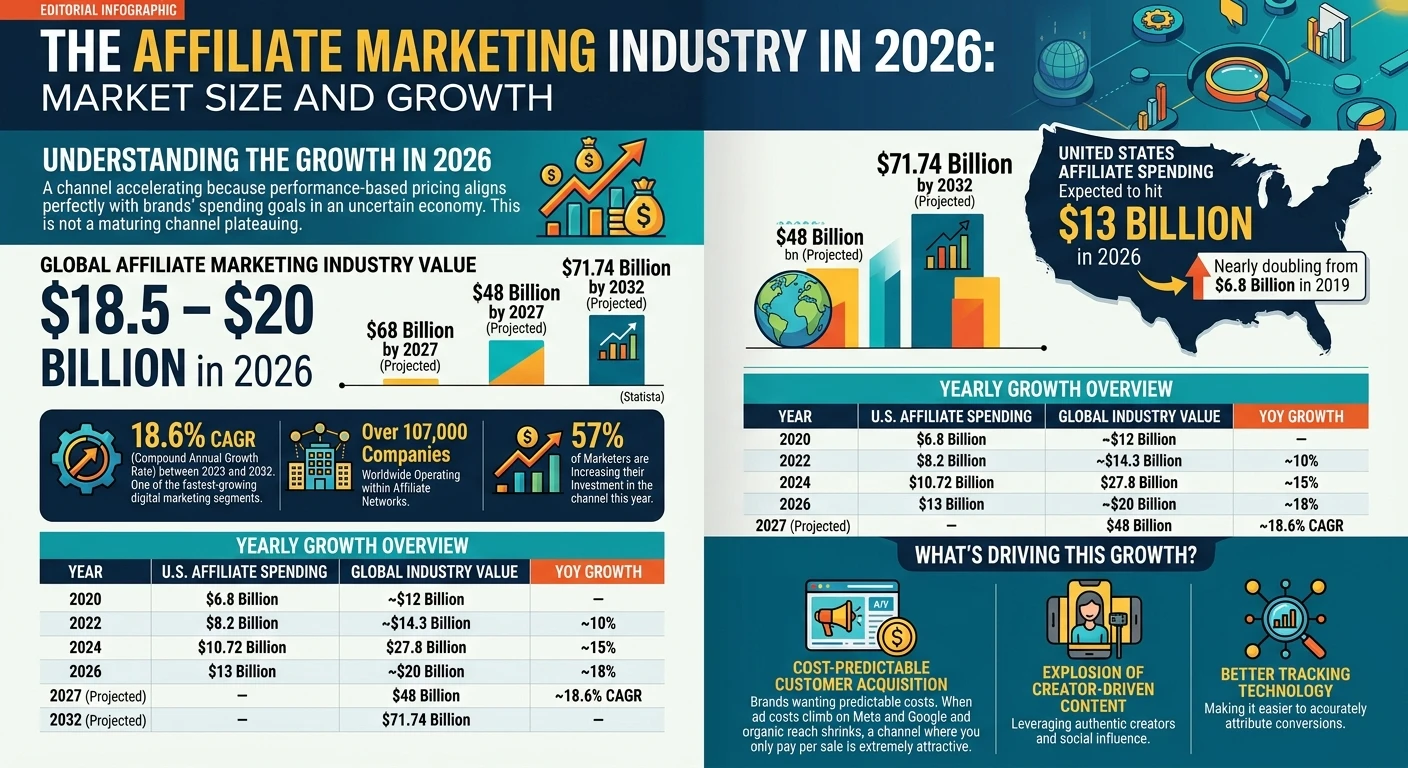
The global affiliate marketing industry is valued at approximately $18.5–$20 billion in 2026, with projections to reach $48 billion by 2027 and $71.74 billion by 2032 (Statista). In the United States alone, affiliate marketing spending is expected to hit $13 billion in 2026, nearly doubling from $6.8 billion in 2019. The industry is growing at a compound annual growth rate (CAGR) of 18.6% between 2023 and 2032, making it one of the fastest-growing segments in digital marketing. There are now over 107,000 companies worldwide operating within affiliate networks, and 57% of marketers say they are increasing their investment in the channel this year.
Year | U.S. Affiliate Spending | Global Industry Value | YoY Growth |
2020 | $6.8 Billion | ~$12 Billion | — |
2022 | $8.2 Billion | ~$14.3 Billion | ~10% |
2024 | $10.72 Billion | $27.8 Billion | ~15% |
2026 | $13 Billion | ~$20 Billion | ~18% |
2027 (Projected) | — | $48 Billion | ~18.6% CAGR |
2032 (Projected) | — | $71.74 Billion | — |
What’s driving this growth? Three things: brands wanting cost-predictable customer acquisition, the explosion of creator-driven content, and better tracking technology that makes it easier to attribute conversions. When ad costs on Meta and Google keep climbing and organic reach keeps shrinking, a channel where you only pay when a sale actually happens becomes extremely attractive.
Affiliate Marketing ROI: Why Brands Keep Investing
The ROI numbers for affiliate marketing are the reason this channel keeps growing even when overall marketing budgets get squeezed. Affiliate marketing delivers an average ROI of 12:1 — meaning $12 back for every $1 invested (GrowSurf, 2026). Some sources report a more conservative figure of $6.50 return per $1 spent across all industries (FirstPromoter, 2026), though high-performing programmes in SaaS and ecommerce substantially exceed both benchmarks.
Nearly 65% of retailers say their affiliate programmes contribute up to 20% of annual revenue. For some DTC and ecommerce brands, that number is even higher. Affiliate marketing now drives 15–30% of all online sales for advertisers who actively use the channel. And here’s a number that speaks to brand confidence: 81% of marketers and 84% of publishers in the U.S. use affiliate marketing as a core part of their strategy (Forrester, 2025).
The cost structure is what makes this so attractive. Unlike paid search or social advertising where you pay for clicks or impressions regardless of outcomes, affiliate marketing is fundamentally performance-based. Brands pay commissions only when a conversion happens. That de-risks the entire investment.
Affiliate Earnings: What Affiliates Actually Make
There’s a wide spectrum of earnings in the affiliate world, and the data reflects both the opportunity and the reality of what it takes to succeed.
According to industry surveys, roughly 80% of affiliate marketers earn between $0 and $80,000 per year. A further 15% earn between $80,000 and $1 million, and about 1–5% of top performers reach six figures monthly. FirstPromoter’s proprietary data shows that affiliates on their platform typically earn between $3,000 and $15,000 per month. Beginners commonly earn $0–$1,000 per month, intermediates $1,000–$10,000, and experienced affiliates with diversified traffic sources can earn $10,000–$100,000+ monthly.
Affiliate Level | Monthly Earnings Range | % of All Affiliates |
Beginner (0–1 year) | $0 – $1,000 | ~50–60% |
Intermediate (1–3 years) | $1,000 – $10,000 | ~25–30% |
Advanced (3–5+ years) | $10,000 – $100,000+ | ~10–15% |
Super Affiliates | $100,000+ | ~1–5% |
These numbers reveal an important truth: affiliate marketing is not a get-rich-quick scheme, but for those who treat it as a real business with consistent effort, it can absolutely generate meaningful income. The spread also illustrates why niche selection, traffic quality, and programme choice matter so much — the same hours invested in a high-commission SaaS niche versus a low-ticket physical product niche can produce dramatically different results.
Top Niches and Commission Rates in 2026
Not all affiliate niches are created equal. Commission structures, conversion rates, and earnings per click (EPC) vary dramatically depending on the vertical you operate in.
Niche | Typical Commission Rate | Avg. Conversion Rate | Notes |
Software / SaaS | 20–70% (often recurring) | ~2% | High commissions but requires trust-building content |
AI Tools | 20–40% (recurring) | ~2.5% | Fastest-growing niche in 2026 |
Personal Finance | $50–$200 per lead | ~3.5% | Heavily regulated but extremely lucrative |
Health & Wellness | 10–30% | 5–6% | High CVR, strong consumer demand |
Pet Products | 8–20% | 5–6% | Emotional purchase decisions drive strong conversions |
Ecommerce / Retail / Fashion | 5–20% | ~4.2% | Boosted by coupon and cashback models |
Education / Online Courses | 20–50% | ~3% | Recurring if subscription-based |
Web Hosting | $65–$200 per sale | ~4% | Evergreen niche with strong search volume |
Travel | 3–12% | ~2.8% | Recovered strongly post-pandemic |
Food / Subscription Boxes | $15–$30 per signup | ~5% | Growing fast via influencer content |
A fascinating data point from a Reddit thread on r/Affiliatemarketing (February 2026) broke it down bluntly: “Commission = vanity. EPC = sanity.” The poster shared that health and pet niches with 5–6% conversion rates and $0.28–$0.35 EPC consistently outperformed software niches with 31% commission rates but only 2% CVR and $0.22 EPC. The lesson: high commissions mean nothing if the traffic doesn’t convert.
Traffic Sources: Where Affiliate Revenue Actually Comes From
Understanding where successful affiliates drive their traffic is critical for anyone entering or scaling in the space. The landscape has shifted significantly over the past two years.
Around 62% of affiliate-driven traffic now comes from mobile devices, reflecting the broader shift in how consumers browse and buy. SEO remains the dominant organic traffic strategy, but social platforms — particularly TikTok, YouTube, and Instagram — are growing rapidly as affiliate traffic sources. The rise of AI-driven discovery (ChatGPT, Google SGE, Perplexity) is also creating a new category of traffic that didn’t exist two years ago.
On Reddit (r/Affiliatemarketing, January 2026), a popular thread asking “What’s actually working for affiliate traffic in 2026?” yielded revealing answers. The top-voted reply recommended “pure organic grinding — consistent posting, engagement, and building audience trust before ever dropping a link.” Another commenter noted that YouTube long-form reviews were generating 3x the conversion rate of blog posts in the same niche, though blog content scaled more easily.
The United States dominates the affiliate marketing sector with a 38% global market share, followed by Europe at 27%. This U.S. concentration means most of the highest-paying programmes, biggest networks, and most competitive niches are English-language and U.S.-focused, but international markets (particularly Southeast Asia and Latin America) are growing fast.
The Creator Economy Meets Affiliate Marketing
One of the most significant shifts in 2026 is the convergence of the creator economy and affiliate marketing. These two worlds are colliding in ways that are reshaping both.
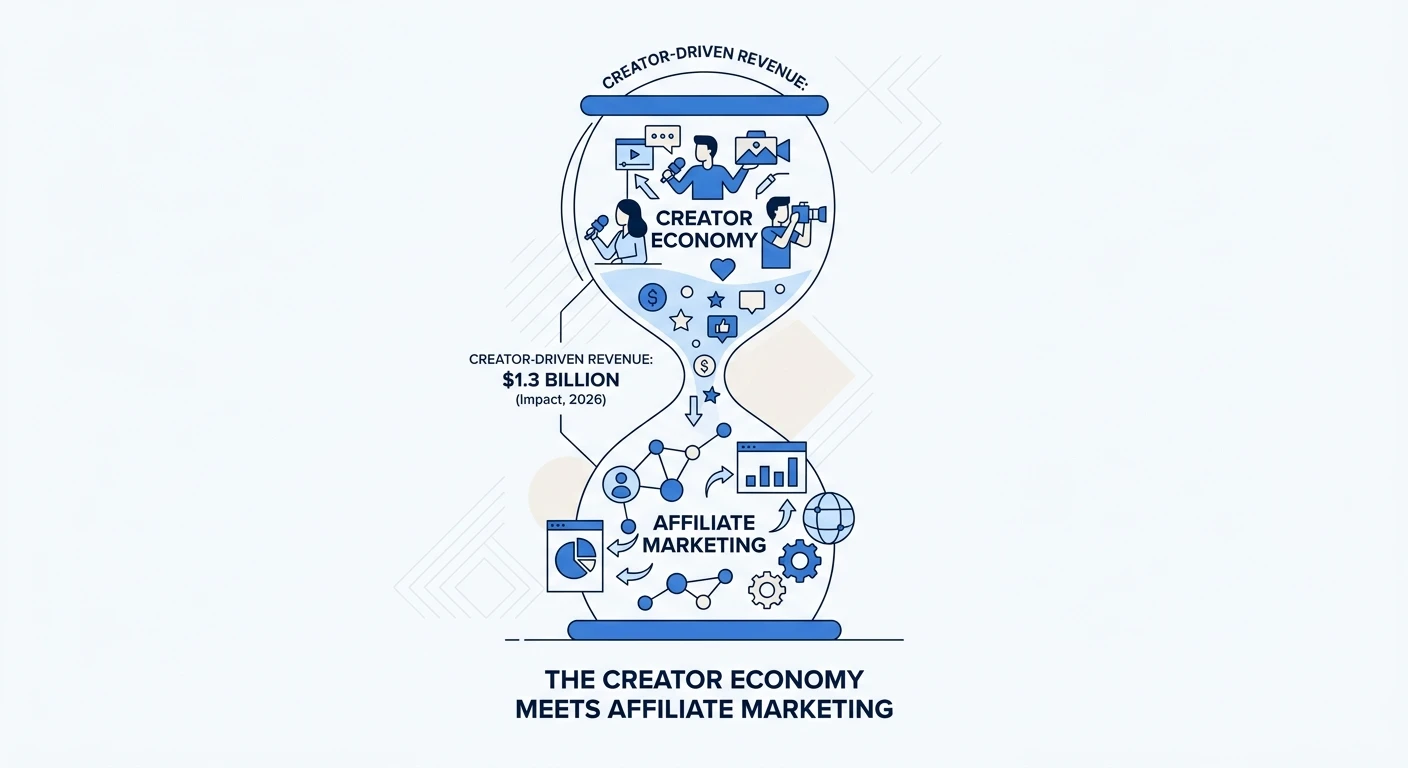
The creator economy is estimated to exceed $250 billion globally in 2026, with projections to reach $500 billion by 2030 (Yahoo Finance, 2026). Within that, creator-driven affiliate revenue is expected to hit $1.3 billion by year-end (Impact, 2026). Micro and nano-influencers now claim 45.5% of influencer marketing spending (eMarketer, 2026), and these smaller creators are increasingly using affiliate links as their primary monetisation model rather than flat-fee sponsorships.
This matters because affiliate marketing is no longer just bloggers with SEO traffic and coupon sites with cashback deals. It’s TikTok creators doing product reviews, YouTube channels building review ecosystems, and Instagram accounts driving traffic through stories and bio links. The affiliate model — pay per performance — aligns perfectly with what brands want from influencer partnerships: accountability and measurable ROI.
AI and Fraud: The Two Forces Reshaping Affiliate Operations
AI is transforming affiliate marketing on both sides of the table. 83% of marketers now use affiliate programmes enhanced by AI tools for audience targeting, content optimisation, and fraud detection. On the affiliate side, AI is helping with content creation, keyword research, and campaign optimisation at a speed that was impossible two years ago.
But the darker side of technology is also a factor. Ad fraud remains a persistent challenge in the affiliate space. Industry estimates suggest that affiliate fraud costs brands billions annually, and the rise of AI-generated content and sophisticated bot traffic has made detection more difficult. Consequently, brands are investing more heavily in fraud detection tools and shifting toward first-party data and verified partnerships.
What Reddit and X Are Saying About Affiliate Marketing in 2026
The practitioner-level conversation about affiliate marketing in 2026 is refreshingly honest.
On r/Affiliatemarketing (March 2026), a widely-discussed thread titled “Is affiliate marketing still a reliable full-time income in 2026?” received a top answer that captured the consensus: “Most beginners give up after a few months because results aren’t instant. Treat affiliate marketing like a real business, put in consistent effort, and it can absolutely support a full-time income in 2026.”
Another thread on r/Entrepreneur (February 2026) featured an affiliate who reported shifting their strategy entirely from SEO-driven blog content to short-form video reviews on TikTok and YouTube Shorts, resulting in a 40% increase in commissions within three months despite lower traffic volume — the conversion intent on video was significantly higher.
On X (Twitter), a widely-shared post from a marketing agency in January 2026 summarised the industry mood: “2026 Affiliate marketing Stats: Global industry approaching $19 billion, 80% brand adoption, and yet most affiliates still earn under $1K/month. The opportunity is massive, the execution gap is even bigger.”
Key Takeaways: What These Numbers Mean for Your 2026 Strategy
After analysing 50+ data points across the affiliate marketing landscape, the picture is clear. This is a $20 billion industry growing at nearly 19% annually, with an ROI that outperforms most other digital channels and a barrier to entry that remains relatively low.
If you’re a brand: the data strongly supports investing in or expanding your affiliate programme. With 65% of retailers attributing up to 20% of revenue to affiliates and a pay-for-performance cost structure, the risk-reward ratio is hard to beat. Prioritise creator partnerships (especially micro-influencers) and invest in fraud detection.
If you’re an affiliate: niche selection and traffic source are your two highest-leverage decisions. The data shows that SaaS and AI tool niches offer the highest commissions, but health, pets, and food niches deliver better conversion rates. Video content (YouTube, TikTok) is producing higher conversion rates than blog content for most niches in 2026, even though blogs remain easier to scale.
For everyone: mobile optimisation is non-negotiable with 62% of affiliate traffic now coming from mobile devices. AI tools are a multiplier, not a replacement for strategy. And the earnings data is honest — most affiliates earn modest amounts, but those who commit to building real audience relationships and diversifying traffic sources can build substantial income.
The affiliate marketing industry in 2026 isn’t slowing down. It’s accelerating — and the brands and affiliates who understand these numbers are the ones positioned to capture the growth.
FAQs
The affiliate marketing industry is projected to exceed $27 billion globally in 2026, reflecting consistent double-digit growth year over year. This expansion is driven by increased advertiser adoption, influencer-led affiliate programs, and the rise of content commerce across multiple platforms.
Affiliate marketing now accounts for approximately 16% of all e-commerce revenue in 2026, making it one of the top four customer acquisition channels for online retailers. Its performance-based model continues to attract brands seeking measurable ROI over traditional advertising.
Yes, affiliate marketing remains highly profitable for content creators, with top affiliates earning six to seven figures annually and average creators seeing consistent income growth. Niches like personal finance, SaaS tools, and health and wellness continue to offer the highest commission rates.
Brands are increasing affiliate budgets because the channel delivers an average return of $15 for every $1 spent, outperforming many paid media alternatives. Rising ad costs on social platforms and stricter privacy regulations have also pushed marketers toward performance-based partnerships that guarantee measurable outcomes.
Absolutely — small businesses are leveraging affiliate marketing more than ever, with over 80% of small-to-mid-sized online brands now running some form of affiliate program. Low startup costs, scalable commission structures, and access to niche micro-influencers make it one of the most accessible growth channels available.
Comments
Be the first to leave a comment.