
Remote work has changed how the world does business. What started as an emergency measure during the pandemic has become a permanent feature of modern employment. In 2026, the debate is no longer about whether remote work is here to stay — it clearly is. The real conversation is about how companies and workers are making it work, and what the data tells us about productivity, wellbeing, money, and the future.
This article brings together the most comprehensive and up-to-date remote work statistics for 2026, pulled from trusted sources including the U.S. Bureau of Labor Statistics, Gallup, Stanford University, the World Economic Forum, and Statista. Whether you are a business leader, HR professional, employee, or curious reader, these numbers give you the full picture.
The Big Picture: How Many People Work Remotely in 2026?
Remote work is no longer a niche arrangement. It has settled into a stable, permanent position in the global workforce.
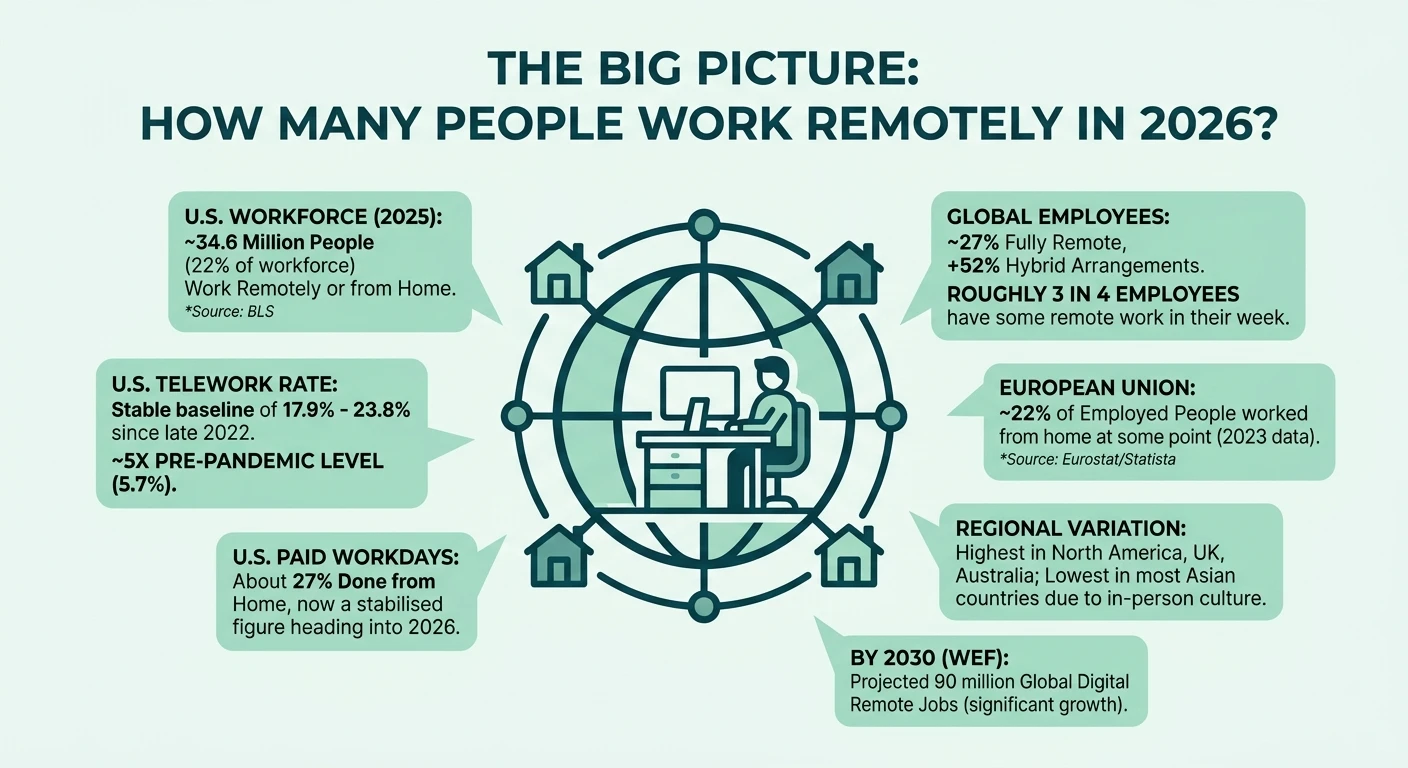
Approximately 34.6 million Americans worked remotely or from home in 2025, representing around 22% of the U.S. workforce, according to the Bureau of Labor Statistics.
The U.S. telework rate has held steady between 17.9% and 23.8% since late 2022 — a baseline that is roughly five times higher than the pre-pandemic level of just 5.7%.
About 27% of all paid workdays in the U.S. are now done from home, a figure that has stabilised heading into 2026.
Globally, around 27% of full-time employees work fully remotely, and an additional 52% work in hybrid arrangements that include some remote days. This means roughly three in four employees have at least some remote work in their week.
In the European Union, around 22% of employed people worked from home at some point in 2023, according to Eurostat data published by Statista.
Remote work is highest in North America, the UK, and Australia, and lowest in most Asian countries, where in-person workplace culture remains dominant.
By 2030, the World Economic Forum projects that 90 million global digital remote jobs will exist — up significantly from current levels.
Region | Remote/Hybrid Work Adoption |
North America | Highest — ~22–28% of workforce |
United Kingdom | High — ~93% of workers want some flexibility |
Australia | High — similar to UK and US |
European Union | Moderate — ~22% of employed people |
Asia (average) | Low — mostly in-person |
Hybrid vs. Fully Remote vs. In-Office: Where Things Stand
The most important shift in 2026 is that hybrid work has become the dominant model, not the exception. Companies and employees have largely settled on a middle ground.
According to Gallup’s latest research among remote-capable U.S. employees:
52% work in hybrid arrangements
27% work fully remote
21% remain fully in-office
Fully in-office working among those who could do their jobs remotely has now fallen to just one in five. The “five days a week at the desk” era is over for most knowledge workers.
Among new job postings, the trend is equally clear. Robert Half’s analysis of over 423,000 U.S. job positions in Q4 2025 found:
24% of new postings were for hybrid roles
11% were fully remote
Hybrid job postings have jumped from 15% in mid-2023 to 24% by mid-2025
Meanwhile, fully in-office job listings have declined from 83% in 2023 to 66% in 2025 — a significant drop in just two years.
What Workers Actually Want: Employee Preferences
Workers are not shy about what they prefer. The data is consistent and overwhelming — flexibility is no longer just a perk. For most professionals, it is a dealbreaker.
Key preference statistics:
83% of global employees say they prefer a hybrid setup that mixes remote and in-office days
98% of professionals say they want to work remotely at least part of the time for the rest of their careers (Buffer)
60% of remote-capable employees prefer a hybrid arrangement; 30% want to be fully remote; fewer than 10% prefer full-time office work (Gallup)
55% of hybrid or fully remote workers say they would be unlikely to stay at their current job if that flexibility were removed
In the UK, 93% of workers said they would consider quitting if remote flexibility were revoked
73% of Amazon employees surveyed said they were considering quitting because of strict return-to-office policies
33% of workers say they would not apply to a role that requires a fully in-person presence (Monster’s WorkWatch Report)
Among job seekers in 2026, just 16% say their top choice is an in-office job, and only 25% are even willing to consider a role requiring five days in the office (Robert Half)
55% of hybrid and remote working role preferences are for hybrid, with workers split between wanting 1–2 days in the office (28%) and 3–4 days (27%)
What Workers Would Give Up for Remote Work
This is perhaps the most striking set of data in all of remote work research. Workers value flexibility so much they are willing to sacrifice real money for it.
Sacrifice | Share of Workers |
Would accept a 10% pay cut to work remotely | 21% of U.S. workers |
Would accept a 20% pay cut to work remotely | 9% of U.S. workers |
Would accept any reduction in salary for remote work | 40% of U.S. workers |
Value hybrid work as equivalent to an 8% pay raise | Majority (Stanford) |
Would change or consider changing jobs for more flexibility | 67% (FlexJobs, 2025) |
Stanford economist Nick Bloom’s research quantifies this clearly: workers value the option of hybrid work similarly to receiving an 8% salary increase. That number makes the preference data easy to understand. Flexibility is not just about comfort — it has real financial value to workers.
Remote Work Productivity: What Does the Research Say?
This is the most debated topic in remote work. Here is what the data actually shows.
The evidence strongly supports that remote and hybrid work, when well-managed, does not hurt productivity — and often improves it.
77% of remote workers self-report being more productive working from home than in an office
85% of managers say their remote teams are meeting or exceeding pre-remote productivity levels
A landmark Stanford randomised controlled trial of over 1,600 employees found that hybrid workers were just as productive as fully on-site colleagues, with no negative impact on promotions or career advancement over a two-year follow-up
The Bureau of Labor Statistics found that a 1 percentage-point increase in remote work participation is associated with a 0.08 percentage-point increase in total factor productivity growth
Remote workers gain approximately 62 hours of productive work per year due to fewer in-office interruptions
Focus time — uninterrupted blocks for deep work — is 40% longer for remote workers than office workers on average
Remote workers save an average of 55 minutes per day by not commuting, and many redirect that time to work or personal health
McKinsey’s analysis found that well-organised hybrid teams are about 5% more productive than either fully remote or fully in-office counterparts
Employees at the Fortune 100 Best Companies to Work For (97 of which support remote or hybrid work) have productivity nearly 42% higher than a typical U.S. workplace
However, the picture is not all positive. Remote work does create real challenges for certain types of work:
Remote workers report 23% fewer spontaneous collaboration moments compared to in-office peers
Onboarding new employees takes 30–40% longer in fully remote environments
85% of business leaders report struggling to trust productivity in hybrid setups — a “productivity paranoia” that sometimes leads to excessive monitoring
The honest reading of this data: remote work is genuinely better for focused, individual tasks and genuinely harder for collaborative, team-based work. The companies that thrive are those that design their remote model around this reality.
Remote Work and Employee Retention: The Talent Factor
Remote work has become one of the most powerful tools for attracting and keeping talent. Ignore it, and you risk losing your best people.
76% of companies report greater employee retention by allowing remote work
Employee resignations dropped 33% when workers shifted from full-time office attendance to a hybrid schedule (Stanford/Nature study, 2024)
Employees with a real choice over where they work are 14 times more likely to stay at their company
69% of workers say they would accept a pay cut to work remotely — an 11-percentage-point increase from 2024 (FlexJobs, 2025)
46% of hybrid and remote workers say they are unlikely to stay at their job if that flexibility were removed
57% of workers say they would consider quitting if remote work were taken away
56% of respondents know someone who has already quit — or plans to quit — due to a return-to-office order (Gallup)
Remote job postings increased by 20% in Q1 2026 quarter over quarter (FlexJobs Q1 2026 Remote Work Index)
A remote job listing can lead to a 17% overall increase in applicant experience, which means more qualified candidates apply (Wharton School research)
Cost Savings: What Remote Work Saves Employers and Workers
Remote work delivers real financial benefits on both sides of the employment relationship.
For Employees:
Remote workers save an average of $6,000 to $12,000 per year on commuting costs, food, work clothing, and other expenses
Remote workers save approximately 72 minutes per day in commute time — the equivalent of 6 hours per week (American Economic Association)
40% of remote workers use the time saved from commuting to work additional hours or take on a second job
27% of millennials say remote work helps them save money on daily expenses
For Employers:
Employers save an average of $11,000 per year for each remote worker, through reduced real estate costs, lower turnover, and higher productivity
If every remote-capable job in the U.S. allowed employees to work from home just 50% of the time, total annual savings would exceed $700 billion (Global Workplace Analytics)
A company with 50 employees going fully remote could save roughly $500,000 annually in office overhead
Saving | Amount |
Average employee savings per year | $6,000 – $12,000 |
Average employer savings per remote worker | ~$11,000/year |
Potential U.S. economy-wide savings (50% remote) | $700+ billion/year |
Daily commute time saved per remote worker | 72 minutes |
Remote Work by Industry and Demographics
Remote work is not available equally to everyone. Access depends heavily on job type, education level, age, and industry.
By Industry:
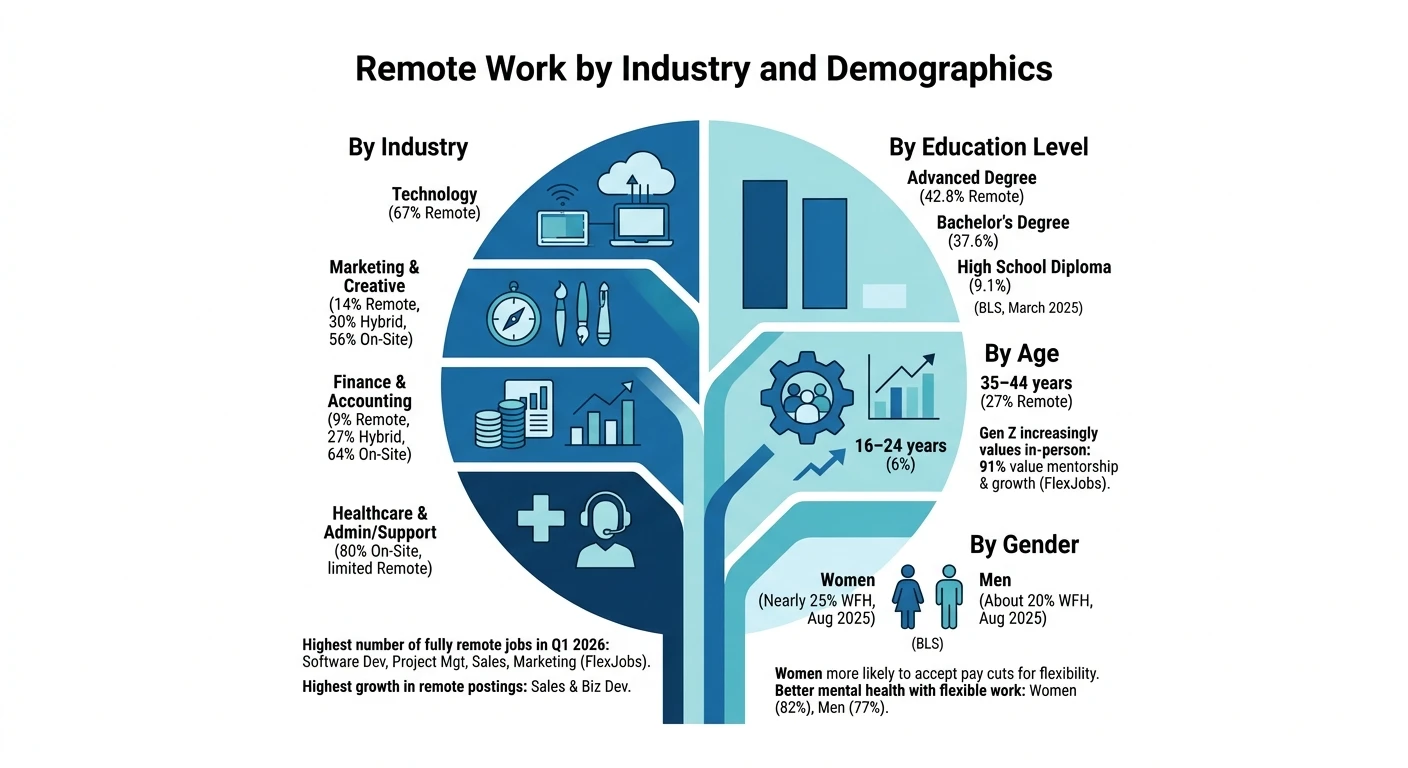
Technology leads all industries, with 67% of tech employees working primarily from home
Marketing and creative roles are 56% fully on-site, 30% hybrid, 14% remote
Finance and accounting are 64% on-site, 27% hybrid, 9% remote
Healthcare and administrative/customer support are both 80% on-site with very limited remote options
The career fields with the highest number of fully remote jobs in Q1 2026 included software development, project management, sales, and marketing (FlexJobs)
Sales and business development saw the highest growth in remote job postings in Q1 2026
By Education Level:
42.8% of workers with an advanced degree work remotely (BLS, March 2025)
Workers with a bachelor’s degree telework at 37.6%
Workers with a high school diploma telework at just 9.1%
By Age:
Workers aged 35–44 have the highest teleworking rate at around 27%
Workers aged 16–24 have the lowest adoption at just 6%
Gen Z increasingly values in-person collaboration for professional growth, with 91% saying they value in-person time for mentorship and career development
By Gender:
Nearly 25% of employed women worked from home in August 2025, compared to about 20% of employed men (BLS)
Women are more likely than men to accept pay cuts for flexibility
82% of women report better mental health with flexible work, compared to 77% of men
The Wellbeing Question: Is Remote Work Good for Mental Health?
The mental health picture of remote work is complex. It has real benefits and real costs.
The Positives:
79% of remote professionals report lower stress levels with flexible work
82% say their mental health is better when working remotely or in a hybrid arrangement
Remote employees spend 24 more minutes sleeping or resting and 15 more minutes exercising compared to office-based peers
72% of remote workers say they experience a better work-life balance
61% of remote workers say they are more productive at home, and 81.4% report improved work-life balance
The Challenges:
25% of fully remote employees say they experience loneliness at work, compared to 16% of fully on-site workers
67% of fully remote employees feel lonelier than those who work in-office or hybrid
Fully remote workers report higher levels of anger (25%), sadness (30%), and loneliness (27%) compared to hybrid and on-site workers (Gallup)
86% of full-time remote workers report experiencing burnout, with 81% checking work emails outside regular hours
66% of American workers report burnout in 2025, an all-time high (Modern Health, 2025)
Fully remote employees report higher stress levels (45%) compared to on-site workers (38–39%)
Gen Z struggles the most, with 20% experiencing high-frequency loneliness while remote — double the rate of Millennials
Only 36% of fully remote workers report thriving in their lives overall, compared to 42% of hybrid workers and 42% of on-site workers (Gallup)
The clearest finding from the data: hybrid work appears to be the sweet spot for mental health. It provides autonomy and flexibility while preserving the human connection and social interaction that reduces loneliness and burnout. Fully remote workers report the highest engagement but the lowest overall wellbeing — a paradox that employers need to take seriously.
Return-to-Office Mandates: What’s Actually Happening?
High-profile return-to-office mandates from Amazon, JPMorgan Chase, Dell, and the U.S. federal government have generated enormous headlines. But the data tells a more nuanced story.
61% of U.S. companies now have formal return-to-office policies
Employers cite collaboration (68%), productivity (64%), and communication (61%) as their top reasons for RTO mandates
83% of global CEOs anticipate a full return to in-person work by 2027 (KPMG CEO Outlook)
54% of businesses say major corporations’ RTO decisions influenced their own remote work policies
Despite all mandates, the U.S. telework rate was higher in early 2025 (23.7%) than in October 2022 (17.9%) — meaning RTO orders are having less impact than they appear
Stanford research found that all planned RTO mandates combined would reduce work-from-home days by only about 0.5%
Only 30% of companies plan to completely remove remote work by 2026
90% of companies plan to maintain or expand their remote work options
University of Pittsburgh research found that RTO mandates hurt job satisfaction without improving business performance, and 8 in 10 companies lost talent after implementing them
Cybersecurity and Remote Work
The shift to distributed working has created serious new security challenges that organisations cannot ignore.
76% of cybersecurity professionals say their organisation is more vulnerable to cyberattacks because of remote work
73% of remote employees admit using personal devices for work — dramatically increasing exposure to phishing and ransomware attacks
42% of organisations reported a successful phishing attack — the most common attack on remote workers — in the past year
60% of business and tech leaders are making cyber risk investment one of their top three strategic priorities in 2026
Only 6% of organisations feel confident across all cybersecurity vulnerabilities
36% of organisations say AI tools are the top budget priority for cybersecurity in the next 12 months
The Future of Remote Work: Where Things Are Headed
Remote work is not going backwards. The trend lines all point in one direction.
Remote job postings increased 20% in Q1 2026 quarter over quarter (FlexJobs)
The World Economic Forum projects 90 million global digital remote jobs by 2030
By 2030, nearly 40% of the global workforce is expected to operate in remote or hybrid setups
The remote workplace services market is expected to grow from $20.1 billion in 2022 to $58.5 billion by 2027 — a CAGR of 23.8%
Hybrid job postings have already grown from 15% in mid-2023 to 24% in mid-2025 and continue to rise
97 of the top 100 companies recognised for employee satisfaction in 2025 offer remote or hybrid work models
Zoom has 300 million daily active users in 2026, up from just 10 million in 2019 — a clear indicator of how permanently remote work technology has embedded itself
Remote Work Statistics at a Glance: Summary Table
Statistic | Number |
U.S. remote workers | 34.6 million |
Share of U.S. workforce working remotely | ~22% |
Remote-capable workers in hybrid | 52% |
Remote-capable workers fully remote | 27% |
Global employees who prefer hybrid | 83% |
Workers who’d quit without flexibility | 55–57% |
Average employer savings per remote worker/year | $11,000 |
Average employee savings per year | $6,000–$12,000 |
Remote workers reporting productivity gains | 77% |
Fully remote workers experiencing burnout | 86% |
Remote job posting growth (Q1 2026) | +20% QoQ |
Projected global remote jobs by 2030 | 90 million |
Frequently Asked Questions
How many people work remotely in 2026?
Approximately 34.6 million Americans work remotely, representing about 22% of the U.S. workforce. Globally, around 27% of full-time employees work fully remotely, and a further 52% work in hybrid arrangements that include remote days.
Is hybrid work now more common than fully remote work?
Yes. Among remote-capable U.S. employees, 52% now work in hybrid arrangements compared to 27% who are fully remote. Hybrid is clearly the dominant model in 2026.
Does remote work actually improve productivity?
Generally, yes. A Stanford randomised controlled trial found hybrid workers were equally as productive as on-site colleagues. The Bureau of Labor Statistics found a measurable productivity gain for every percentage-point increase in remote work. Remote workers also report 40% longer uninterrupted focus time compared to office workers.
What do remote workers earn compared to office workers?
In most knowledge-based fields, remote and hybrid roles carry competitive salaries. In-demand fully remote roles in Q1 2026 include senior product managers ($136,000), data engineers ($135,000), and senior software engineers ($132,000), according to FlexJobs.
How much do remote workers and employers save?
Remote employees save between $6,000 and $12,000 per year on commuting, food, and clothing. Employers save an average of $11,000 per year for each remote worker through lower real estate costs, reduced turnover, and higher output.
Comments
Be the first to leave a comment.