
India’s e-commerce story in 2026 is unlike anything the world has seen before. A country of 1.4 billion people — hundreds of languages, uneven infrastructure — and yet one of the fastest-growing online shopping markets on the planet.
What started as something only urban professionals with credit cards did has now become a daily habit for hundreds of millions of Indians across cities, towns, and villages.
This article gives you all the latest numbers in one place. No jargon. No fluff. Just simple, accurate stats.
Quick Snapshot: India E-Commerce at a Glance (2026)
Metric | Data |
Market Size (2026) | ~USD 159–194 billion |
Projected Market Size (2030) | USD 345 billion |
Projected Market Size (2035) | USD 550 billion |
Market CAGR (2026–2031) | ~15.89–16.49% |
Online Shoppers (2024) | 270 million |
Projected Shoppers (2026) | 350–500 million |
Mobile Share of GMV (2025) | 76.42% |
UPI Transactions (Full Year 2025) | 228.3 billion |
Quick Commerce CAGR | 70–80% |
D2C Market (2027 projection) | $60 billion |
E-Commerce Startup Funding (FY25) | $3.1 billion |
Diwali 2025 Overall Sales | $68.77 billion (record) |
1. India E-Commerce Market Size in 2026
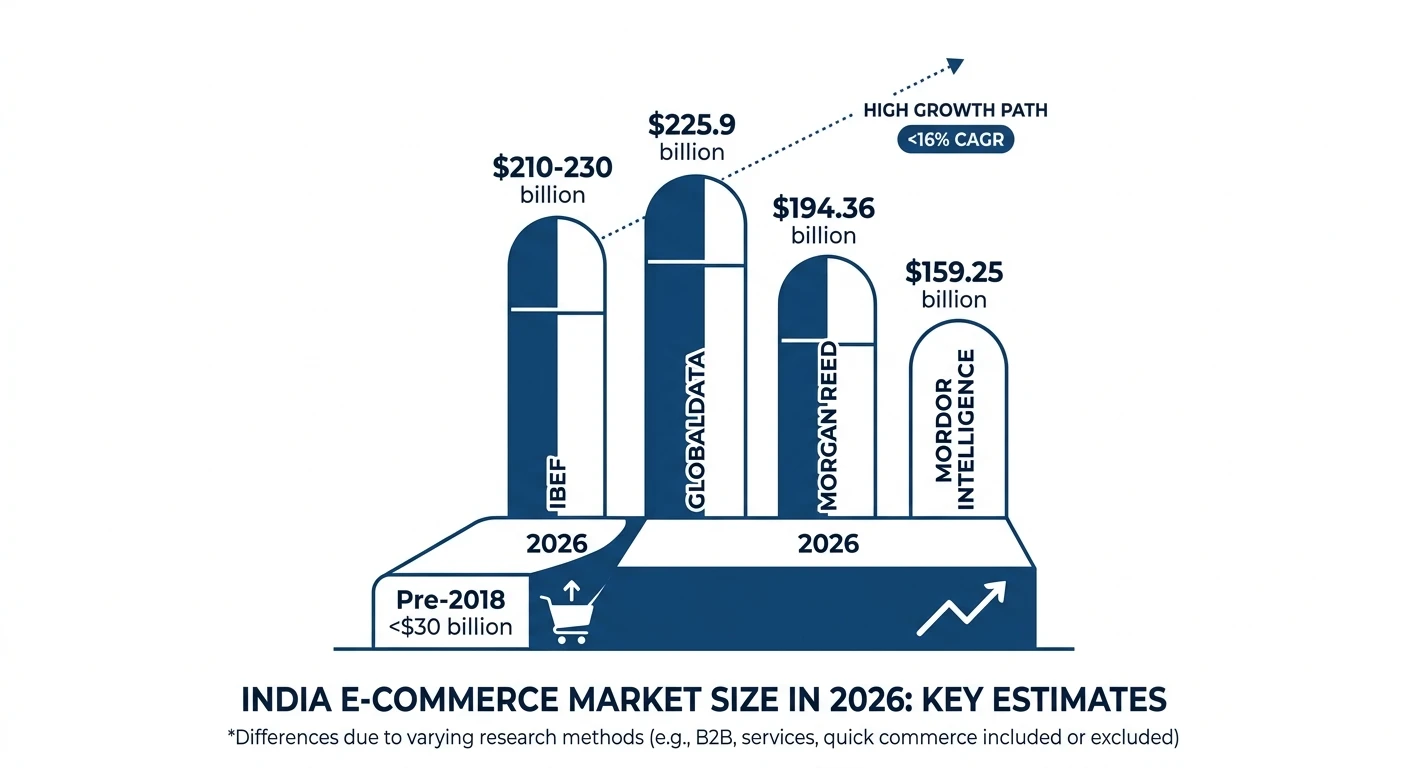
India’s e-commerce market has grown at a breathtaking pace. The entire market was worth less than $30 billion just eight years ago. Today, it sits in the hundreds of billions.
Different research firms measure it slightly differently. Here’s what the major ones say:
The India e-commerce market stood at USD 159.25 billion in 2026 and is projected to reach USD 332.94 billion by 2031, reflecting a 15.89% CAGR over the forecast period. Mordor Intelligence
The India E-commerce market is valued at $194.36 billion in 2026 and is expected to reach $767.43 billion by 2035, growing at a CAGR of 16.49%. Morgan Reed Insights
India’s e-commerce market is forecast to grow by 12.4% in 2026, reaching INR 19.7 trillion ($225.9 billion), driven by strong consumer appetite for online shopping and growing trust in digital payments. GlobalData
India’s e-commerce industry, valued at USD 125 billion in 2024, is projected to grow to USD 345 billion by 2030, and further expected to reach USD 550 billion by 2035. IBEF
The wide range in numbers comes from different research methods. Some only count physical product sales (B2C), while others include B2B, services, and quick commerce. Either way — this is a market growing fast and attracting serious global attention.
2. How Many People Shop Online in India?
India now has one of the biggest online shopper communities in the world. And the new shoppers are not all coming from big cities anymore.
India has surpassed the United States to become the world’s second-largest e-retail market, with 270 million online shoppers in 2024. IBEF
Earlier, India had 150 million online shoppers in FY21, with expectations of 350 million by FY26. Between 2019 and 2026, rural online shoppers are expected to grow at a CAGR of 22% to 88 million, while urban online shoppers will rise at a CAGR of 15% to 263 million. IBEF
Metric | Data |
Online Shoppers (2024) | 270 million |
Projected Shoppers (2026) | 350–500 million |
Rural Online Shoppers (2026) | ~88 million (22% CAGR from 2019) |
Urban Online Shoppers (2026) | ~263 million (15% CAGR from 2019) |
New Shoppers from Tier 2 & 3 Cities | ~60% of all new online shoppers |
Women Shoppers (share) | 35–38% of all online shoppers |
Global Rank (Shopper Base) | 3rd largest, after China and the US |
The real growth story in 2026 is smaller cities. Places like Patna, Surat, Coimbatore, Indore — cities that were barely on the e-commerce radar five years ago — are now driving millions of new orders every month.
Women shoppers are also a growing force. Women now account for approximately 35–38% of all online shoppers in India, a figure that has climbed steadily as categories like fashion, beauty, home décor, and health products have become more prominent online. SaaS Ultra
3. Mobile Commerce (M-Commerce) Statistics
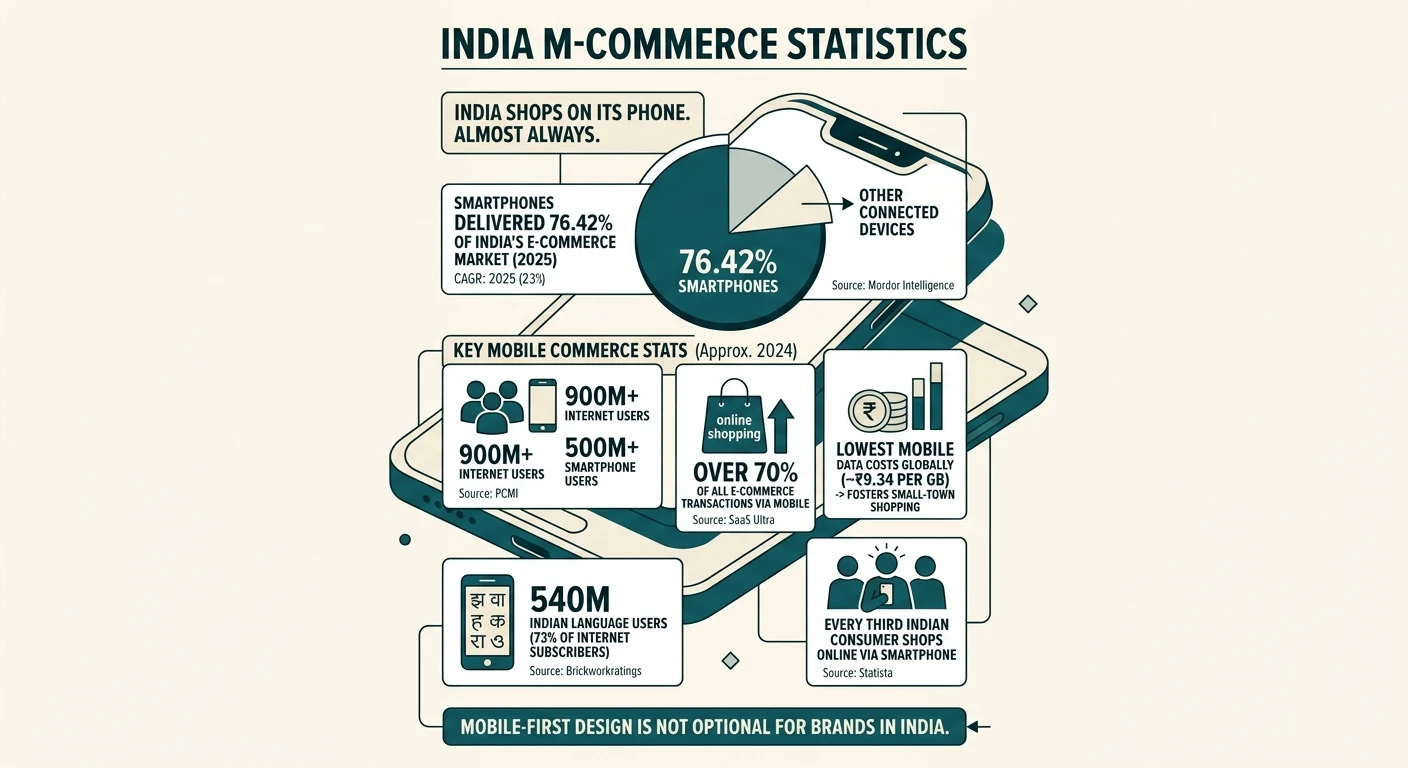
If you want to understand how India shops online, understand this one fact: India shops on its phone. Not sometimes. Almost always.
By device type, smartphones delivered 76.42% of India’s e-commerce market in 2025. Other connected devices are expected to grow at an 18.23% CAGR between 2026 and 2031. Mordor Intelligence
Key mobile commerce stats:
As of 2024, India is home to over 900 million internet users and over 500 million smartphone users. PCMI
Mobile commerce accounts for over 70% of all e-commerce transactions in India, making it the primary channel for online shopping. SaaS Ultra
India’s mobile data costs are among the lowest in the world — around ₹9.34 per GB — which is why even small-town users shop freely on their phones.
With 540 million Indian language users accounting for 73% of India’s internet subscribers, local language features are critical for reaching new mobile shoppers. Brickworkratings
Every third Indian consumer shops online using a smartphone. Statista
Mobile-first design is not optional for brands in India. It is the only way to reach most shoppers.
4. Digital Payments & UPI Statistics
No article on Indian e-commerce is complete without UPI — the Unified Payments Interface. UPI has completely transformed how India pays, and it is the backbone of digital commerce today.
UPI Key Numbers (2025–2026)
UPI transaction volume reached 228.3 billion in 2025, compared to 131.13 billion in 2024 — a growth of nearly 74% compared to the previous year. Meetanshi
UPI transaction volume hit 21.63 billion in December 2025, up 29% YoY, with a daily average of 698 million. UPI value reached ₹27.97 trillion in December 2025. CoinLaw
Metric | Data |
UPI Transactions (Full Year 2025) | 228.3 billion (up 29.3% YoY) |
UPI Monthly Record (Dec 2025) | 21.63 billion transactions |
UPI Monthly Value (Dec 2025) | ₹27.97 trillion (~$336 billion) |
UPI Transactions (Aug 2025) | 20 billion (34% volume growth YoY) |
Daily UPI Transactions (Feb 2026) | 743 million average |
UPI + Digital Wallets (payment share) | 49.68% of e-commerce payments |
UPI Share of Retail Digital Payments | ~80–84.8% of all digital transactions |
PhonePe Market Share (UPI) | ~48.3–48.4% |
Google Pay Market Share (UPI) | ~36.9–37.0% |
Paytm Market Share (UPI) | ~6.9% |
UPI Countries Outside India | 8 countries live |
QR Codes Expanded To | 678 million locations |
The daily UPI transaction value in February 2026 was recorded at ₹26.84 lakh crore. In the first half of 2025, UPI processed 106.36 billion transactions worth ₹143.35 lakh crore. Person-to-Merchant (P2M) payments reached 67.01 billion transactions in H1 2025, growing 37% YoY. Meetanshi
PhonePe is the leading UPI platform in India with a 48.4% market share followed by Google Pay with 36.9%. Both these players handle 85.3% of the country’s UPI transaction volume. GrabOn
Source: NPCI.org – UPI Product Statistics | Statista – E-commerce India
5. Top Product Categories in Indian E-Commerce (2026)
Different categories grow at very different speeds. Here’s a clear breakdown:
Category | Market Share / Size | Growth Rate |
Fashion & Apparel | 31.67% of market (2025) | +35% YoY |
Electronics & Consumer Goods | ~20%+ of market | +28% YoY |
Grocery & Food (Quick Commerce) | Fastest growing | +45% YoY |
Beauty & Personal Care | Projected $30B by 2027 | +18% YoY (10% annually) |
Home & Furnishing | Significant segment | +22% YoY |
Online Grocery Market | $9B (2023) → $80.6B by 2032 | 26.7% CAGR |
Fashion E-commerce (long-term) | 34% CAGR through 2030 | High growth |
Electronics Market | Projected $43.5B by 2028 | 14.2% CAGR (2024–2028) |
By product category, fashion and apparel led with 31.67% of India’s e-commerce market in 2025, while food and beverages are projected to rise at a 17.68% CAGR through 2031. Mordor Intelligence
The Indian Beauty and Personal Care (BPC) market is expanding at an annual growth rate of around 10%, making it the fastest-growing BPC market among major economies. IBEF
Source: Statista – B2C E-commerce in India by Category
6. Quick Commerce (Q-Commerce) Statistics
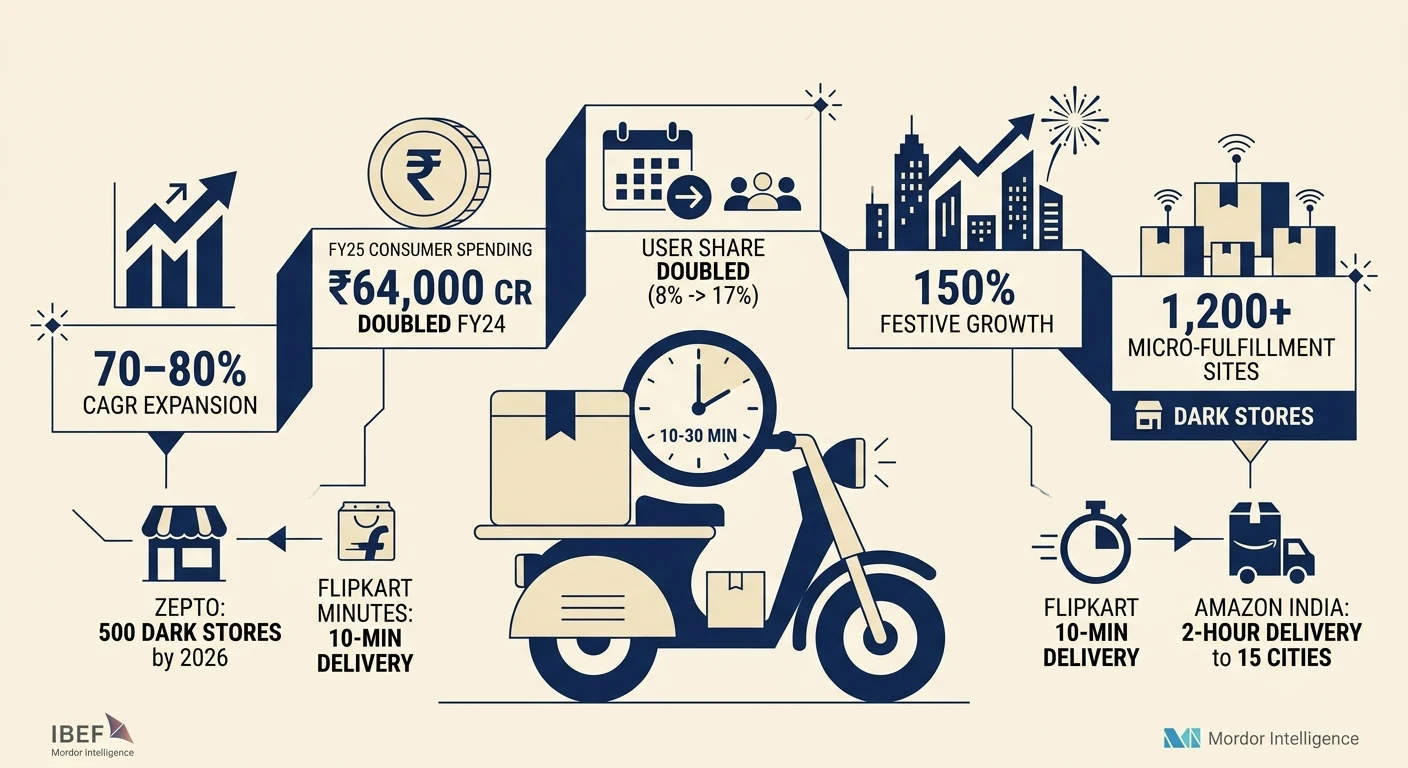
Quick commerce — delivery in 10 to 30 minutes — is one of the most exciting segments in Indian e-commerce. It started in metros but is spreading fast to smaller cities.
Quick commerce is expanding at a 70–80% CAGR, while the D2C market is set to cross ₹8,70,500 crore ($100 billion) in 2025. Overall annual industry growth is projected at 17–22% in 2025. IBEF
India’s quick commerce sector witnessed rapid momentum in FY25, with consumers spending ₹64,000 crore ($7.47 billion), more than doubling FY24 levels. Gross order value is expected to touch ₹2,00,000 crore ($23.34 billion) by FY28. IBEF
Quick commerce platforms like Blinkit have significantly expanded their user base, with daily order user share doubling from 8% in March 2025 to 17% in November 2025. IBEF
During the 2025 festive season, quick commerce was expected to see the sharpest jump at 150% growth. IBEF
Quick-commerce platforms have opened more than 1,200 micro-fulfillment sites, enabling 10-minute grocery delivery within 2–3 kilometers of dense catchments. Mordor Intelligence
Zepto unveiled a roadmap for 500 dark stores by mid-2026 across Tier 2 hubs like Jaipur, Lucknow, and Chandigarh.
Flipkart launched Flipkart Minutes, promising 10-minute delivery in Bengaluru and Mumbai via 50 dark stores.
Amazon India committed $500 million to extend two-hour grocery delivery to 15 cities.
7. Direct-to-Consumer (D2C) Market Statistics
India’s D2C market — where brands sell directly to customers without middlemen — is growing at an incredible pace.
The rapidly expanding Direct-to-Consumer (D2C) segment is driving growth, with India’s D2C market projected to grow at a 40% CAGR, reaching USD 60 billion by 2027. IBEF
Over 10,000 active D2C brands are selling exclusively or primarily through online channels in India. SaaS Ultra
There are over 360,000 independent e-commerce stores in India in 2026, reflecting rapid digital retail growth across metros and smaller cities. Shopify fuels approximately 145,465 stores in India. WooCommerce supports around 141,232 stores in India. Couponsly
The number of standalone e-commerce websites has more than doubled compared to the early 2020s.
Consumers are increasingly shifting from buying on Amazon or Flipkart to buying directly from brand websites — seeking better authenticity and exclusive offers.
Source: Statista – D2C Market in India
8. B2B E-Commerce Statistics
Business-to-business e-commerce in India is large and expanding fast — connecting manufacturers, distributors, wholesalers, and retailers digitally.
India’s Business-to-Business (B2B) online marketplace is expected to be a USD 200 billion opportunity by 2030. IBEF
The business-to-business slice of the India e-commerce market is expected to clock a 16.87% CAGR from 2026 to 2031, surpassing consumer momentum. B2C transactions still dominate, holding 86.34% of India’s e-commerce market share in 2025. Mordor Intelligence
The Government e-Marketplace (GeM) crossed a GMV of ₹5 lakh crore ($58.5 billion) in FY25, achieving the feat 18 days before year-end. Services led the growth at 62%, while products made up 38%. IBEF
As of August 2025, the Government e-Marketplace (GeM) had crossed ₹15,00,000 crore ($171.3 billion) in cumulative GMV since its launch in 2016. IBEF
Faster digital invoicing is cutting working-capital cycles from 45–60 days down to under 20 days for many businesses.
9. Festive Season E-Commerce Statistics
India’s festive season (October–November) is the most important period for e-commerce. Dussehra, Diwali, and Navratri sales generate billions in just a few days.
India’s e-commerce sector is set for robust festive growth in 2025, with gross merchandise value (GMV) projected to cross ₹1,15,000 crore ($13.12 billion), reflecting a 20–25% expansion, according to a Redseer report. The surge is being fuelled by repo rate cuts, higher disposable incomes, improved rural earnings, and pent-up demand. IBEF
Diwali 2025 sales hit a record $68.77 billion, up 25% YoY, driven by lower GST rates, strong consumer confidence, and rising preference for Indian-made products. IBEF
Quick commerce was projected to grow 150% during the festive season — the sharpest jump of any segment.
Value-led platforms could expand by 30–35% during festive season. Fashion, beauty, home, and grocery categories are projected to drive strong sales, alongside a 10% increase in mobiles and electronics. IBEF
In October 2025, major e-commerce platforms including Flipkart, Amazon, and Myntra ramped up seasonal hiring, collectively creating over 3.8 lakh seasonal job opportunities across supply chain, logistics, and customer service. IBEF
Tier-III cities powered India’s festive e-commerce boom as growth shifted from discount-driven sales to smarter logistics and rising demand from smaller cities. IBEF
Source: Statista – India Festive Month E-commerce GMV Growth
10. E-Commerce Investments & Funding in India
India’s e-commerce sector attracted record investment in FY25, making it the most funded startup segment in the country.
In 2024–25, e-commerce attracted ₹26,527 crore ($3.1 billion) across 79 deals, accounting for 31% of total startup funding. This marked a 128% jump from 2023, when it recorded ₹11,980 crore ($1.4 billion) across 59 deals. IBEF
Zepto (Kirana Kart Technologies) alone raised ₹11,980 crore ($1.4 billion), accounting for 44% of all e-commerce-related PE/VC investments. IBEF
Amazon CEO Andy Jassy announced a commitment to invest $26 billion in India by 2030; $11 billion has already been invested as of July 2025.
In February 2025, Shein re-entered India through a partnership with Reliance Retail.
IKEA launched its e-commerce platform in Delhi-NCR in February 2025.
In December 2024, Amazon partnered with the government’s Startup India initiative to help startups build and scale their e-commerce businesses. GlobalData
11. AI & Technology in Indian E-Commerce
Artificial intelligence is now a major force in how Indians discover products, get personalised offers, and receive support.
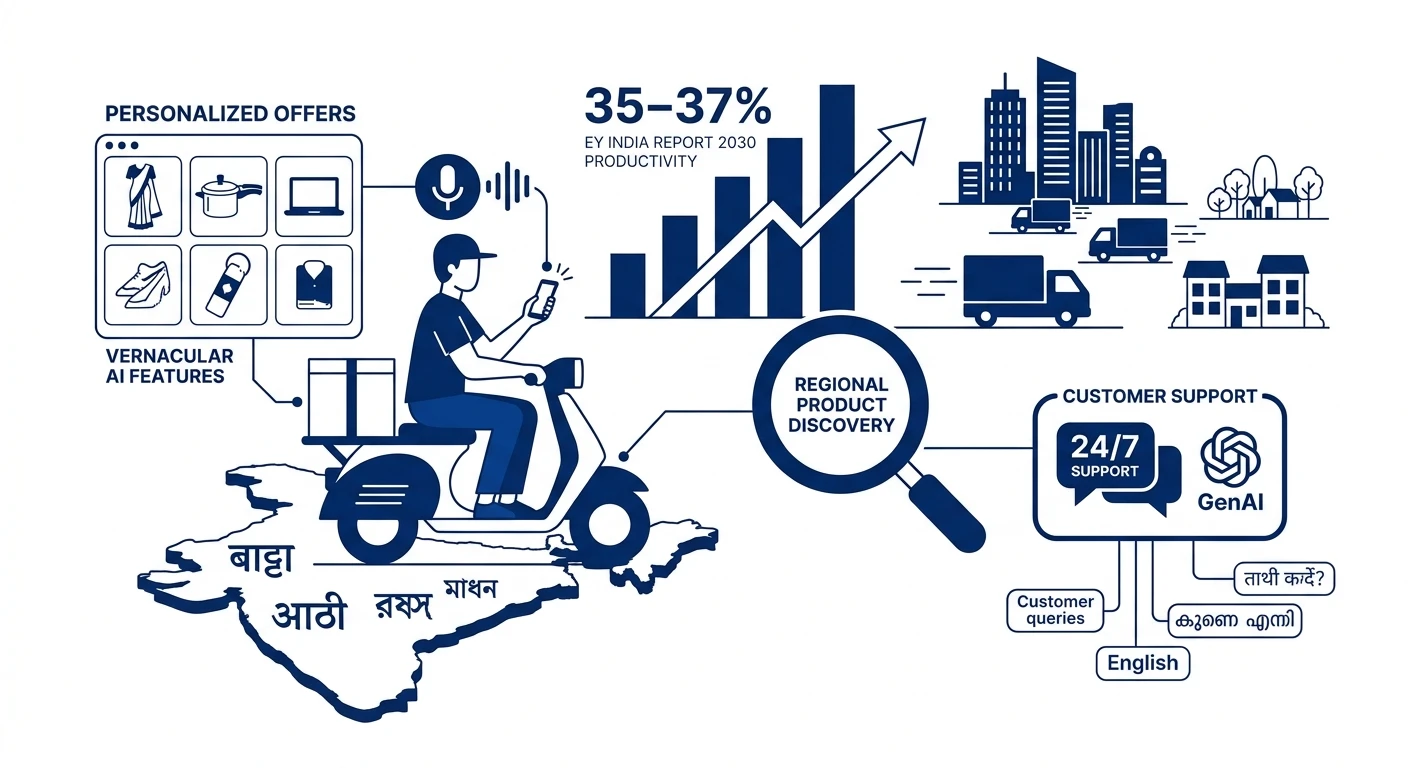
According to a recent report by EY India, generative AI could enhance productivity in India’s retail industry by 35–37% by 2030. The report highlighted that 48% of Indian businesses have already initiated proof of concept (PoCs) for GenAI solutions, while another 32% are planning to invest or have allocated budgets for AI adoption. IBEF
Online retailers are increasingly using AI to personalise product discovery, compare products, support advanced search, and tailor content by region and consumer behaviour. GlobalData
AI-powered chatbots provide 24/7 customer support across major platforms.
Voice search in Indian languages is picking up fast in Tier 2 and 3 cities.
540 million Indian language users account for 73% of India’s internet subscribers Brickworkratings, making vernacular AI features critical for reaching the next 200 million shoppers.
12. Logistics & Delivery Statistics
Getting packages to customers fast is the backbone of e-commerce growth in India. Here’s what the infrastructure looks like in 2026:
As of August 2025, Flipkart added nearly 400 micro-fulfillment centres and dark stores across 19 cities, while Amazon added 12 new large fulfillment centres and 6 new sort centres to improve reach and delivery speed. IBEF
Over 1,200 micro-fulfillment sites are now open across India, enabling 10-minute delivery.
Zepto plans 500 dark stores by mid-2026 across Tier 2 hubs.
Dense last-mile networks enable 1–2 day deliveries in metros — a standard B2B industrial suppliers are beginning to match.
Government initiatives like the National Logistics Policy aim to smooth deliveries to hinterlands, making logistics efficient and cost-effective. Brickworkratings
13. India E-Commerce: Master Data Table (2026)
Statistic | Number |
Market size (2026) | ~USD 159–194 billion |
Projected market size (2030) | USD 345 billion |
Projected market size (2035) | USD 550 billion |
Market CAGR (2026–2031) | ~15.89–16.49% |
Online shoppers (2024) | 270 million |
Projected shoppers (2026) | 350–500 million |
Rural online shoppers (2026) | ~88 million |
Urban online shoppers (2026) | ~263 million |
Mobile share of GMV (2025) | 76.42% |
Internet users in India | 900 million+ |
Smartphone users | 500 million+ |
UPI transactions (2025 full year) | 228.3 billion |
UPI monthly peak (Dec 2025) | 21.63 billion |
Digital payment transactions (FY25) | 222.19 billion |
Quick commerce CAGR | 70–80% |
Quick commerce GOV target (FY28) | ₹2,00,000 crore ($23.34B) |
D2C market projected (2027) | $60 billion (40% CAGR) |
Active D2C brands | 10,000+ |
Independent e-commerce stores (2026) | 360,000+ |
B2B e-commerce target (2030) | $200 billion |
GeM cumulative GMV (Aug 2025) | ₹15 lakh crore ($171.3B) |
E-commerce startup funding (FY25) | $3.1 billion (128% YoY jump) |
Diwali 2025 overall sales | $68.77 billion (record) |
Festive season e-commerce GMV (2025) | ~$13.12 billion |
Amazon India investment pledge (by 2030) | $26 billion |
GenAI productivity boost in retail (by 2030) | 35–37% |
Conclusion
India’s e-commerce market in 2026 is not just growing — it is transforming. New shoppers from smaller cities are coming online every day. UPI has made digital payments simple and free for everyone. Quick commerce is redefining what fast delivery means. And thousands of small Indian brands are building national businesses without a single physical store.
The data is clear: India is not catching up to the world’s top e-commerce markets. It is building its own unique story — on its own terms.
Whether you are a buyer, seller, investor, or researcher — understanding India’s e-commerce statistics in 2026 means understanding one of the most important economic shifts of our time.
Frequently Asked Questions
Q1. What is the size of India’s e-commerce market in 2026?
India’s e-commerce market is valued at approximately USD 159 to 194 billion in 2026, depending on the research firm and methodology. GlobalData estimates it at around USD 225.9 billion when broader definitions are used. It is one of the fastest-growing digital commerce markets in the world, and projected to reach $345 billion by 2030.
Q2. How many people shop online in India in 2026?
India had approximately 270 million online shoppers as of 2024 — already the world’s second-largest e-retail market after China. By 2026, estimates range from 350 to 500 million shoppers. A large share of new shoppers are coming from Tier 2 and Tier 3 cities, not metros.
Q3. What is the role of UPI in Indian e-commerce?
UPI is the backbone of digital commerce in India. In 2025, UPI processed 228.3 billion transactions — a 29.3% rise year-over-year. It accounts for nearly 80–85% of all digital payment transactions. PhonePe leads with ~48% market share, followed by Google Pay at ~37%. UPI is now also live in 8 countries outside India.
Q4. Which product categories are growing fastest in Indian e-commerce?
Grocery and food (driven by quick commerce) is growing at over 45% year-over-year. Fashion and apparel leads by market share at 31.67% of the total market. Beauty and personal care is growing at 10% annually — the fastest among all major economies globally. Electronics, home, and health are also strong performers.
Q5. What is quick commerce and how big is it in India?
Quick commerce means delivery in 10 to 30 minutes. In India, it is growing at 70–80% CAGR. Consumers spent ₹64,000 crore ($7.47 billion) on quick commerce in FY25 — more than double FY24 levels. By FY28, quick commerce gross order value is expected to hit ₹2,00,000 crore ($23.34 billion). Key players: Blinkit, Zepto, Swiggy Instamart, and Flipkart Minutes.
Comments
Be the first to leave a comment.