

Churn is the one metric every SaaS founder knows they should be tracking but not enough of them benchmark properly. If you are here because you just pulled your churn number and you are not sure whether it is good, bad, or somewhere in between — this article will give you a clear answer with real 2026 data to compare against.
The short version: the average annual churn rate for SaaS companies in 2026 is 5.2%. But that single number hides a lot of important variation depending on your customer type, deal size, and where you are in your growth journey. A churn rate that would be catastrophic for an enterprise SaaS company is completely normal for a consumer-facing product — and vice versa.
Here is everything broken down so you can find the benchmark that actually applies to your business.
What Is Churn Rate and Why Does It Matter So Much?
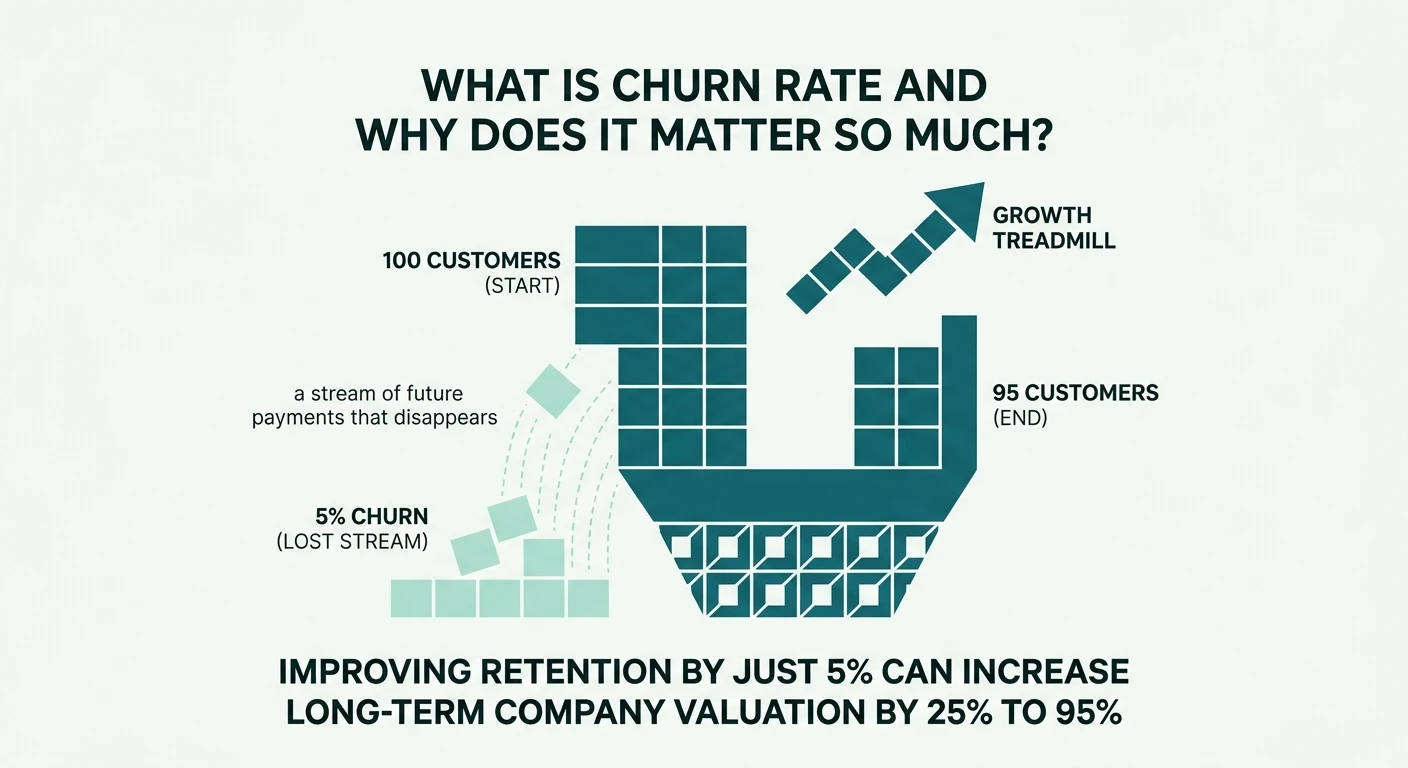
Churn rate is the percentage of customers or revenue you lose over a given period. If you start January with 100 customers and end it with 95, your monthly churn rate is 5%.
Simple enough. But the reason churn gets so much attention in SaaS specifically is what it does to your growth over time. SaaS businesses are built on recurring revenue — which means every customer you lose is not just a one-time sale gone, it is a stream of future payments that disappears. A company losing 10% of its customers every year has to replace all of those lost customers before it can grow at all.
Here is the stat that makes this concrete: improving retention by just 5% can increase long-term company valuation by 25% to 95%. That is not a typo. The compounding effect of keeping customers longer is one of the most powerful forces in SaaS economics — and it is why the best SaaS investors look at retention numbers before almost anything else.
What Is the Average SaaS Churn Rate in 2026?
The Headline Number
The average annual churn rate for SaaS companies in 2026 is 5.2%. On a monthly basis, that works out to roughly 0.43% per month.
That is the across-the-board average. In practice, what counts as a good churn rate depends heavily on three things: who your customers are, how much they pay, and how long they have been with you.
Churn by Customer Type
Consumer SaaS typically sees the highest churn — monthly rates of 3–8% are common and not necessarily a sign of a broken product. Consumer behaviour is simply more volatile. People try things, forget to cancel, and switch on a whim in a way that businesses generally do not.
SMB-focused SaaS sits in the middle. Monthly churn rates of 1–2% (or 12–24% annually) are typical for products selling to small and medium businesses. This segment is harder to retain than enterprise but more stable than pure consumer.
Enterprise SaaS has the lowest churn by a significant margin. Monthly churn rates of 0.5–1% are normal for products with large annual contracts, deep integrations, and procurement-driven buying decisions. Switching costs are high, decision-making is slow, and once a product is embedded in an enterprise workflow it tends to stay there.
Churn by ARR Band
Churn also varies by how large the SaaS company itself is:
ARR Band | Typical Annual Churn Range |
Under $1M ARR | 10–20% |
$1M – $5M ARR | 7–15% |
$5M – $20M ARR | 5–10% |
$20M+ ARR | 3–7% |
Enterprise-focused ($50M+ ARR) | 1–5% |
The pattern is consistent — churn tends to fall as companies scale. Partly because larger companies attract larger customers who churn less. Partly because a bigger product team can build better retention features. And partly because companies that survive to $20M+ ARR have usually figured out product-market fit in a way that reduces churn structurally.
Customer Churn vs Revenue Churn — Know the Difference
This is where a lot of founders get confused and it is worth being clear about.
Customer churn measures the percentage of customers you lose. If you lose 10 out of 100 customers, your customer churn is 10%.
Revenue churn (also called Gross Revenue Retention or GRR) measures the percentage of revenue you lose from existing customers — accounting for downgrades and cancellations but not expansion. This is often a more useful number because not all customers are equal in value.
And then there is Net Revenue Retention (NRR), which accounts for expansion revenue on top of churn and contraction. An NRR above 100% means your existing customers are growing in revenue even after all the losses — which is the holy grail of SaaS retention.
According to SaaS Capital’s 2026 survey of 1,000+ private B2B SaaS companies:
Median Gross Revenue Retention (GRR) for bootstrapped SaaS ($3M–$20M ARR): 91%
90th percentile GRR: 100% — the top performers are losing essentially zero revenue from existing customers
Median Net Revenue Retention (NRR): 103%
90th percentile NRR: 117.9%
A GRR of 91% means the median bootstrapped SaaS company loses about 9% of its existing revenue to churn and downgrades each year before any expansion is counted. A NRR of 103% means that after counting upgrades and expansion, those same companies grow their existing revenue base by 3% per year — meaning they would grow even if they never signed a single new customer.
What Is a Good NRR for a SaaS Company?
Since NRR is often a more meaningful benchmark than raw churn, here is how to read the numbers:
NRR | What It Means |
Below 80% | Serious retention problem — fix before scaling |
80–90% | Below average — churn is offsetting expansion significantly |
90–100% | Average range — retention is okay but not a growth driver |
100–110% | Good — existing customers are a net positive for growth |
110–120% | Great — expansion is meaningfully outpacing churn |
120%+ | Exceptional — top-tier SaaS performance |
The 90th percentile NRR of 117.9% gives you a sense of what the best-performing SaaS companies at the $3M–$20M ARR stage are achieving. It is a high bar — but it is not an unreachable one.
For context, some of the best-known high-NRR SaaS companies historically have reported NRRs of 130%+ (Snowflake, Datadog, Confluent in their high-growth phases). These are outliers, but they show what is possible when expansion revenue is built deeply into the product and pricing structure.
Why Churn Happens — The Real Reasons
Understanding your churn number is useful. Understanding why customers are leaving is what actually lets you fix it.
The most common reasons SaaS customers churn in 2026:
Poor onboarding. The customer signed up, never really got the product working for their use case, and quietly stopped paying when the renewal came around. This is the most common churn cause for SMB SaaS and it is almost entirely preventable with better onboarding design.
The product stopped solving the problem. Either the customer’s needs changed or a competitor built something that fits better. This one is harder to address — it usually requires product investment rather than a customer success call.
Price increases at renewal. With 79% of IT leaders reporting SaaS price hikes in the past 12 months, renewal-time price increases are now a significant churn trigger. Customers who feel blindsided by a renewal price jump are far more likely to use it as a moment to evaluate alternatives.
Lack of perceived ROI. The customer cannot articulate the value the product is delivering. This is partly a product problem and partly a customer success and communication problem — but the result is the same: they cancel when it is time to make a deliberate spending decision.
Champion left the company. One of the most frustrating causes of enterprise churn — the person who bought the product and loved it gets a new job, and their replacement has no emotional attachment to the tool and switches to whatever they used at their last company.
How to Reduce SaaS Churn — What Actually Works
Invest in onboarding before anything else. The customers most likely to churn are the ones who never fully activated the product. A structured onboarding flow — particularly one that gets customers to their first meaningful outcome quickly — has more impact on long-term retention than almost any other intervention.
Build expansion into the product. The best way to improve NRR is not just to reduce churn but to make it natural for customers to spend more over time. Usage-based pricing, seat expansion, higher-tier plans with genuine additional value — any mechanism that allows expansion revenue to grow alongside customer success.
Track leading indicators not just lagging ones. By the time a customer cancels, it is usually too late. Usage drop-off, login frequency decline, and support ticket patterns are all early warning signs of churn that give you time to intervene. Most modern SaaS businesses have this data — not enough of them act on it systematically.
Fix the renewal conversation. Given that price increases are now a top churn trigger, the renewal moment deserves more attention than a 30-day-out automated email. A genuine business review conversation that ties product usage to business outcomes before a renewal discussion makes the price conversation far less fraught.
Agentic AI is starting to help here too. According to recent data, agentic AI technologies reduce customer support handling time by more than 52% — saving companies hundreds of thousands of work hours and improving response quality. Faster, better support is one of the most direct levers on retention for SaaS businesses with a large SMB customer base.
Churn Rate Benchmarks by Industry
Not all SaaS markets churn at the same rate. Here is a rough breakdown by vertical:
Industry | Typical Annual Churn Range |
FinTech SaaS | 3–6% |
HR & Payroll SaaS | 4–8% |
Marketing & CRM SaaS | 5–10% |
Project Management SaaS | 6–12% |
Healthcare SaaS | 2–5% |
Security & Compliance SaaS | 2–4% |
Consumer / Productivity SaaS | 15–30% |
Healthcare and security SaaS tend to have the lowest churn — regulatory requirements and deep workflow integration create high switching costs. Consumer and productivity tools have the highest churn because the barrier to switching is low and alternatives are plentiful.
The One Number to Watch Above All Others
If you take nothing else from this article, take this: track your Net Revenue Retention every month, not just your customer churn rate.
Customer churn tells you how many customers you are losing. NRR tells you whether your existing customer base is growing or shrinking in revenue — and that is the number that determines whether your SaaS business compounds over time or spins its wheels.
The median is 103%. The top 10% hit 117.9%. Where does your business sit?
Conclusion
A good churn rate for SaaS in 2026 is below 5% annually for most B2B products — and the best companies in the market are operating with NRR well above 100%, meaning their existing customers are a net growth engine rather than a leaky bucket.
The average of 5.2% annual churn is a useful starting point but it is not the number to obsess over. What matters more is whether your best customers are staying, whether your revenue per customer is growing over time, and whether your NRR is trending in the right direction quarter over quarter.
Churn is fixable. It almost always comes back to onboarding, product value, and the renewal conversation — three things that are within the control of the SaaS team, not external market conditions. The companies that treat retention as seriously as acquisition are the ones that build something genuinely durable.
We will keep this article updated as new 2026 benchmark data becomes available.
FAQs
A good monthly churn rate for SaaS companies is typically between 2% and 8%, with top-performing companies achieving rates below 2%. Annual churn rates under 5-7% are generally considered healthy for most SaaS businesses.
Larger enterprise-focused SaaS companies often maintain lower churn rates of 1-2% monthly due to longer contracts and higher switching costs. Smaller SMB-focused SaaS products typically see higher churn rates of 3-7% monthly because smaller businesses have less stability and shorter commitments.
Yes, negative churn occurs when revenue from existing customer expansions and upgrades exceeds revenue lost from cancellations. It is considered the gold standard for SaaS growth because it means your existing customer base is growing in value even without acquiring new customers.
Churn rate directly impacts customer lifetime value, monthly recurring revenue, and the long-term viability of a SaaS business. Even a small reduction in churn can dramatically increase profitability since retaining customers costs significantly less than acquiring new ones.
A higher churn rate may be acceptable for SaaS products targeting early-stage startups or highly seasonal industries, where customer turnover is naturally elevated. However, even in these cases, companies should benchmark against industry peers and continuously work to reduce churn through better onboarding and customer success efforts.
Comments
Be the first to leave a comment.