
Everyone has an opinion about AI and jobs. Most of them are either too optimistic or completely panicked. The reality, based on actual research data from the IMF, World Economic Forum, McKinsey, and dozens of other institutions, sits somewhere more complicated than either extreme.
Some jobs are disappearing fast. Others are growing. A lot of roles are simply changing — not being eliminated, but being reshaped around what AI can and cannot do. And the timeline matters more than most headlines suggest.
Here is a comprehensive look at the numbers — what they actually say, which industries are most at risk, and what is likely to happen between now and 2030.
The Short Answer: Key AI Job Replacement Statistics at a Glance
Before diving into the detail, here are the headline numbers worth knowing.
Statistic | Number |
Global jobs at risk of displacement by 2030 | 92 million |
US workers at risk of automation over next decade | 47% |
Tech jobs cut due to AI in first half of 2025 | 77,999 |
Work tasks that could be fully automated by 2030 | 34% |
Workers who may need to change careers by 2030 | 375 million (14% of global workforce) |
Customer service roles that could be automated | 80% |
Data entry and admin jobs at risk by 2027 | 7.5 million |
People who believe AI will eliminate more jobs than it creates | 55% |
New jobs AI could help generate by 2030 | 170 million |
Projected net job gain (new minus lost) | 78 million |
The picture these numbers paint is not simple destruction or simple creation. It is disruption — fast in some areas, slower in others, and unevenly distributed across industries, geographies, and demographics.
How Many Jobs Could AI Replace Globally by 2030?
Start with the big picture.
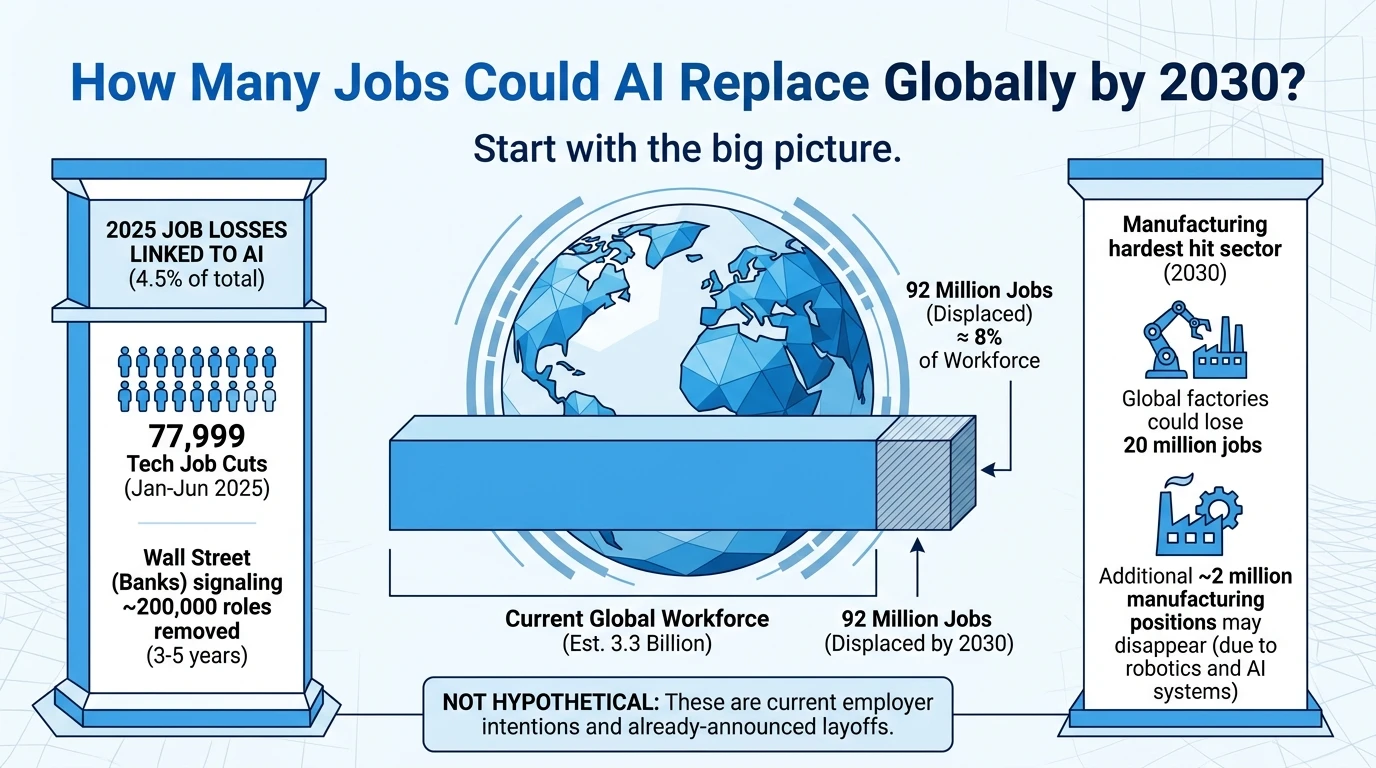
By 2030, experts estimate that 92 million jobs worldwide could be displaced due to AI and related labour market shifts. That is roughly 8% of today’s total global workforce. Manufacturing is the hardest hit sector — global factories could lose 20 million jobs to automation tools by 2030 alone, as machines take over physical tasks that once required human hands.
But the numbers are already moving, not just projected. In 2025, AI was directly linked to 4.5% of all reported job losses. Between January and June 2025, companies reported 77,999 tech job cuts connected to AI adoption — that is hundreds of people every single day. Wall Street banks have signalled plans to remove approximately 200,000 roles over the next three to five years, focusing on entry-level and back-office work. An additional 2 million manufacturing positions may disappear as robotics and AI systems expand in factories.
These are not hypothetical numbers from think tanks. They are current employer intentions and already-announced layoffs.
How Many Workers Are Actually at Risk?
“At risk” is a contested term. There is a difference between a job being fully automatable and a job having some tasks affected by AI. Here is how the data breaks down across both categories.
Risk Level | Statistic | Source Type |
Already replaceable by existing AI | 11.7% of US workforce | Study data |
At risk of automation over next decade | 47% of US workers | Projection |
Exposed to AI globally | 40% of jobs (IMF) | Global report |
Impacted in advanced economies | 60% of jobs | IMF |
Facing automation in US and Europe | ~66% of all jobs | Research |
Daily tasks affected (19% of US workers) | >50% of tasks | US labour data |
Tasks influenced by LLMs (80% of US workers) | ≥10% of tasks | Research |
Jobs least likely to be affected | 23% of workforce | Study |
Tasks AI can currently handle | ~25% of all work tasks | Research |
One thing the data makes clear: exposure does not equal replacement. Most workers will experience AI changing parts of their job rather than eliminating it entirely. But for a significant minority, that shift will be much more severe.
Education plays an interesting role here:
27% of workers with a bachelor’s degree are in highly exposed jobs
19% of workers with some college face high exposure
12% of high school graduates face high exposure
Only 3% of workers without a diploma are highly exposed
This counterintuitive finding shows AI often targets white-collar, knowledge work first — not manual labour.
How Much of Today’s Work Can AI Already Handle?
This is where things get concrete. The question is not what AI might do in five years — it is what it is already capable of doing today.
Almost 49% of jobs can use AI for at least a quarter of their tasks right now
AI systems can assist with or fully complete tasks across 18,000 different work roles, with an estimated economic value of $4.5 trillion in the US alone
AI exposure scores are growing at 9% per year, meaning capability is expanding continuously
In 77% of jobs, the tasks AI performs best are considered important or very important to those roles
Where automation is already highest by task category:
Task Category | Current Automation Potential |
Customer service and support | Up to 80% |
Data processing and information handling | ~65% |
Administrative tasks | ~46% |
Legal and compliance tasks | ~44% |
Construction and physical trades | ~6% |
Maintenance and repair | ~4% |
The pattern is consistent: repetitive cognitive work is highly automatable. Physical work involving unpredictable environments is much harder to automate, even with advanced robotics.
One important nuance: analysts estimate it may take around 20 years to automate half of all current global work tasks. AI replacing jobs happens in phases, not overnight. The jobs most at risk are losing tasks first, roles second.
Which Specific Jobs Are Most Likely to Disappear?
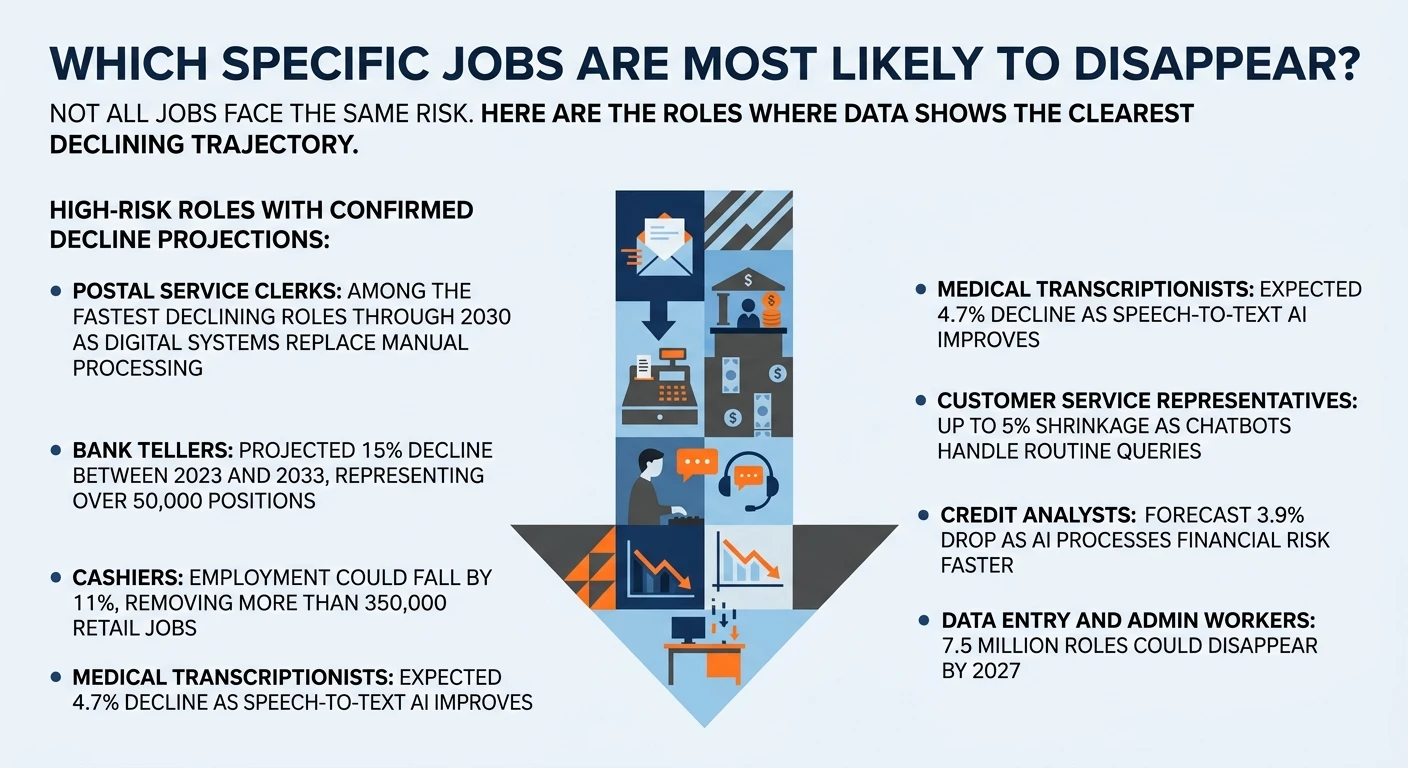
Not all jobs face the same risk. Here are the roles where data shows the clearest declining trajectory.
High-risk roles with confirmed decline projections:
Postal service clerks — Among the fastest declining roles through 2030 as digital systems replace manual processing
Bank tellers — Projected 15% decline between 2023 and 2033, representing over 50,000 positions
Cashiers — Employment could fall by 11%, removing more than 350,000 retail jobs
Medical transcriptionists — Expected 4.7% decline as speech-to-text AI improves
Customer service representatives — Up to 5% shrinkage as chatbots handle routine queries
Credit analysts — Forecast 3.9% drop as AI processes financial risk faster
Data entry and admin workers — 7.5 million roles could disappear by 2027
Since 2000, automation has already eliminated 1.7 million manufacturing jobs. The current wave of AI is simply the continuation of a longer trend — but moving at a faster pace and hitting white-collar roles for the first time.
Roles with lowest automation risk:
Trades requiring physical problem-solving (plumbers, electricians)
Healthcare roles requiring human judgment and empathy
Creative work requiring original thought
Roles requiring complex interpersonal skills and negotiation
Education and coaching roles
Are Companies Already Replacing Workers With AI?
Yes. This is not a future concern — it is happening now.
Around 30% of US companies have already replaced workers with AI tools, and that number could reach 38% in the near term
Nearly 40% of companies that adopt AI choose automation over using AI to augment workers
About 1 in 6 employers expect AI to reduce headcount in 2026
26% of large private sector firms expect workforce cuts linked to AI adoption
AI contributed to 4.5% of total job losses in 2025 — the first year this metric was measurable at scale
The banking sector provides the clearest example of intentional AI-driven workforce reduction. Wall Street institutions have publicly stated plans to cut approximately 200,000 roles over three to five years, specifically targeting entry-level positions and back-office operations that AI can now handle at lower cost.
Are Workers Scared? What the Surveys Show
Concern is high, especially among younger workers.
Group | Fear Level | Statistic |
US workers believing AI will reduce job opportunities | Moderate | 32% |
Workers worried AI will make their job obsolete | High | 43% |
People believing AI eliminates more jobs than it creates | Majority | 55% |
Workers believing AI creates more opportunities | Very low | 6% |
Young adults (18-24) worried about career impact | High | 52% |
Younger workers vs older workers — fear gap | Very high | 129% more likely to fear job loss |
Remote workers believing AI will disrupt their job | Elevated | 42% more likely than in-person workers |
Marketing workers expecting job changes due to AI | High | 51% |
Digital marketers believing content writers will lose jobs | Very high | 81.6% |
The fear around generative AI replacing creative roles is particularly notable. More than 4 in 5 digital marketers believe content writers will lose jobs — which is a much higher rate of concern than most other sectors.
Whether that fear is fully justified is another question. What is clear is that AI is already changing what creative work looks like, even if it is not eliminating it entirely.
Will AI Create More Jobs Than It Destroys?
This is the question everyone wants a clean answer to, and the honest answer is: probably yes, net positive — but the transition will be painful for specific groups.
The jobs being created:
New AI Role | Growth Rate |
AI Engineer | +140% demand growth |
AI Content Creator | +130% growth |
Prompt Engineer | +35% to 110% growth |
AI Solutions Architect | High demand growth |
AI Product Manager | High demand growth |
Big Data Specialist | Largest net growth globally (2025-2030) |
Software Developer | +17.9% growth (2023-2033) |
The World Economic Forum projects that by 2030, AI could help generate 170 million new jobs worldwide. After accounting for expected losses, the projected net gain is 78 million jobs globally. That is a positive outcome in aggregate.
But aggregate numbers hide the reality for individual workers. A 55-year-old bank teller does not smoothly transition into a role as an AI Solutions Architect. The new jobs being created require skills, training, and educational pathways that the displaced workers often do not currently have. The net positive for the economy does not feel positive to someone mid-career who just lost their position to automation.
The Gender Gap in AI Job Displacement
One of the most significant and underreported aspects of this trend: women face disproportionately higher risk.
Metric | Women | Men |
US workers in high automation-risk jobs | 79% | 58% |
Jobs at highest risk in high-income countries | 9.6% | 3.2% |
Jobs facing severe disruption globally | 4.7% | 2.4% |
The reason is structural. Women are more heavily represented in administrative, clerical, and service roles — exactly the categories where AI automation is advancing fastest. Men are more concentrated in physical and technical trades, which face slower automation. This is not a comment on capability — it is a reflection of how the workforce is currently organised and which roles AI is targeting first.
Which Industries Face the Biggest Disruption?
High disruption risk:
Financial services and banking
Customer service across all sectors
Data entry, admin, and back-office operations
Legal research and compliance
Basic accounting and bookkeeping
Retail and checkout operations
Moderate disruption risk:
Marketing and content creation
Software development (some tasks automated, demand still growing)
Healthcare administration
Middle management coordination
Lower disruption risk:
Skilled trades (plumbing, electrical, HVAC)
Healthcare delivery and patient care
Mental health services
Creative strategy and direction
Education and teaching
Leadership and executive functions
Will AI Force Career Changes on a Massive Scale?
Fourteen percent of the global workforce — roughly 375 million workers — may need to switch careers by 2030 because of AI-driven disruption. That is not a minor adjustment. That is hundreds of millions of people needing to retrain, pivot, and enter different fields than the ones they built their experience in.
Young workers are already feeling this. Data shows a 13% decline in employment among workers aged 22 to 25 in AI-exposed roles — meaning the entry-level positions that used to serve as career starting points are disappearing precisely when young people are trying to enter the workforce.
With AI exposure growing at 9% annually, career disruption will accelerate through the late 2020s before new job creation has time to absorb displaced workers.
What the “Godfather of AI” Says About 2026
Geoffrey Hinton — the computer scientist widely credited as the godfather of modern AI — has been more direct than most about the near-term impact. In a 2026 CNN interview, he stated AI will have “the capabilities to replace many, many jobs” this year specifically, noting it is “already able to replace jobs in call centers” and moving into broader territory.
This is significant because Hinton was one of the people who built the foundational models that enabled modern AI. His concern is not abstract. He sees what the technology is capable of and is drawing a clear line between current capability and current employment trends.
How to Think About Your Own Risk
The question most workers actually want answered is: am I personally at risk?
A few questions that help assess your situation:
High risk signals:
Your job involves primarily repetitive tasks with clear rules
Your output is digital (documents, data, reports)
A significant portion of your day involves processing or categorising information
Your role is entry-level in a field with heavy back-office operations
You work in customer service, finance, legal admin, or data entry
Lower risk signals:
Your work requires physical presence and unpredictable problem-solving
Your role involves complex human relationships, negotiation, or trust
You make judgment calls that depend on context and experience
Your work is creative in ways that require original perspective
Your role requires licensed professional accountability
Building resilience regardless of risk:
Learn to work with AI tools rather than avoiding them
Develop skills that are complementary to AI (strategy, judgment, relationships)
Move toward roles where AI augments your output rather than replaces it
Build specialisation in a narrow domain where your expertise has clear value
Final Thoughts
AI is not coming for every job. But it is already taking some, automating parts of many others, and creating entirely new ones that did not exist five years ago. The net outcome globally may well be positive — more jobs created than destroyed. But that aggregate number offers cold comfort to the millions of workers in the middle of a transition they did not choose.
The most honest thing anyone can say about AI and employment in 2026 is this: the disruption is real, measurable, and accelerating. The outcome is not predetermined. Workers who understand what AI can and cannot do, and who position themselves to work alongside it rather than in competition with it, have significantly better odds than those who are waiting to see what happens.
The data does not tell you to panic. It also does not tell you to ignore it.
FAQs
Full replacement of all jobs is not realistic in any near-term timeframe, with analysts estimating it could take 20 or more years just to automate half of today's work tasks. Economic justification, regulatory requirements, and societal acceptance all act as significant brakes on the pace of automation.
Roles in physical trades, healthcare delivery, mental health services, creative direction, and education face the slowest automation trajectory. Jobs that require genuine human connection, licensed accountability, or unpredictable physical environments are the most resilient to AI replacement.
Yes, roles such as AI Engineer, Prompt Engineer, AI Solutions Architect, and AI Content Creator are growing at rates between 35% and 140%. Big Data Specialist is projected to see the largest net global job growth between 2025 and 2030, showing that AI disruption cuts both ways.
Women face disproportionate risk due to their higher concentration in administrative and service roles, while workers aged 22 to 25 are already experiencing employment declines in AI-exposed entry-level positions. Workers in advanced economies also face higher overall exposure rates compared to those in developing countries.
AI exposure scores are growing at approximately 9% per year, and the first half of 2025 alone saw nearly 78,000 tech job cuts directly tied to AI adoption. The pace is measurable, documented, and continuing to accelerate across multiple industries.
Comments
Be the first to leave a comment.