

Agentic AI went from research demo to production line item in 18 months. The numbers in 2026 are no longer projections — they are production data from enterprises that have deployed agents at scale. Some of those numbers are remarkable. Some of them are sobering. All of them are worth knowing.
This article pulls together 60+ data points from Gartner, McKinsey, Salesforce, Bain, NVIDIA, Deloitte, and primary research covering 250+ enterprise deployments.
Key AI Agent Statistics 2026 at a Glance
Metric | Number |
Global AI agents market size (2026) | $10.91 billion |
Projected market size by 2030 | $50.31 billion |
CAGR 2026–2030 | 45.8% |
Enterprise applications with AI agents by end of 2026 | 40% (Gartner) |
Enterprises with AI agents in production | 51% |
Enterprises that have adopted AI agents in some form | 79% |
Enterprises running agents in production (the gap) | 11% (vs 79% that adopted) |
Companies planning to increase AI budgets | 88–92% |
Average ROI from deployed AI agents | 171% |
Companies that see ROI within first year | 74% |
Deployments that never reach payback | 19% |
AI agent production deployments that fail | 88% |
Weekly hours saved per knowledge worker using agents | 6.4 hours (median) |
Customer service cases handled by AI agents | ~30% (growing to 50% by 2027) |
Enterprises using more than 10 AI agents | 39% |
Decisions expected to be made autonomously by AI | 15% by 2028 |
The Market: $10.9 Billion in 2026 and Growing at 46%
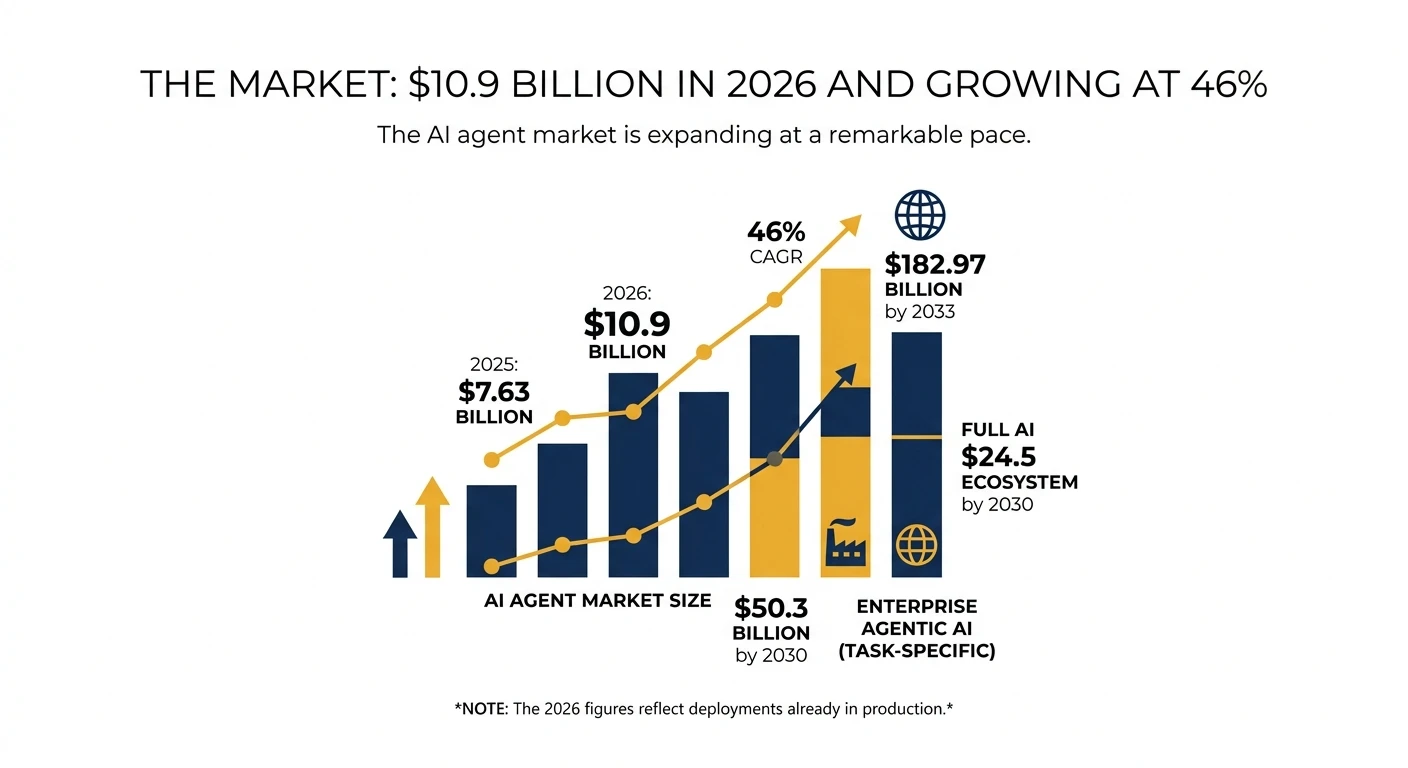
The AI agent market is expanding at a pace that makes most enterprise technology growth curves look flat.
Market size projections:
2025: $7.63 billion
2026: $10.91 billion
2030: $50.31 billion (45.8% CAGR)
2032: $93.20 billion (broader agentic AI including infrastructure)
2033: $182.97 billion (full AI agent ecosystem at 49.6% CAGR)
The enterprise agentic AI slice alone — task-specific, governed agents in production — was $2.58 billion in 2024 and is projected to reach $24.50 billion by 2030 at a 46.2% CAGR. AI spending overall is growing at 31.9% annually through 2029 (IDC).
This is not speculative. The 2026 numbers reflect deployments already in production, not pilots or proof-of-concepts.
The Adoption Reality: 79% Have Started, Only 11% Are Capturing Value
This is the most important statistic in this entire article.
79% of enterprises have adopted AI agents in some form. Only 11% run them in production.
This gap — what analysts are calling the “production-readiness gap” — is the defining challenge of 2026. Nearly four in five enterprises have experimented with or deployed agents. Fewer than one in nine are actually running them in production at a scale that generates measurable business value.
Why the gap exists:
Governance frameworks not established before deployment
Observability tooling — the ability to monitor what agents are actually doing — was not built in
Baseline metrics were not captured before pilots, so ROI cannot be measured
No dedicated business owner with accountability for post-deployment performance
Security concerns: 51% of service leaders say security concerns have delayed or limited AI initiatives
The 12% that succeed share four consistent attributes: pre-deployment infrastructure investment, governance documentation before deployment, baseline metrics captured before pilots, and dedicated business ownership with accountability for performance.
The ROI Data: Real Numbers From Production Deployments
Average ROI from deployed AI agents: 171% (US enterprises average 192%)
Treat these averages with appropriate caution — survivorship bias does real work in self-reported ROI surveys. The more useful data is the distribution:
74% of executives report achieving ROI within the first year
19% of deployments never reach payback
41% of deployments cross positive ROI within 12 months
Payback periods by deployment type (Bain Agentic AI Benchmark 2026):
Customer service agents: 4.1 months median payback
Marketing operations agents: 6.7 months median payback
Engineering / code review agents: 9.3 months median payback
Vendor-deployed agents (Salesforce Agentforce, Microsoft Copilot, Glean): 2.4x faster payback than custom builds
Time-to-first-value:
Vendor agents: 38 days average
In-house custom builds: 94 days average
Productivity Numbers: What Agents Are Actually Saving
Worker Type | Weekly Hours Saved | Notes |
Knowledge workers (median) | 6.4 hours/week | McKinsey + Slack Workforce Index |
Senior practitioners | 10–12 hours/week | Higher-value task delegation |
Customer service reps | 8–9 hours/week | Consistent across deployments |
Cost-per-task reductions (real production data from Forrester TEI and Anthropic enterprise data):
Customer service ticket: $4.18 human → $0.46 AI agent (9x reduction)
Code review (routine PR): $48 senior engineer → $0.72 AI agent (66x reduction)
Productivity multiplier by function:
Customer service: 4.2x productivity gain
Code review: 3.6x
Marketing operations: 3.1x
Legal tasks: 1.4x (governance review consumes most speed advantage)
Clinical tasks: 1.2x (strictest oversight requirements)
Industry Adoption: Who Is Leading and Who Is Cautious
Highest adoption rates by sector:
Industry | Adoption Rate | Notes |
Telecommunications | 48% | Highest enterprise adoption rate |
Retail and CPG | 47% | Clear ROI on customer service and operations |
Financial services | Growing rapidly | 56% plan to increase AI investment 10%+ |
Manufacturing | 69% have implemented ≥1 use case | 89% of execs aim to implement AI in production |
Healthcare | 36.83% CAGR — fastest growth | Strict governance requirements |
Legal | More cautious | BakerHostetler cut research hours 60% as example |
Customer service leads all use cases due to clear ROI and measurable outcome metrics. Salesforce’s own Agentforce handled over 380,000 support interactions and resolved 84% of cases without human involvement — a real production number, not a vendor projection.
30% of customer service cases are currently handled by AI. This is projected to reach 50% by 2027.
The 88% Failure Rate: What Goes Wrong
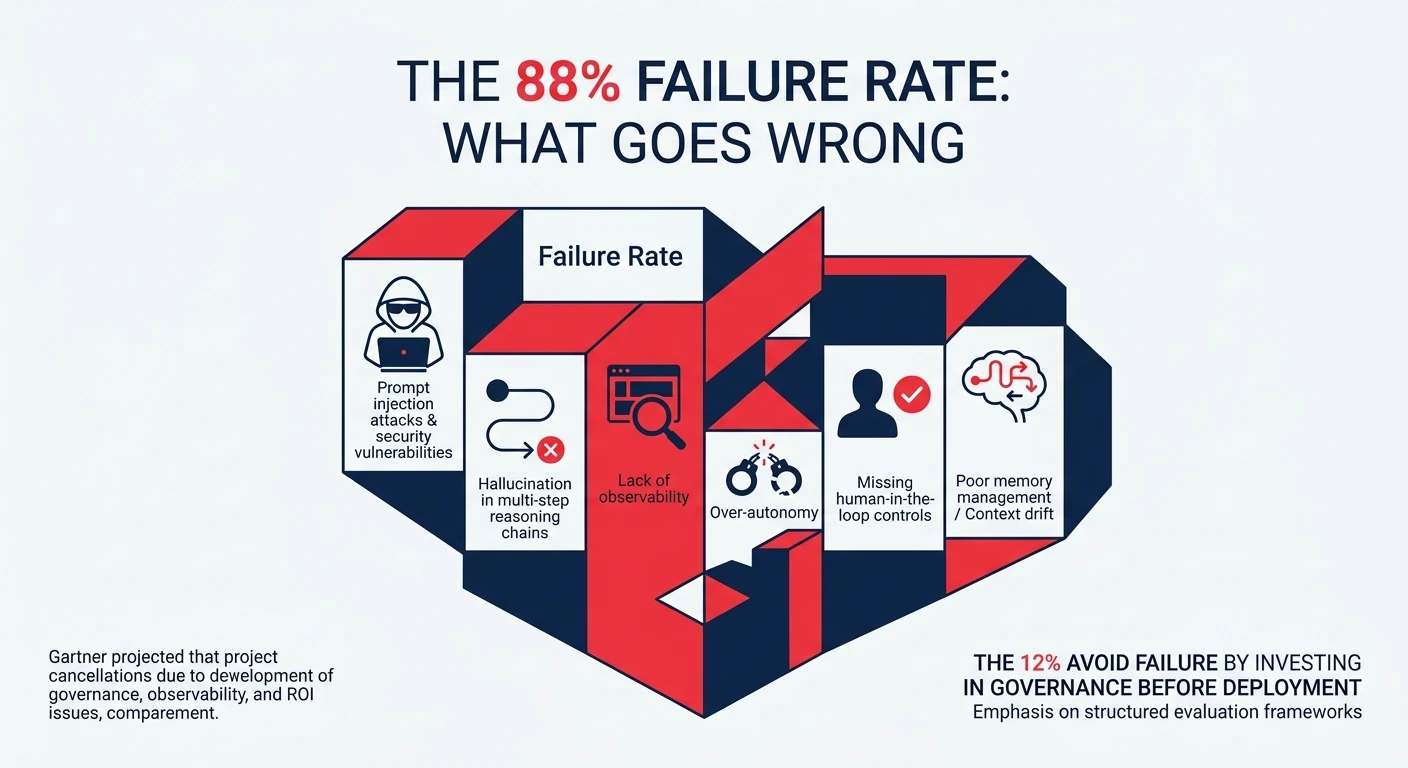
Gartner projects that over 40% of agentic AI projects will be cancelled by 2027 if governance, observability, and ROI clarity are not established. But the failure rate for agents that do get deployed is worse: 88% of AI agent deployments report incidents in production.
Why agents fail in production:
Prompt injection attacks and security vulnerabilities
Hallucination in multi-step reasoning chains
Lack of observability — teams cannot see what the agent is doing
Over-autonomy — agents given more authority than the task requires
Missing human-in-the-loop controls at critical decision points
Poor memory management leading to context drift across long tasks
The organisations that avoid these failures invest in governance before deployment, not after. The 12% with production-ready agents all started with structured evaluation frameworks, not “ship it and see.”
The Security Problem
Security statistics for agentic AI are deeply concerning and consistently underreported.
88% of enterprises deploying AI agents report security incidents
1 in 8 enterprise data breaches are linked to AI agent activity
72% of CEOs identify integrated enterprise data architecture as their top infrastructure need
Gartner expects more than 2,000 “death by AI” claims by end of 2026 — incidents where autonomous systems caused harm leading to regulatory investigations
Agents have broad data access, autonomous action capability, and are running on infrastructure that most security teams are not equipped to defend. The attack surface created by MCP integrations, tool-calling permissions, and memory systems requires dedicated security architecture that most deployments lack.
What the Winning Companies Are Doing Differently
The enterprises seeing 171%+ ROI share a consistent operating model:
Before deployment:
Capture baseline metrics for every process targeted
Document governance framework — who can the agent contact, what can it access, what requires human approval
Invest in observability tooling from day one
During deployment:
Start with task-specific, narrow-scope agents rather than broad autonomous systems
Use vendor agents (Agentforce, Copilot, etc.) for faster time-to-value before building custom
Maintain human-in-the-loop for high-stakes decisions
After deployment:
Measure ROI against pre-deployment baseline, not vendor benchmarks
Expand scope incrementally based on production performance data
Treat agent failure as a data point, not a crisis — use it to refine governance
FAQs
The AI agent market is valued at $10.91 billion in 2026 and is projected to reach $50.31 billion by 2030, growing at a 45.8% CAGR. The enterprise-specific segment is expanding even faster than the overall market.
The average ROI from AI agent deployments is 171%, but 19% of deployments never reach payback at all. Companies that invest in governance frameworks, baseline metrics, and dedicated business ownership before deployment reach positive ROI 2.4x faster than those that don't.
Customer service offers the shortest payback period at just 4.1 months and has proven ROI at scale, making it the best starting point. Marketing operations comes second at 6.7 months, followed by engineering at 9.3 months.
Although 79% of enterprises have adopted AI agents, only 11% are in production due to a readiness gap around governance, security, observability, and ROI measurement. Most pilots stall before scaling because infrastructure investment happens after deployment rather than before it.
Prompt injection is the primary security threat, where malicious instructions hidden in content cause agents to take unintended actions. It is the leading driver behind the 88% incident rate among AI agent deployers, and the main defences are observability tooling and human-in-the-loop controls at critical decision points.
Comments
Be the first to leave a comment.