

The business of creators partnering with brands is no longer a side hustle story. It is one of the fastest growing segments in global marketing, and in 2026 the numbers behind it are bigger, more specific, and more useful than they have ever been. Whether you are a creator trying to understand what you should be charging, a brand trying to figure out where your budget actually goes, or simply someone curious about how this industry works, this article covers everything that matters backed by real data.
The Global Creator Brand Deals Market in 2026
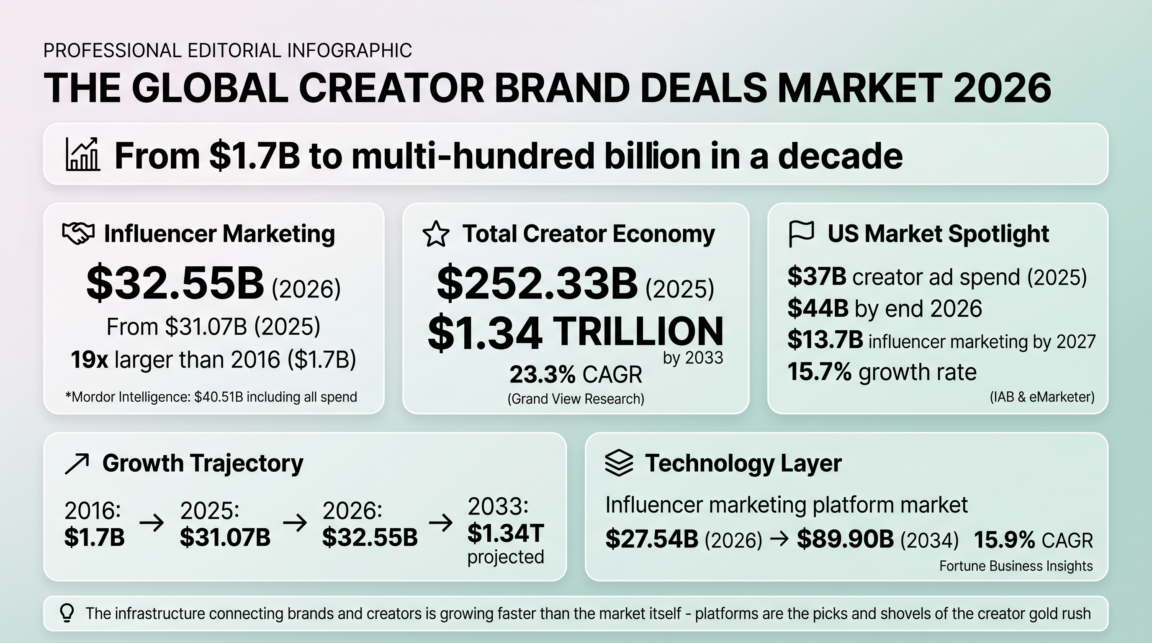
The influencer marketing industry hit $32.55 billion in 2026, growing from $31.07 billion in 2025 and roughly 19x larger than it was in 2016 when the entire market was worth $1.7 billion. Mordor Intelligence puts the 2026 figure at $40.51 billion when you include all influencer marketing spend beyond just platform-based deals.
The creator economy as a whole — which includes brand deals, subscriptions, merchandise, courses, and platform revenue — was valued at $252.33 billion in 2025 and is projected to reach $1.34 trillion by 2033 at a CAGR of 23.3% according to Grand View Research.
In the United States specifically, creator ad spend reached an estimated $37 billion in 2025 according to the IAB’s Creator Economy Ad Spend and Strategy Report, with the US market on track to hit $44 billion by end of 2026. US influencer marketing spend is growing at 15.7% in 2026 and is projected to reach $13.7 billion by 2027 by eMarketer when measuring paid influencer-specific spend separately from the broader creator economy.
The influencer marketing platform market — the technology layer that connects brands and creators — is growing even faster. Fortune Business Insights projects this segment will grow from $27.54 billion in 2026 to $89.90 billion by 2034 at a CAGR of 15.9%.
What Brands Are Actually Spending and Why
The adoption numbers are striking. 93% of marketers who have used influencer marketing say it is effective. 74% of marketers plan to increase their influencer budgets in 2026. 63% of brands are planning to increase influencer spend this year. And 26% of marketing agencies and brands worldwide now allocate more than 40% of their total marketing budgets to influencer partnerships according to Sprout Social.
The reason the budgets keep growing is simple: the returns justify it. Brands earn an average of $5.78 for every $1 spent on influencer marketing according to Hubfluence’s 2026 benchmark report. Top-performing campaigns push that figure to $11 to $18 ROI per dollar spent. For context, the average return on Google Ads sits around $2 per dollar spent. Creator partnerships, done well, are significantly more efficient.
80% of marketers say creator-produced content outperforms brand-created assets, which helps explain why brands keep increasing spend rather than producing more in-house content. Authenticity drives performance, and audiences respond to creator content differently than they respond to traditional advertising.
86% of consumers make at least one influencer-driven purchase per year and 72% of consumers say they trust influencer recommendations more than traditional advertising. These are not marginal behavioural shifts — they represent a fundamental change in how purchase decisions are made, particularly among audiences under 35.
How Much Creators Actually Earn From Brand Deals
Brand deals are the dominant income source for working creators. According to Digital Applied’s 150+ data point report, 68% of creator income comes from brand partnerships in 2026 — compared to just 32% from platform revenue, merchandise, and other sources combined. A separate survey by The Influencer Marketing Factory found that brand sponsorships drive 70 to 80% of working creator income.
The median annual income for a full-time creator in the US is $76,000 in 2026. The top 1% of creators average $1.2 million annually, with brand deals typically making up the majority of that figure. Nearly half of creators earn between $10,000 and $100,000 annually, representing what researchers are calling the creator “middle class” — a segment that barely existed five years ago.
Creators making over $100,000 annually typically earn from five to seven different income sources. Around 30% comes from brand deals, 25% from their own products or services, and the remainder split across platform monetisation, subscriptions, affiliate commissions, and speaking engagements. Only 18% of all creators currently earn revenue from advertising or sponsorships, which means the majority of the market opportunity in brand deals remains untapped by most creators.
Brand Deal Rates by Creator Tier in 2026
Rates vary significantly by follower count, engagement rate, platform, and niche. Here is what the current market looks like:
Nano influencers (1K to 10K followers) charge between $50 and $250 per post on average. These creators have the highest engagement rates in the industry — typically 4 to 8% — which makes them valuable for brands targeting highly specific audiences. Their cost per engaged follower is the lowest of any tier.
Micro influencers (10K to 100K followers) charge between $500 and $5,000 per post according to Social Native’s 2026 pricing analysis. Stan Store’s influencer rate guide puts YouTube-specific micro rates at $2,000 to $10,000 per integration. Micro influencers deliver 60% higher engagement at roughly one-tenth the cost of macro influencers according to Digital Applied.
Mid-tier influencers (100K to 500K followers) charge between $10,000 and $30,000 per campaign. These creators typically have established audiences with strong niche authority and are the most common target for mid-market brand partnerships.
Macro influencers (500K to 1M followers) command between $30,000 and $75,000 or more per campaign. Brands working at this tier are typically running national awareness campaigns where reach matters as much as engagement.
Mega influencers and celebrities (1M+ followers) charge $75,000 to $200,000 or more per post. The highest-profile TikTok and YouTube creators with massive engaged audiences can and do command rates well above this ceiling for exclusive or long-term partnerships.
Platform-by-Platform Rate Breakdown
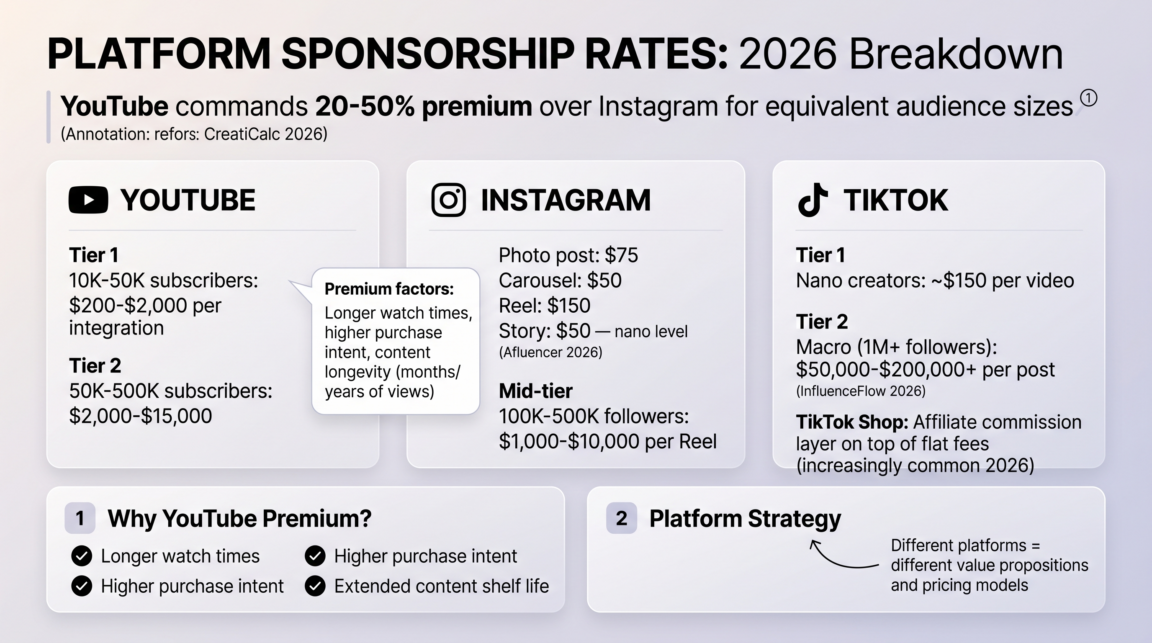
Platform choice significantly affects what brands pay and what creators earn. CreatiCalc’s 2026 data shows YouTube sponsorships command a 20 to 50% premium over Instagram for equivalent audience sizes.
On YouTube, small channels (10K to 50K subscribers) charge $200 to $2,000 per integration. Mid-sized channels (50K to 500K) charge $2,000 to $15,000. The premium comes from longer watch times, higher purchase intent, and the fact that YouTube content has a much longer shelf life — a sponsored video continues generating views and conversions for months or years after upload.
On Instagram, rates per post start at $75 for a photo post, $50 per carousel, $150 per Reel, and $50 per Story at the nano level according to Afluencer’s 2026 rate guide. Mid-tier Instagram creators (100K to 500K followers) typically charge $1,000 to $10,000 per Reel.
On TikTok, rates are competitive but engagement-driven. Nano creators on TikTok charge around $150 per video. Macro TikTok creators with 1M+ followers charge $50,000 to $200,000 or more per post according to InfluenceFlow’s 2026 pricing guide. TikTok Shop partnerships add an additional affiliate commission layer on top of flat fees, which is increasingly common in 2026.
Brand Deals by Niche: Which Categories Pay Most
Niche significantly affects both deal volume and rate. According to Collabstr’s 2026 Influencer Marketing Report, the niches with the highest average engagement fees include technology, finance, health and wellness, and lifestyle. The niches with the lowest average engagement fees per post are beauty at $210, gaming at $214, fashion at $217, and cannabis at $214 — these lower per-post rates reflect the high volume of creators in these spaces rather than lower brand interest.
Beauty and skincare remains one of the most active brand deal categories. By early 2026, online beauty sales in the US climbed to 68.4% of total market revenue with TikTok Shop and Instagram Checkout driving much of that volume. Brands in this category run more brand deal campaigns than almost any other sector.
Finance and fintech commands the highest per-post rates in the industry. A finance creator with 100K YouTube subscribers can typically command $5,000 to $20,000 per integration, reflecting the high customer lifetime value of financial product conversions.
Gaming sees enormous volume at lower per-post rates. The sheer number of gaming creators keeps individual rates compressed, but the category generates significant total spend because brands run campaigns with dozens or hundreds of creators simultaneously.
The Shift Toward Long-Term Partnerships
One of the clearest trends in 2026 is the move away from one-off sponsored posts toward ongoing ambassador relationships. The Influencer Marketing Factory’s Brand Deals Report 2026 — which analysed over 316,000 promoted posts across Instagram, TikTok, and YouTube — found that one-off collaborations still dominate by volume but long-term partnerships are growing faster as brands learn that repeated exposure to the same creator’s audience drives significantly better conversion than a single post.
59% of marketers now use AI in their influencer marketing operations to identify creators, predict performance, and manage contracts. 81% of brands use AI tools to assist with influencer selection and campaign analysis. This is changing how brand deals are negotiated and structured, with data-driven matching replacing gut-feel decisions in larger campaigns.
74% of marketers use AI to assist with content optimisation as part of their influencer campaigns, meaning the briefing and review process has also changed significantly.
Key Takeaways
The creator brand deals market is a $32.55 billion industry in 2026 growing at roughly 25% year over year, with the broader creator economy valued at over $252 billion. Brands earn an average of $5.78 for every $1 spent on creator partnerships — significantly outperforming most traditional channels. Brand deals drive 68 to 80% of working creator income, with the median full-time creator earning $76,000 annually in the US. Rates range from $50 per post for nano creators to $200,000 or more for mega influencers, with YouTube commanding a 20 to 50% premium over Instagram for equivalent audiences. The industry is maturing fast, with AI adoption accelerating and long-term ambassador partnerships replacing one-off posts as the dominant model.
For creators, the data is clear: the market is large, growing, and willing to pay well for the right audience and authentic content. For brands, the returns justify continued investment — and the brands increasing spend in 2026 are the ones that have already seen the ROI firsthand.
FAQs
The creator brand deals market is valued at approximately $32.55 billion in 2026, reflecting explosive growth driven by brands shifting budgets from traditional advertising to influencer partnerships. This growth is fueled by measurable ROI data and the expansion of creator tiers across platforms like TikTok, Instagram, and YouTube.
Nano creators (1K–10K followers) typically earn $50–$500 per post, while mid-tier creators (100K–500K followers) can command $2,000–$10,000 per sponsored post. Top-tier macro and mega influencers with over 1 million followers often negotiate deals ranging from $10,000 to over $100,000 per campaign.
Yes, influencer marketing continues to deliver strong ROI, with studies showing brands earn an average of $5–$6 for every $1 spent on creator partnerships. Micro and nano influencers often outperform larger accounts in engagement rates, making them particularly cost-effective for targeted campaigns.
Micro-influencers typically have more niche, highly engaged audiences who trust their recommendations, resulting in engagement rates of 3–8% compared to 1–2% for mega influencers. Brands increasingly recognize this dynamic and are allocating more budget toward smaller creators for authentic storytelling and community-driven conversions.
Absolutely — creators can negotiate higher rates by showcasing strong engagement metrics, audience demographics, and past campaign performance data rather than focusing solely on follower count. Presenting a media kit with conversion stats, click-through rates, and audience insights gives smaller creators significant leverage in brand deal negotiations.
Comments
Be the first to leave a comment.