
Gartner warned this week that up to $234 billion in enterprise application software spending is exposed to what it calls “agentic arbitrage” between now and 2030 — a shift the research firm says will fundamentally break the economics that have powered the SaaS industry for two decades.
The figure, published in a new Gartner report, represents roughly 20% of total enterprise application SaaS spending by the end of the decade. The firm’s warning has been widely dubbed the “SaaSpocalypse” across tech and investor circles, a term explored in this YouTube discussion.
What Agentic Arbitrage Actually Means
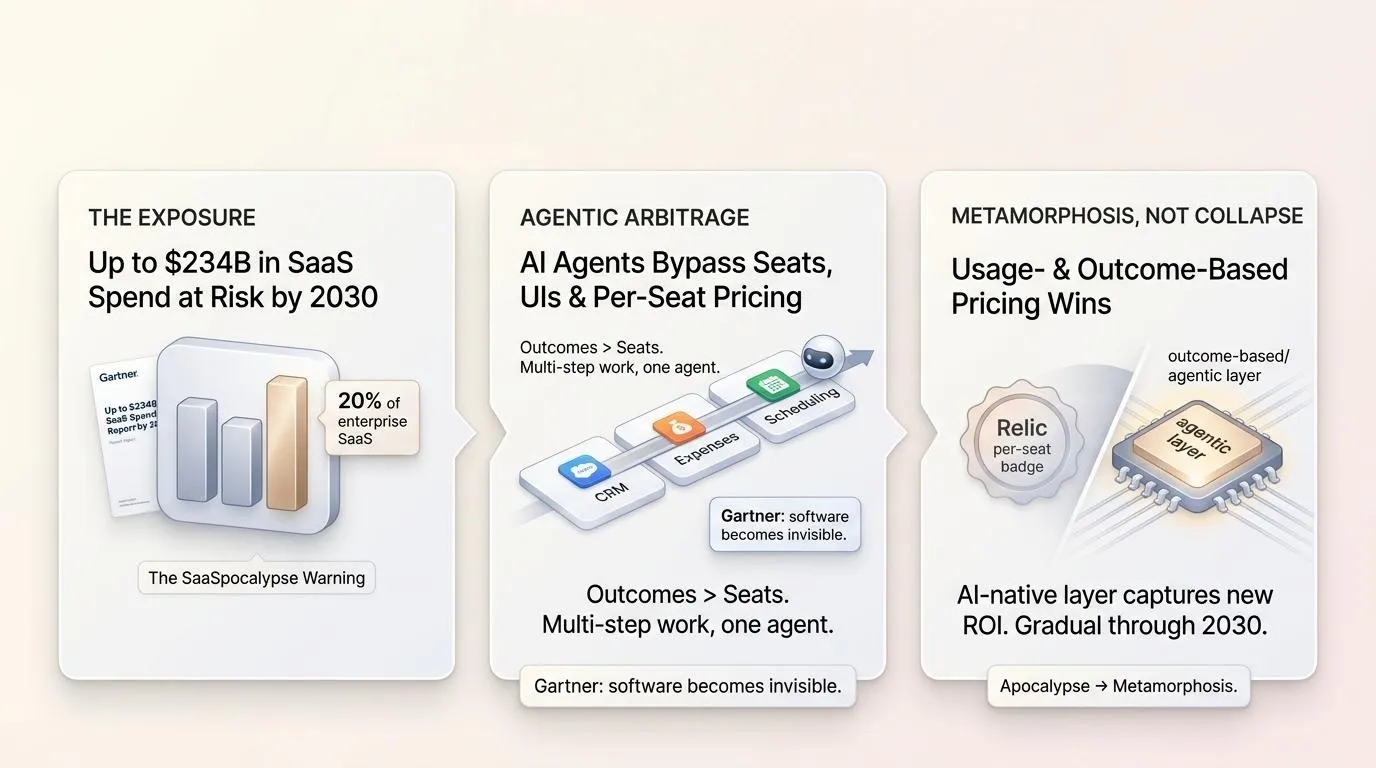
Traditional SaaS pricing is built around seats — the more employees who log into an application, the more a vendor charges. Gartner argues that logic collapses once AI agents, not humans, become the primary users of enterprise software. Agentic arbitrage occurs when AI agents complete multi-step tasks by working across several systems directly, bypassing the user interfaces those systems were built around.
“Agentic AI changes the economics of software,” said George Brocklehurst, managing vice president at Gartner. “Agentic systems deliver outcomes directly, bypassing traditional user experience (UX)-heavy applications and making the software invisible. This breaks the link between user growth and revenue growth for many enterprise software vendors.”
In practice, that means a company might no longer need employees clicking through a CRM, an expense tool and a scheduling app separately — an AI agent can execute the underlying task across all three, reducing the need for the polished interface each vendor spent years building.
Winners, Losers and a “Metamorphosis”
Gartner’s report suggests the shift creates an opening for AI-native startups and service providers to act as an “agentic layer” sitting on top of enterprise systems, delivering measurable outcomes rather than features — and capturing not just existing software budgets but new spending unlocked by the ROI those outcomes generate.
Brocklehurst was careful to frame the change as evolution rather than collapse: “This is less an apocalypse and more of a metamorphosis.
SaaS will not be destroyed; it will emerge in a different form.” Vendors that adapt their pricing toward usage- or outcome-based models, rather than clinging to per-seat licensing, are best positioned to retain revenue as agents take over routine tasks.
The report lands amid a broader reckoning for software stocks, several of which have sold off in 2026 on investor fears that agentic AI could hollow out recurring revenue — even as many of the same companies continue to post growth.
Gartner’s numbers suggest the disruption will be gradual and uneven through 2030 rather than an overnight collapse, but the direction of travel, the firm says, is now clear.
Quick Links:
Comments
Be the first to leave a comment.