
Alibaba made a massive move in early August 2026 that flew a little under the radar in Western media. The company released Qwen3.8-Max, which it describes as its biggest and most powerful AI model to date.
The model runs on 2.4 trillion parameters and Alibaba is claiming it performs on par with Anthropic’s Claude on several standard benchmarks including reasoning, coding, and multilingual understanding.
How Qwen3.8-Max Stacks Up Against US Models
Benchmark results shared by Alibaba show Qwen3.8-Max performing competitively against top U.S. models on tasks like math reasoning, code generation, and long-context comprehension.
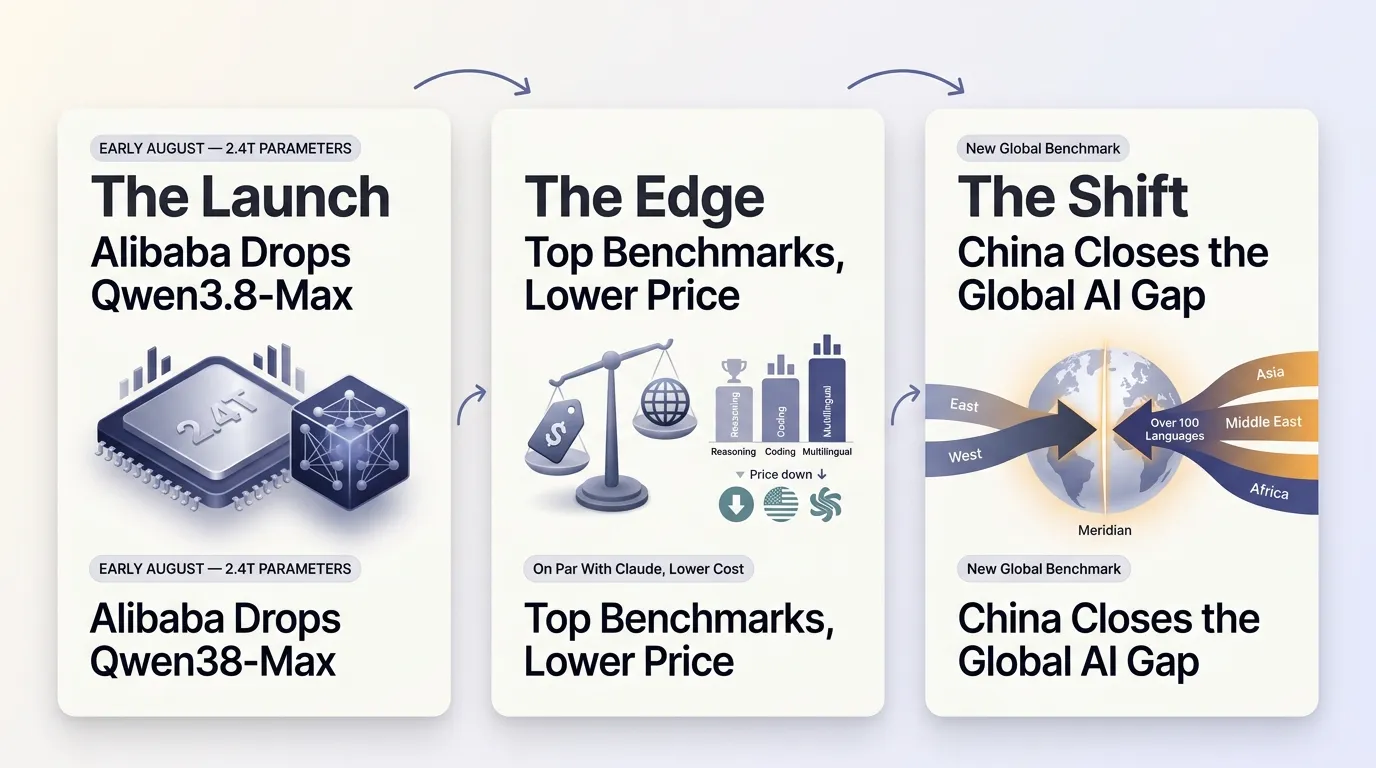
Bloomberg reported on August 3 that independent reviewers broadly confirmed the model holds its own against Claude and GPT-5 on several standard tests, though it trails on some nuanced language tasks. What makes this especially significant is the pricing.
Alibaba is offering Qwen3.8-Max API access at costs well below what OpenAI and Anthropic charge for comparable models. For developers and businesses running high-volume AI workloads, that price gap is a serious consideration.
This video from The China Show digs into what the Qwen push means for the global AI race:
Alibaba’s Qwen Model Raises Stakes in AI Race
China Is Closing the Gap Faster Than Expected
A year ago, the consensus in Western tech circles was that U.S. export controls on advanced chips would slow China’s AI progress significantly. Qwen3.8-Max challenges that assumption hard.
Alibaba has clearly found ways to optimize training efficiency and model architecture to punch above its weight in compute. The model also supports over 100 languages natively, which gives it a strong edge in non-English markets across Asia, the Middle East, and Africa.
For global businesses looking at AI vendors, Alibaba is now a credible option in a way it was not 12 months ago. The geopolitical dimension of this is enormous.
Western policymakers are watching whether companies outside the U.S. adopt Chinese AI infrastructure, which could have long-term implications for data sovereignty and technology standards worldwide.
Quick Links:
Comments
Be the first to leave a comment.