

Here is a question that sounds simple but has a surprisingly interesting answer. A few years ago the trajectory was clear — companies were adding SaaS tools constantly and the number kept going up every year. In 2022 the average enterprise was using 130 SaaS applications. That felt like it would keep climbing indefinitely.
It did not. The number is now falling — and the reasons why tell you a lot about where the SaaS market is heading. This article pulls together the most current data on SaaS app usage, spending, and consolidation trends from 2025 and 2026 primary research so you can see exactly what is happening and why it matters.
Here is the full picture.
The Core Number — How Many SaaS Apps Does the Average Company Use?
The Headline Figure
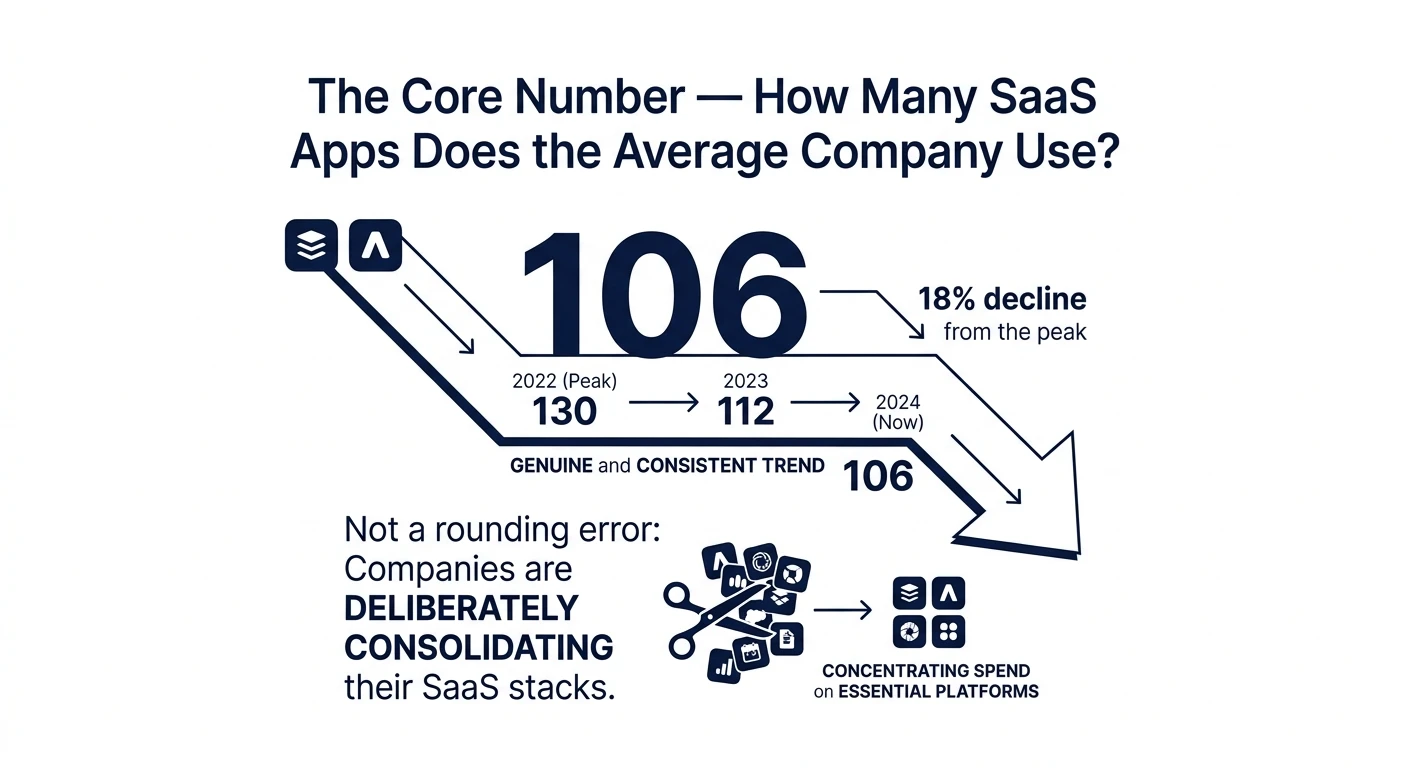
The average enterprise now uses 106 SaaS applications — down from 112 in 2023 and a peak of 130 in 2022. That is an 18% decline from the peak in just three years.
This is not a rounding error or a methodology change between surveys. It is a genuine and consistent trend across multiple independent data sources. Companies are deliberately consolidating their SaaS stacks — cutting tools they added during the growth years that are not delivering clear value and concentrating spend on the platforms that are genuinely embedded in how work gets done.
By company size the numbers break down like this:
Company Size | Average SaaS Apps Used |
75 – 199 employees | 44 apps |
200 – 749 employees | 96 apps |
750 – 1,499 employees | 116 apps |
1,500 – 4,999 employees | 101 apps |
5,000+ employees | 131 apps |
The most interesting number in that table is the mid-market segment — companies with 1,500 to 4,999 employees — which saw the biggest drop in app usage of any size band, falling 29% in 2025. This is the segment where IT teams have enough scale to identify and act on redundant tools but not so much complexity that consolidation becomes politically impossible. They are cutting faster and more decisively than anyone else.
Large enterprises (5,000+ employees) still use the most apps on average at 131 — which is actually slightly above the overall 2022 peak. At enterprise scale, different business units and geographies often run their own tool stacks, making consolidation genuinely harder even when there is appetite for it.
Why the Number Is Falling — The SaaS Consolidation Story
The Pandemic Hangover
The peak of 130 apps per company in 2022 was not organic growth in tool usage. It was largely a consequence of the rapid, often chaotic digitization that happened during the pandemic. Companies needed remote collaboration tools immediately. Teams bought whatever solved the immediate problem. Nobody had time for proper evaluation and IT had limited ability to govern rapid decentralized purchasing.
When the dust settled, many companies found themselves paying for tools that were barely used, that overlapped significantly with other tools in the stack, or that had been bought by a specific team lead who had since left the company. The consolidation wave since 2023 is in large part the delayed rationalization of that pandemic-era sprawl.
The Economic Pressure
SaaS spending is expected to grow 20% in 2026 — even as the number of apps falls. That apparent contradiction makes sense when you understand what is driving it. Companies are using fewer tools but paying more for each one — as vendors raise prices, bundle AI features, and move contracts to annual enterprise agreements from month-to-month subscriptions.
When budgets get tighter and renewals get more expensive, the natural response is to cut the tools at the margins and concentrate spend on the ones that are genuinely indispensable. 79% of IT leaders faced SaaS price increases at renewal in the past 12 months — and each price increase triggers a fresh evaluation of whether the tool is worth the new rate.
The AI Bundling Effect
This is the factor that will shape SaaS app counts most significantly over the next two to three years. As major platforms bundle AI features into their core offering, they are eating use cases that previously required separate point solutions.
A company that previously used a standalone AI writing assistant, a separate SEO tool, and a dedicated content workflow manager might now be able to cover all three use cases through AI features built into their existing CMS and marketing platform. The point solutions get cut. The platform contract grows. Net result: fewer apps, higher spend on the ones that remain.
By the end of 2026, more than 80% of companies are expected to have deployed AI-enabled apps in their IT environments. As AI capability concentrates in fewer, larger platforms, the long-tail of specialist SaaS tools faces real consolidation pressure.
SaaS Renewal Management — The Hidden Operational Burden
The average organization manages 211 SaaS renewals per year. Read that again. More than four renewals every single week, on average, across the SaaS stack.
This is one of the most underappreciated operational burdens in modern enterprise IT. Every renewal involves at minimum a contract review, a usage assessment, a cost-benefit evaluation, a vendor conversation, and an approval process. At 211 renewals per year that is a massive ongoing time commitment — and it is one of the primary reasons SaaS management has become a dedicated function rather than something IT handles as a side responsibility.
The renewal burden is also where a lot of SaaS waste is created. Tools that auto-renew without anyone noticing. Contracts that roll over at higher prices than the previous year because nobody flagged the renewal notice in time. Licenses that continue long after the users who needed them have left the company.
Zylo’s 2026 SaaS Management Index — which tracks $75 billion in real SaaS spend — found that a meaningful percentage of enterprise SaaS licenses are unused or significantly underused at any given time. The consolidation trend is, in part, companies finally getting visibility into this waste and acting on it.
SaaS Spending — Paying More for Less
The Spending Paradox
The paradox at the heart of the current SaaS market is that companies are using fewer applications but spending more money on software overall.
SaaS spending is expected to grow 20% in 2026
The average organization manages 211 renewals per year — most of which now include price increases
73% of SaaS vendors raised prices by an average of 12% between 2022 and 2023
79% of IT leaders faced renewal price hikes in the past 12 months
The math is straightforward. Fewer apps at significantly higher prices per app equals higher total SaaS spend. For IT and finance teams this creates a real budgeting challenge — software costs are rising faster than headcount or revenue in many cases and the increases are often hard to predict because they happen at renewal rather than at a fixed annual schedule.
Where the Spend Concentrates
As companies consolidate their stacks, spending concentrates in a smaller number of large platform vendors. Microsoft, Salesforce, ServiceNow, Workday, Google, and a handful of others capture an increasingly large share of enterprise SaaS budgets — because they are the platforms that are hardest to remove and most capable of absorbing adjacent use cases through feature expansion and acquisition.
This concentration is good for the platform vendors and challenging for point-solution SaaS companies that are competing in categories that the platforms have decided to enter.
SaaS Adoption by Business Function
Not all business functions use the same number or type of SaaS tools. Here is roughly how SaaS adoption breaks down by department in a typical mid-to-large enterprise:
Department | SaaS App Density | Most Common Categories |
Marketing | Very High | CRM, marketing automation, SEO, social, analytics, content |
Sales | High | CRM, sales engagement, prospecting, enablement, CPQ |
Engineering / Product | High | Project management, dev tools, monitoring, CI/CD, documentation |
HR and People | Medium | HRIS, payroll, recruiting, L&D, employee engagement |
Finance | Medium | ERP, expense management, FP&A, billing, procurement |
Customer Success | Medium | CS platform, helpdesk, NPS, communication tools |
IT and Security | High | ITSM, security tools, identity management, device management |
Executive / Operations | Lower | BI and analytics, communication, project management |
Marketing consistently has the most SaaS tools per head — reflecting both the diversity of marketing use cases and the relatively low barriers to tool adoption in marketing teams compared to more IT-governed functions like finance and HR.
Shadow IT — The Apps Nobody Knows About
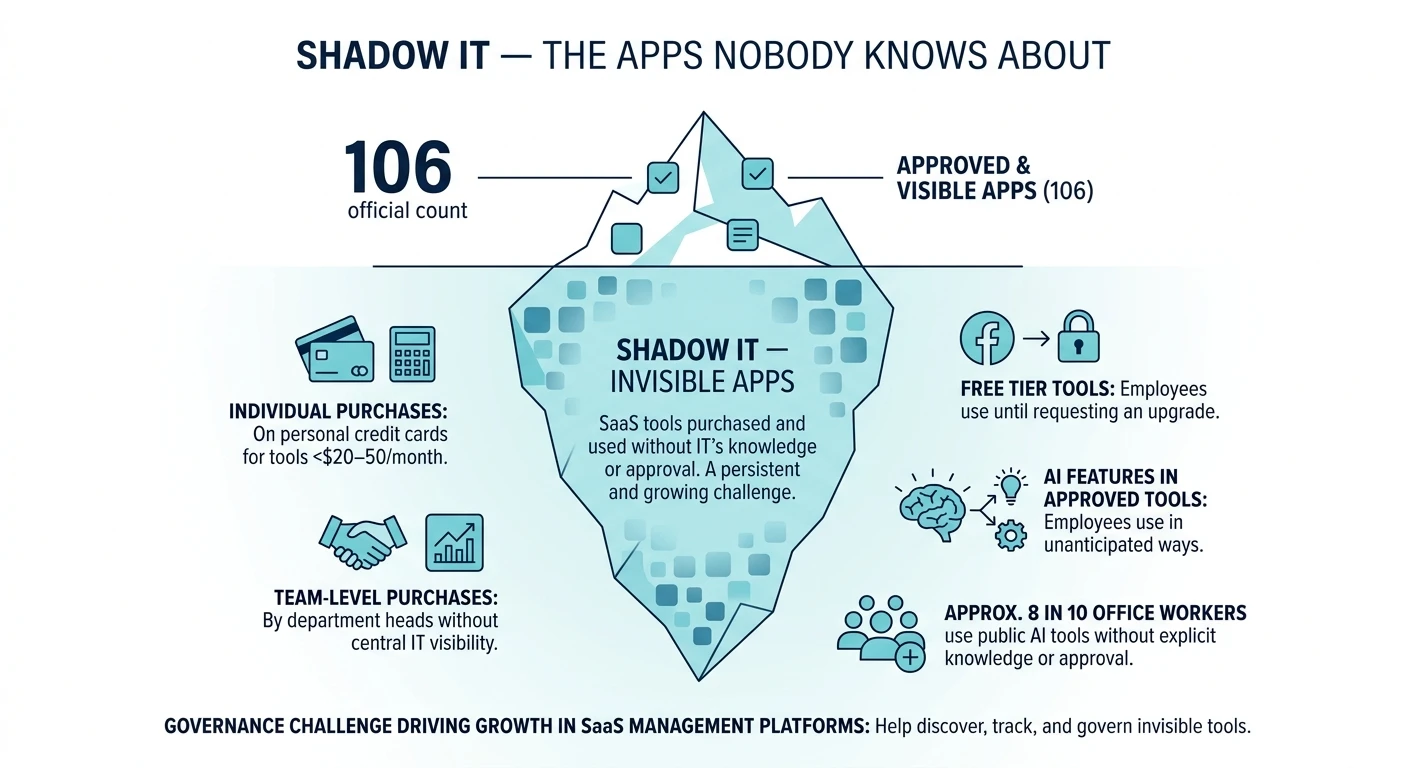
The official count of 106 apps per enterprise almost certainly understates the real number. Shadow IT — SaaS tools purchased and used without IT’s knowledge or approval — is a persistent and growing challenge.
The scale of shadow AI specifically gives you a sense of the broader shadow IT picture. Approximately 8 in 10 office workers now use public AI tools without IT’s explicit knowledge or approval. If AI adoption alone is that widespread outside official channels, it is reasonable to assume that general SaaS shadow IT runs similarly.
The most common sources of shadow IT in 2026:
Individual purchases on personal credit cards for tools costing under $20–50 per month that do not require IT approval
Team-level purchases made by department heads without central IT visibility
Free tier tools that employees start using without any purchase involved — and which only become visible when they request an upgrade
AI features within approved tools that employees use in ways IT did not anticipate or sanction
The governance challenge here is significant — and it is one of the primary drivers of growth in the SaaS management platform category, which helps IT teams discover, track, and govern tools that would otherwise remain invisible.
What This Means for SaaS Vendors
The consolidation trend is not equally bad for all SaaS companies. It creates clear winners and losers.
Winners: Platform companies that can absorb adjacent use cases. Vendors with deeply embedded workflows and high switching costs. Companies serving large enterprise customers with long-term contracts. AI-native platforms that make point solutions redundant.
Losers: Point-solution SaaS companies in categories that larger platforms have decided to enter. Tools with shallow adoption and low switching costs. Products where the value is unclear or hard to measure — the ones that get cut first when procurement scrutiny increases.
The strategic implication for SaaS founders and product teams is clear. A single-feature product in a category that any major platform could absorb is a vulnerable position. Building toward platform status — deeper integration, broader use cases, higher switching costs, genuine expansion revenue — is the direction that produces durable businesses in a consolidating market.
Conclusion
The story of SaaS app usage in 2026 is consolidation — fewer tools, higher spend, more scrutiny at renewal, and a clear shift of budget toward platforms that are genuinely indispensable. The peak of 130 apps per company in 2022 was an anomaly driven by pandemic-era chaos. The current figure of 106 is heading lower, not higher, as AI bundling into major platforms continues to absorb point-solution use cases.
For buyers the implication is to audit your stack before every major renewal cycle. The average company manages 211 renewals per year and most have meaningful waste in their current tool set. For vendors the implication is to make your product indispensable — deeply integrated, clearly measurable in its ROI, and harder to remove than it was to buy.
The SaaS market is not shrinking. It is getting more selective. And the products that survive and thrive in a selective market are the ones with genuine, demonstrable, irreplaceable value.
We will update this data as new benchmark reports are published through 2026.
FAQs
The average company uses between 80 and 200 SaaS apps depending on its size, though recent data shows this number is starting to decline. Larger enterprises tend to have more apps, while small businesses typically run on fewer specialized tools.
Companies are consolidating their software stacks to cut costs, reduce security risks, and eliminate redundant tools that overlap in functionality. Economic pressure and tighter IT budgets are pushing organizations to audit their subscriptions and eliminate underused applications.
SaaS sprawl refers to the uncontrolled accumulation of software subscriptions across a company, often leading to wasted spending and security vulnerabilities. It matters because unused or redundant apps can cost businesses thousands of dollars annually while creating compliance and data protection risks.
Generally yes, using fewer well-integrated SaaS apps improves workflow efficiency, reduces costs, and strengthens data security. The goal isn't to minimize tools at all costs but to ensure every app in use delivers measurable value.
Absolutely, small businesses often benefit the most from consolidation since they have limited budgets and IT resources to manage multiple platforms. Switching to all-in-one solutions can simplify operations and significantly reduce monthly software expenses.
Comments
Be the first to leave a comment.