

If you bootstrapped your SaaS company without outside funding and you are trying to figure out how you stack up against other founders doing the same thing — this article is specifically for you. Most SaaS benchmark reports mix bootstrapped and VC-backed companies together, which makes the numbers almost useless for comparison. A company burning $2 million a month in investor capital to grow at 80% is playing a completely different game than one growing on its own revenue.
This article pulls exclusively from SaaS Capital’s 2026 annual survey of more than 1,000 private B2B SaaS companies — the most detailed primary research available on bootstrapped SaaS benchmarks at the scale-up stage. All numbers below apply specifically to bootstrapped companies with $3M to $20M in Annual Recurring Revenue — the stage where real enterprise value starts to build.
Here is what the data actually shows.
Why the $3M to $20M ARR Stage Matters So Much
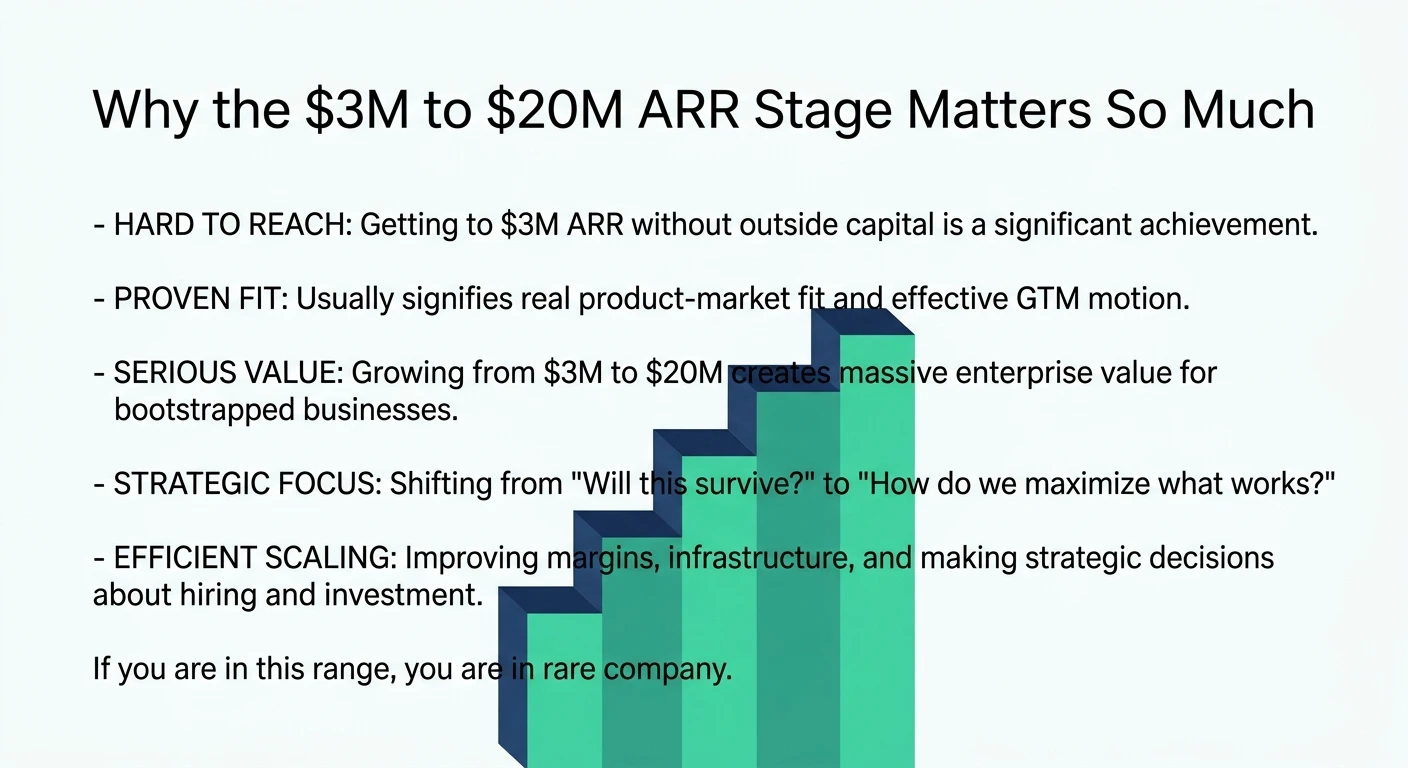
Getting to $3M ARR without outside capital is genuinely hard. Most SaaS companies never get there. The ones that do have usually found real product-market fit, built a go-to-market motion that works without a massive sales team, and developed a level of financial discipline that VC-backed peers rarely have to develop.
But what happens next is where things get really interesting.
Growing from $3M to $20M as a bootstrapped business is where serious enterprise value is created. Margins improve. Infrastructure becomes more efficient. The business shifts from “will this survive?” to “how do we maximise what is already working?” Decisions about hiring, pricing, and where to invest become strategic rather than existential.
If you are in this range right now, you are in rare company. The benchmarks below will tell you exactly how rare — and how you compare.
Bootstrapped SaaS Growth Rate Benchmarks 2026
The Core Numbers
Percentile | Annual Growth Rate |
25th percentile | 7.1% |
50th percentile (median) | 15% |
75th percentile | 27.4% |
90th percentile | 42.3% |
The median bootstrapped SaaS company with $3M–$20M ARR grew at 15% in 2026. The top 10% grew at 42.3%.
That gap between the median and the 90th percentile is the most important number on this page. It is not a small difference — it is nearly 30 percentage points of annual growth separating an average bootstrapped SaaS business from a top-performing one. Understanding what drives that gap is what most of the strategic work at this stage is actually about.
How This Compares to Last Year
The 2026 numbers represent a meaningful step down from 2025:
Median growth dropped from 20% to 15%
90th percentile dropped from 51% to 42.3%
This is not a bootstrapped-specific problem. The broader private SaaS market has seen growth moderate across the board as the pandemic-era digital transformation boom normalizes. The companies that grew at 50%+ in 2022 and 2023 were often doing so in artificially favorable conditions.
A 15% median growth rate for a bootstrapped, profitable SaaS business in 2026 is a real business outcome. It is not a failure — it is a sustainable, compounding result that builds long-term value without the risk that comes with external capital and the growth-at-all-costs pressure that follows it.
Bootstrapped vs VC-Backed Growth Rates
This comparison comes up constantly and the answer is what you would expect — but the magnitude matters.
VC-backed SaaS companies at comparable ARR ranges typically grow at 30–50% annually. Bootstrapped companies grow at 15–25%. The gap is real and it is largely explained by one thing: VC-backed companies are deploying external capital into sales headcount, paid acquisition, and market expansion at a rate that bootstrapped companies simply cannot match on organic revenue alone.
What the growth rate comparison does not capture is the other side of the ledger. Bootstrapped companies at this stage are typically near breakeven or profitable. VC-backed companies at the same stage are often burning $500K to $2M per month. The risk profiles are completely different — and for many founders, the bootstrapped path creates far more personal financial value even at a lower headline growth rate.
Bootstrapped SaaS Revenue Retention Benchmarks 2026
Retention is where bootstrapped SaaS companies often quietly outperform expectations. Without the pressure to grow at any cost, bootstrapped founders tend to be more selective about the customers they take on — and more disciplined about product quality and customer success. The retention numbers reflect that.
Net Revenue Retention (NRR)
NRR measures how much your existing revenue base grows or shrinks over time — accounting for expansion, contraction, and churn. An NRR above 100% means you would grow even if you never signed a new customer.
Percentile | NRR |
25th percentile | 91.3% |
50th percentile (median) | 103% |
75th percentile | 110.2% |
90th percentile | 117.9% |
The median NRR for bootstrapped SaaS companies at this stage is 103% — meaning the average bootstrapped SaaS business in the $3M–$20M ARR range is growing its existing revenue base by 3% per year before counting any new customers. That is a meaningful number. It means the business has a compounding engine built into it, not just a growth treadmill.
The 90th percentile at 117.9% tells you what elite retention looks like at this stage. Companies hitting that number have typically built strong expansion revenue into their pricing structure — through usage-based tiers, seat expansion, or upsells — on top of very low churn.
Importantly, NRR is essentially flat year-over-year despite the growth rate decline. That is actually a positive signal. It means bootstrapped SaaS companies are holding onto their customers and growing revenue from them at the same rate as last year — the slowdown is in new customer acquisition, not in the quality of the existing customer base.
Gross Revenue Retention (GRR)
GRR measures what percentage of existing revenue you keep — excluding any expansion. It is a pure measure of churn and downgrades with no expansion revenue to mask problems.
Percentile | GRR |
25th percentile | 79.8% |
50th percentile (median) | 91% |
75th percentile | 96.4% |
90th percentile | 100% |
The median GRR for bootstrapped SaaS at $3M–$20M ARR is 91% — meaning the average company loses about 9% of its existing revenue to churn and downgrades each year before counting expansion.
The 90th percentile GRR of 100% is striking. The best-performing bootstrapped SaaS companies in this ARR range are losing essentially zero revenue from existing customers to churn and contraction. Every dollar of NRR growth above their GRR baseline is pure expansion.
Like NRR, GRR is essentially flat compared to last year — which reinforces the picture of a cohort of bootstrapped businesses with stable, healthy customer bases that are feeling the growth slowdown primarily on the new customer side.
What ARR Range Are We Talking About?

To be clear about the scope of these benchmarks: all of the above numbers apply to bootstrapped SaaS companies with $3M to $20M in Annualized Run Rate Revenue.
This is a specific and important slice of the market. Here is why:
Below $3M ARR, most bootstrapped SaaS companies are still proving product-market fit. Metrics are noisier and benchmarks less useful because a single large customer win or loss can swing every number dramatically.
Above $20M ARR, the bootstrapped path becomes increasingly rare. Most companies at this scale have either taken on some form of external capital, been acquired, or are operating with significantly different economics than the scale-up stage companies these benchmarks describe.
The $3M–$20M range is where bootstrapped SaaS is most interesting — and most underserved by good benchmark data. It is the stage where founders are making real decisions about whether to raise capital, hire aggressively, or continue scaling on organic revenue. The numbers above give those founders a concrete baseline for those decisions.
ARR Per Employee for Bootstrapped SaaS
One of the clearest advantages of the bootstrapped path shows up in operational efficiency. Without the pressure to hire ahead of revenue, bootstrapped SaaS companies tend to generate significantly more revenue per employee than their VC-backed peers at similar ARR levels.
Across private SaaS companies broadly:
Median ARR per employee: $125,000
Enterprise-focused companies (ARR above $20M): approximately $186,000
Early-stage companies (ARR under $1M): around $50,000
Bootstrapped companies in the $3M–$20M range typically sit at the higher end of their ARR band on this metric — because they have not over-hired relative to revenue. This efficiency advantage tends to translate directly into profitability, which is one of the structural reasons bootstrapped SaaS at this stage creates so much value for founders.
How to Use These Benchmarks
A few practical notes on applying these numbers to your own business.
Compare like with like. If your ARR is $4M and you are comparing your growth rate to a VC-backed company at $4M, you are not comparing the same thing. Use the bootstrapped-specific benchmarks in this article for your baseline.
Focus on your trajectory not just your percentile. Being at the 50th percentile today is fine — the question is whether you are trending toward the 75th or back toward the 25th. Direction matters more than current position for most strategic decisions.
NRR is the most important single metric. If your NRR is above 100%, your business compounds naturally. If it is below 90%, growth is a treadmill — you are running to stand still. Fix retention before pouring more money into acquisition.
Growth rate benchmarks are contextual. A 15% growth rate is respectable for a profitable $15M ARR business. It is a warning sign for a company at $3M ARR with no clear path to acceleration. The same number means different things at different stages and with different cost structures.
Conclusion
The median bootstrapped SaaS company with $3M–$20M in ARR grew at 15% in 2026, retained 91 cents of every existing revenue dollar (GRR), and grew its existing revenue base by 3% net (NRR of 103%). Growth is slower than last year but retention is holding steady — which tells a story of solid, durable businesses rather than struggling ones.
The top 10% of bootstrapped SaaS companies are growing at 42.3% and hitting NRR of 117.9%. That gap between median and top decile is where most of the strategic opportunity lives for founders at this stage — and it is almost always explained by a combination of better retention, smarter pricing, and more disciplined go-to-market execution rather than just more spending.
If your numbers are above the median on NRR and GRR, you have a strong foundation to build on. If they are below, that is the place to start — because no amount of new customer growth fixes a leaky retention bucket at this stage.
We will update these benchmarks as SaaS Capital releases new survey data through 2026.
FAQs
A healthy Net Revenue Retention (NRR) for bootstrapped SaaS companies typically falls between 100% and 120%, with top performers exceeding 120%. Achieving above 100% means expansion revenue from existing customers is offsetting churn, which is a strong signal of product-market fit.
Most successful bootstrapped SaaS companies target 50% to 100% ARR growth annually in early stages, though companies with lower ARR bases may see higher percentages. Growth expectations typically moderate as ARR scales, with companies above $1M ARR often benchmarking at 30% to 60% year-over-year growth.
Gross Revenue Retention (GRR) measures revenue retained from existing customers excluding any expansion, while Net Revenue Retention (NRR) includes upsells, cross-sells, and expansions. A bootstrapped SaaS company with a GRR above 85% and an NRR above 100% is generally considered to have strong retention fundamentals.
Yes, bootstrapped SaaS companies generally grow more slowly than venture-backed competitors because they rely on organic revenue rather than aggressive capital-fueled customer acquisition. However, bootstrapped companies often achieve better unit economics and profitability benchmarks, making slower growth more sustainable long-term.
Benchmarks help bootstrapped founders assess whether their growth rate, churn, and revenue metrics are competitive without the guidance that investors typically provide. Comparing against industry data allows founders to identify weaknesses, set realistic goals, and make informed decisions about pricing, retention, and product investment.
Comments
Be the first to leave a comment.