

The creator economy is no longer a fringe corner of the internet. It is a multi-hundred-billion-dollar industry employing millions, reshaping how brands advertise, and pulling in serious venture money. This guide breaks down the numbers that define it in 2026, with every figure attributed to its source. Because analysts count the market in different ways, the size estimates vary, and where they do, the spread is shown rather than smoothed over.
Key Statistics at a Glance
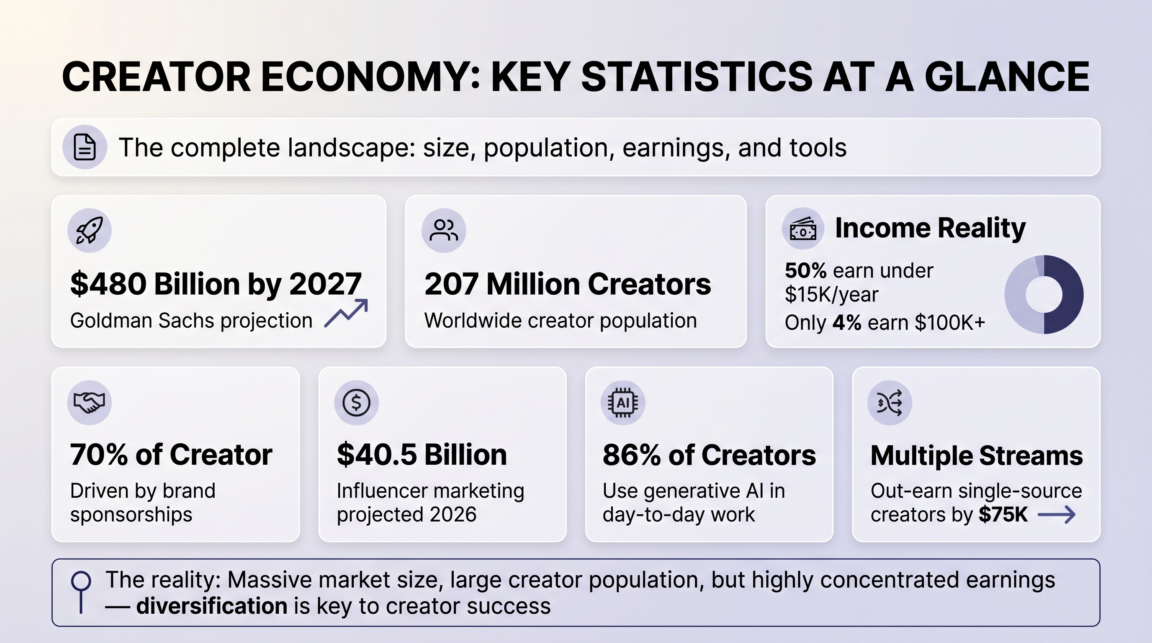
The creator economy is on track to approach $480 billion by 2027, according to Goldman Sachs.
Worldwide, the creator population is most often pegged at around 207 million people.
Half of all creators earn less than $15,000 a year, while only about 4% clear $100,000.
Brand sponsorships drive roughly 70% of creator income.
Influencer marketing alone is projected near $40.5 billion in 2026.
86% of creators now use generative AI in their day-to-day work.
Creators running multiple income streams out-earn single-source creators by about $75,000.
How Big Is the Creator Economy?
Goldman Sachs expects the total addressable market to roughly double to about $480 billion by 2027.
For 2026, current valuations land anywhere from about $205 billion to $323 billion, depending on whether tools, commerce, and platform revenue are included. (Grand View Research, Research and Markets)
Longer term, several analysts project the market will pass $1.3 trillion by 2033, with the most aggressive forecasts going higher. (Grand View Research, Research Nester)
Annual growth estimates cluster between 22% and 26% through the early 2030s.
Investors are betting on it: creator-focused startups pulled in more than $767 million in 2023 to 2024, a 49% jump, with AI tools leading the round. (Whop)
The Creator Population
Around 207 million people create content worldwide in 2026, though some counts run as high as 303 million. (Companies History, Market.us)
About 50 million are professional or semi-professional creators. (Goldman Sachs)
In the US, roughly 27 million people earn money as creators, about 14% of those aged 16 to 54. (inBeat)
US full-time-equivalent creator jobs jumped from roughly 200,000 in 2020 to about 1.5 million in 2024, a 7.5x rise.
Close to half of creators, about 46.7%, treat it as a full-time job. (ConvertKit)
The typical creator takes around six and a half months to earn their first dollar. (DemandSage)
70% of creators put in 10 hours a week or less on content. (DemandSage)
Over 30% of Gen Z see creating as a real career option.
The Money: Earnings and Revenue Streams
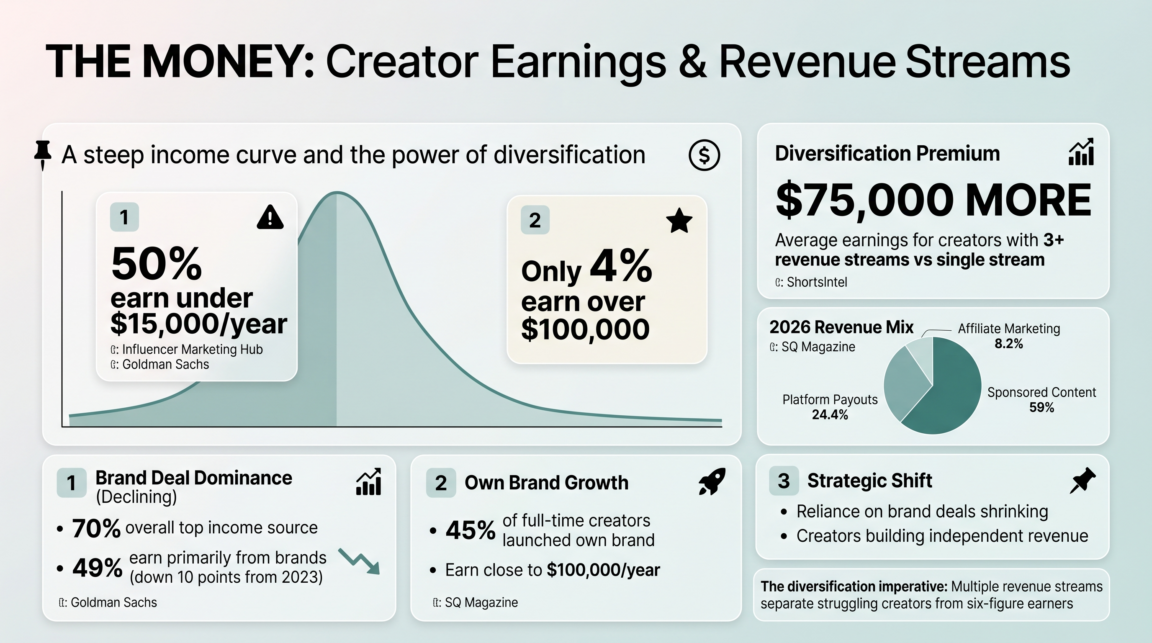
The income curve is steep: about 50% of creators make under $15,000 a year, and only around 4% top $100,000. (Influencer Marketing Hub, Goldman Sachs)
Diversification pays. Creators with three or more revenue streams earn roughly $75,000 more on average than those with one. (ShortsIntel)
Sponsored content accounts for about 59% of creator revenue in 2026, platform payouts 24.4%, and affiliate marketing 8.2%. (SQ Magazine)
Brand deals remain the top income source at around 70% overall, but reliance on them is shrinking. (Goldman Sachs)
The share of creators earning primarily from brand deals fell to 49%, down 10 points from 2023. (Goldman Sachs)
45% of full-time creators have launched their own brand, earning close to $100,000 a year. (SQ Magazine)
Brand Spending and Influencer Marketing
Influencer marketing reached about $32.55 billion in 2025, up 35.6% in a single year, and is projected near $40.5 billion in 2026. (Influencer Marketing Hub, Mordor Intelligence)
The channel has grown at a 33% compound annual rate since 2016, when it was worth just $1.7 billion.
US influencer spend alone is projected at about $12.17 billion in 2026. (Statista)
The payoff is strong: an average of $5.78 returned per $1 spent, with the best campaigns hitting $11 to $18. (Influee)
86% of large-company US marketers used influencer marketing in 2025, up from about 70% in 2021.
86% of consumers say they made a purchase driven by an influencer in the past year. (Influee)
Nearly half of brands, 47%, raised influencer budgets by 11% or more in 2025. (ShortsIntel)
Platform Breakdown
Each major platform plays a different role in how creators reach audiences and get paid.
Platform | Scale | Creator Payout Notes |
YouTube | 61.8M creators, 113M+ channels | Over $70 billion paid to creators in three years; $1.61 to $29.30 per 1,000 views |
TikTok | 1.6 billion+ users | Creator Rewards Program pays 10 to 25 times the old Creator Fund |
200M+ creator and business accounts | 64M+ influencers, about 91% nano; new Meta monetization suite |
YouTube generated over $60 billion in revenue in 2025, beating Netflix by roughly 33%. (Tubefilter)
Instagram is the top platform for brand partnerships at 57% adoption, with TikTok at 52%.
Meta rolled out a Creator Monetization Suite across Instagram and Facebook, bundling ads, Reels bonuses, and brand tools into one dashboard. (CNBC)
The AI Shift
86% of creators already use generative AI tools, according to Adobe’s 2025 survey of more than 16,000 creators.
The highest earners use AI about twice as often as the average creator and report 2 to 5 times higher engagement. (Whop)
AI startups grabbed the biggest slice of creator economy funding, over $300 million across 2023 to 2024. (Whop)
Analysts broadly expect short-form video and AI to be the two main growth drivers of the creator economy through 2030.
Who Creators Are
Millennials make up the largest creator group, while Gen Z is growing fastest and leans toward TikTok. (Linktree, Zippia)
About 64% of influencer-marketing creators are women. (ConvertKit)
Smaller creators win on efficiency: micro and nano-influencers regularly beat mega-influencers on engagement at a fraction of the cost.
North America holds roughly 34% to 38% of the global market. (Grand View Research)
Asia-Pacific is the fastest-growing region at over 20% annual growth, powered by India, Indonesia, and Southeast Asia.
Conclusion
Strip away the noise and three facts define the 2026 creator economy. It is enormous and still growing fast, heading toward half a trillion dollars by 2027. It is brutally unequal, with most creators earning modest sums while a small elite captures the bulk of the money. And it is being reshaped by AI, which the vast majority of creators now use to produce more and earn more.
The throughline for anyone in the space is the same. Single-platform, single-income creators are the most exposed to algorithm shifts and rate pressure, while those who diversify revenue and lean into AI-driven efficiency are pulling ahead. The creator economy is maturing into a real industry with real winners and losers, and the data points clearly toward which side adapts.
FAQs
The creator economy is estimated to be worth between $205 billion and $323 billion in 2026, depending on the analyst and what segments they include. Goldman Sachs projects the market could approach $480 billion by 2027 and surpass $1 trillion in the early 2030s.
Approximately 207 million creators are active worldwide in 2026, with some estimates reaching as high as 303 million. Of those, around 50 million are considered professional or semi-professional creators.
For most creators, a full-time income remains difficult to achieve, with roughly half earning under $15,000 per year and only about 4% earning over $100,000. Creators who do earn a sustainable living typically rely on multiple income streams rather than a single platform or revenue source.
Brand deals and sponsored content are the top earning source for creators, accounting for approximately 70% of creator income. Platform payouts, affiliate marketing, and increasingly, creators' own products and subscription offerings make up the remainder.
Influencer marketing reached roughly $32.55 billion in 2025 and is projected to hit $40.5 billion in 2026, growing at approximately 33% annually since 2016. Brands see strong returns, averaging $5.78 for every dollar spent on influencer marketing campaigns.
Comments
Be the first to leave a comment.