
India’s private space industry has seen remarkable growth in recent years. What started with just one private company in 2014 has now expanded to more than 450 space startups by 2026. This rapid rise shows how policy reforms and private innovation are changing the country’s space landscape.
A recent Firstpost video titled “From One to 450: How India Built a Thriving Private Space Sector” explains this journey in detail. You can watch the full discussion here: https://www.youtube.com/watch?v=QW4x4eyZUDk.
Policy Reforms That Opened the Sector
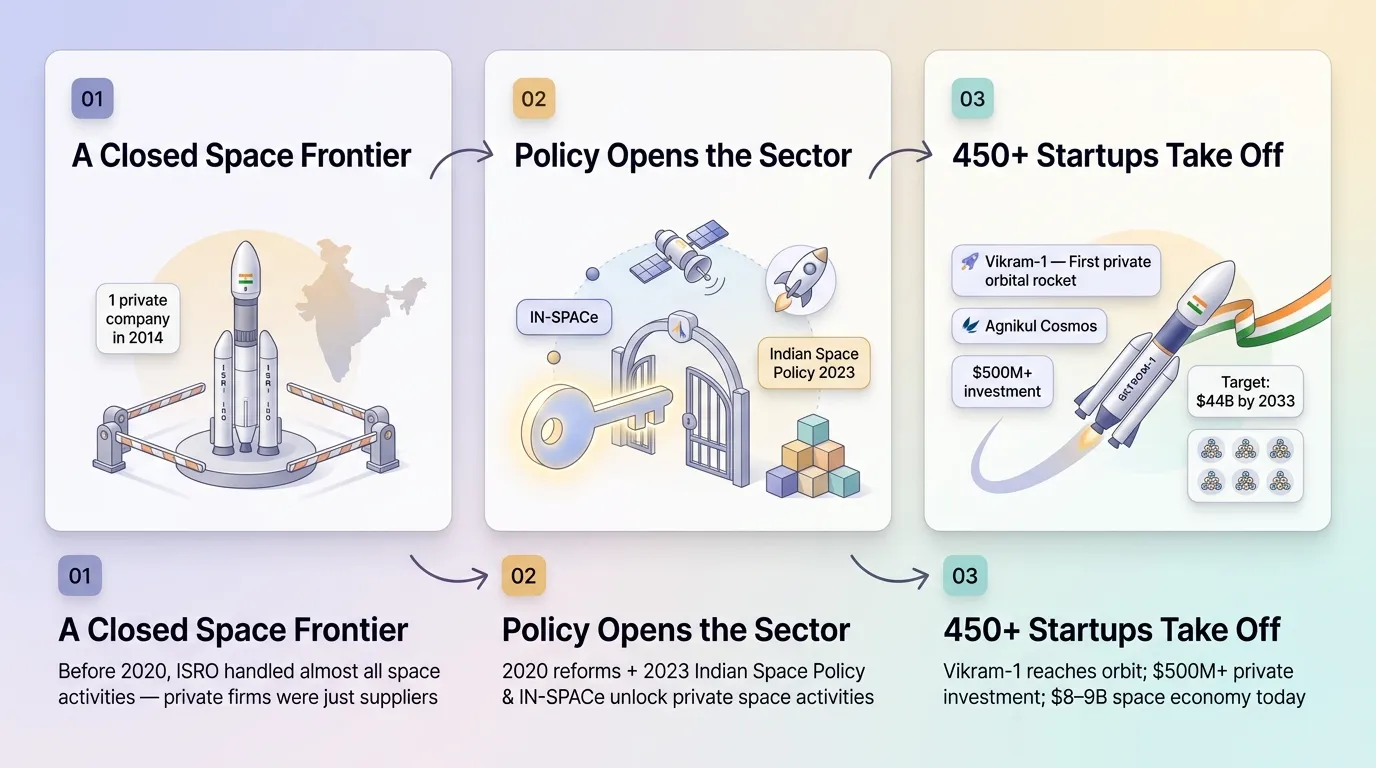
The big change began in 2020 when the Indian government allowed private companies to take part in space activities. Before this, the Indian Space Research Organisation (ISRO) handled almost everything. Private firms could only work as suppliers.
In 2023, the government introduced the Indian Space Policy. This policy gave private players more freedom to build rockets, satellites, and offer space services. It also created IN-SPACe, a single-window agency that helps private companies get approvals and work with ISRO.
These reforms encouraged young entrepreneurs and attracted investment. Cumulative private investment in the sector has crossed $500 million. Many startups now focus on small satellite launches, satellite data analysis, and space technology components.
Key Achievements and Future Goals
One of the biggest milestones came recently when Skyroot Aerospace successfully launched its Vikram-1 rocket. This became India’s first privately developed rocket to reach orbit. Other companies like Agnikul Cosmos are also making progress with their own launch vehicles.
The sector now includes companies working on:
Small satellite manufacturing
Launch vehicles
Satellite data and analytics
Ground stations and tracking systems
India’s space economy currently stands at around $8–9 billion. The government aims to grow it to $44 billion by 2033. Private companies are expected to play a major role in achieving this target.
Experts say the combination of strong ISRO expertise, supportive policies, and growing private investment has created a strong foundation. India is now seen as one of the fastest-growing private space markets in the world.
The rise from one company to over 450 startups in just over a decade shows how quickly the sector has transformed. With continued policy support and successful missions like Vikram-1, India’s private space industry is set to expand further in the coming years.
Quick Links:
Comments
Be the first to leave a comment.