

If you want to understand where SaaS is going in the next three to five years, you have to understand what AI is doing to it right now. The shift is happening faster than most people inside the industry expected — and the data from 2025 and 2026 makes that very clear.
This is not a speculative article about what AI might do to software. It is a data-driven look at what is already happening — how many SaaS companies are monetizing AI today, how much enterprises are spending on it, where adoption is accelerating, and what the governance problems look like on the ground. All stats are sourced from primary research published in 2025 and 2026.
Here is the full picture.
The State of AI in SaaS Right Now
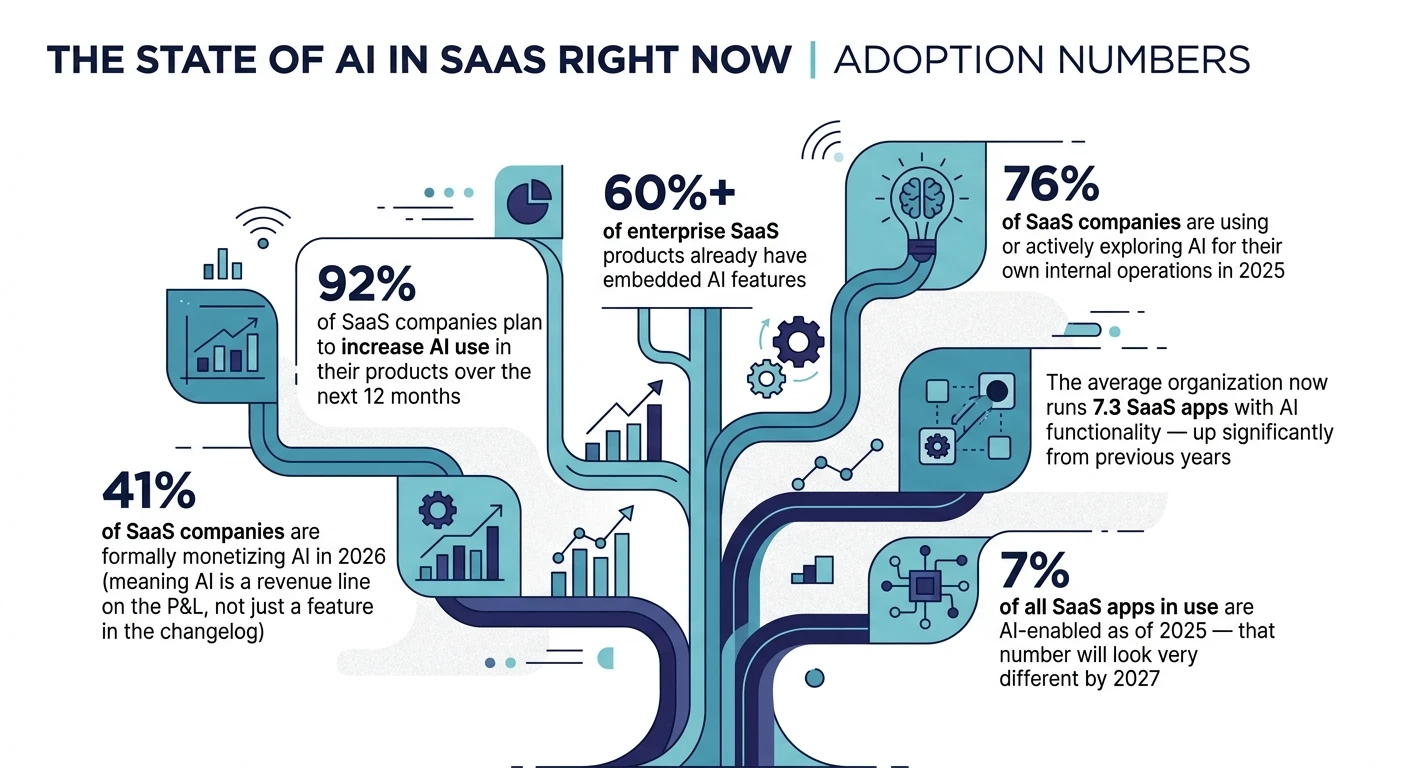
Adoption Numbers
Let’s start with where things actually stand today rather than where analysts predict they will be in five years.
41% of SaaS companies are formally monetizing AI in 2026 — meaning AI is a revenue line on the P&L, not just a feature in the changelog
92% of SaaS companies plan to increase AI use in their products over the next 12 months
60%+ of enterprise SaaS products already have embedded AI features
76% of SaaS companies are using or actively exploring AI for their own internal operations in 2025
The average organization now runs 7.3 SaaS apps with AI functionality — up significantly from previous years
7% of all SaaS apps in use are AI-enabled as of 2025 — that number will look very different by 2027
What Companies Are Doing With AI Revenue
Of the 41% of SaaS companies formally monetizing AI:
53% use subscription pricing for AI features — bundled into existing plans or as a higher tier
The remaining 47% use a mix of usage-based pricing, consumption models, or outcome-based fees
The subscription approach is winning for now — largely because it is simpler to sell and easier to forecast. But as AI compute costs become more variable and customers become more sophisticated about what they are actually using, usage-based AI pricing is expected to grow significantly. Gartner predicts that by 2027, 70% of top SaaS vendors will offer consumption-based pricing for at least part of their portfolio — and AI is the primary driver of that shift.
Enterprise AI Spending Statistics
The Budget Commitment Is Real
68% of CEOs plan to increase AI spending in 2026 — this is not experimental budget anymore, it is a line item
33% of organizations with 1,000+ employees have already deployed agentic AI as of late 2025
Another 48% expect to deploy agentic AI within 12 months
Only 2% of large organizations have no plans to deploy agentic AI — essentially the entire enterprise market is moving in this direction
The Agentic AI Shift
Agentic AI deserves its own section because it represents a qualitatively different kind of AI adoption from the chatbots and autocomplete features that defined the first wave.
Agentic AI takes autonomous actions — it does not just answer questions, it completes tasks, makes decisions within defined parameters, and operates across systems without constant human input. Think of it as the difference between a calculator and an assistant who can actually do your accounting.
According to IDC, agentic AI spending is expected to exceed 26% of worldwide IT spending over the next five years, reaching $1.3 trillion by 2029. To put that in context — total global IT spending in 2026 is around $5 trillion. Agentic AI alone is projected to account for more than a quarter of that within five years.
42% of large organizations are already scaling agentic AI across multiple business functions — not just piloting it in one department. This is a sign that the technology has crossed from proof-of-concept into production deployment for a significant portion of the enterprise market.
AI and SaaS Market Size Statistics
The AI SaaS Market Is Growing Faster Than Anything Else
The global AI SaaS market is expected to grow at a 38.28% CAGR from 2023 to 2031
By 2031, the AI SaaS market is projected to reach approximately $775 billion
The AI-created SaaS market specifically is projected to grow at a 39.4% CAGR from 2025 to 2031
Global AI software revenue grew from $9.5 billion in 2018 to $118.6 billion in 2025 — a 12x increase in seven years
For comparison, the overall SaaS market is growing at around 13% CAGR. The AI SaaS segment is growing at nearly three times that rate. This means AI is not just a feature layer on top of existing SaaS — it is becoming its own market category that is expanding the overall pie significantly.
Where the Investment Is Going
Private investments in AI ventures are anticipated to reach $200 billion globally and $100 billion in the U.S. annually
Revenue from AI data services for Machine Learning Operations tools is projected to nearly quadruple between 2024 and 2028
The global Artificial Intelligence Software market reached $16.98 billion in 2024 and is projected to reach $80.6 billion by 2031 at a 29.64% CAGR
AI Adoption by Business Function
Where are companies actually using AI within their SaaS tools? The breakdown by function shows clear patterns:
Business Function | % of Companies Using AI Here |
Customer service and support | 40% |
IT service management | 45% |
Sales and CRM | Growing rapidly |
Marketing automation | Growing rapidly |
HR and recruitment | Emerging |
Finance and accounting | Emerging |
Customer service is the most mature AI use case in SaaS — partly because the ROI is easiest to measure (ticket deflection, response time, handling cost) and partly because the technology has been good enough for this application for longer than most others.
The results back up the investment. Agentic AI technologies reduce customer support handling time by more than 52% — saving companies hundreds of thousands of work hours per year and improving response quality simultaneously. For SaaS companies with large SMB customer bases where support costs are a significant percentage of gross margin, this is a transformational efficiency gain.
The Shadow AI Problem
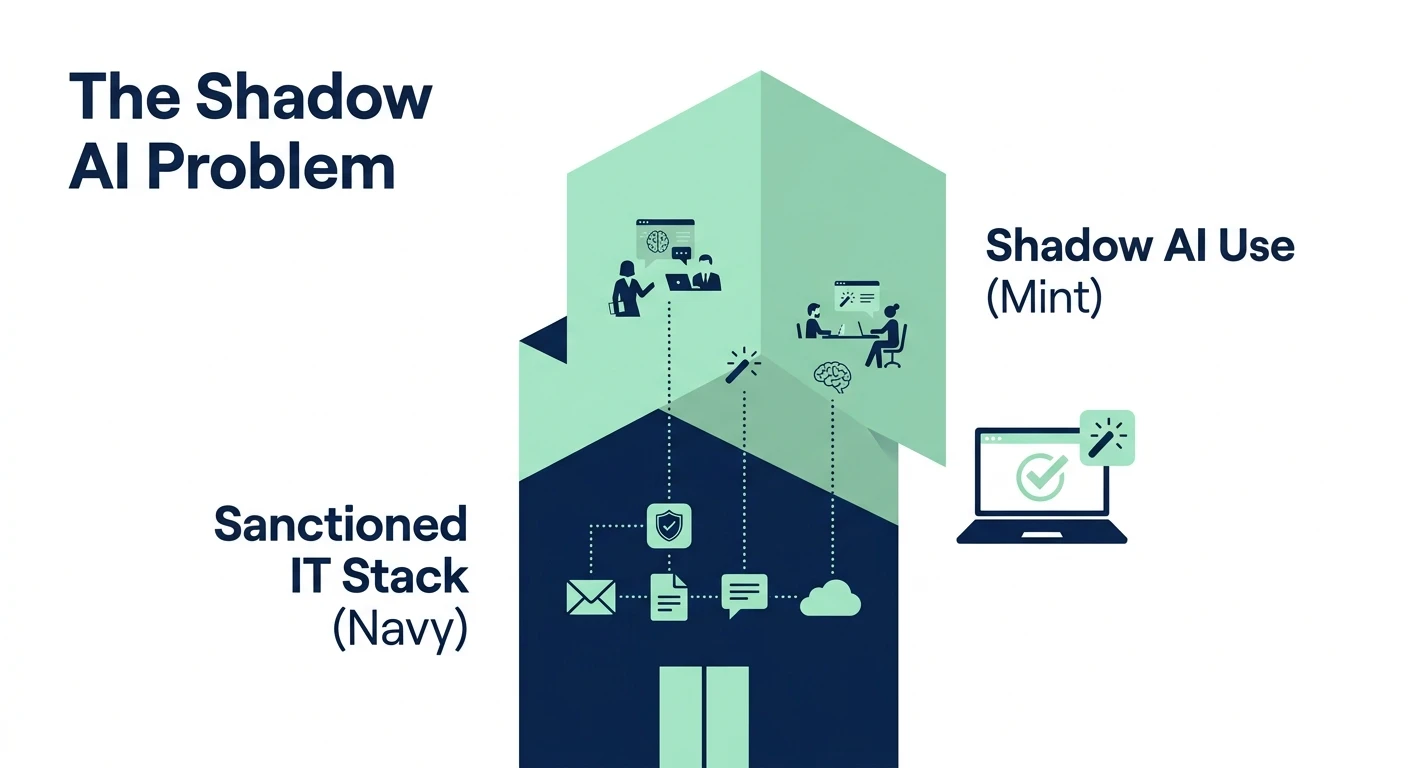
This is the AI statistic that does not get enough attention in the press — and it is one of the most operationally significant numbers in this article.
Approximately 8 in 10 office workers are now using public AI tools without the explicit knowledge or approval of their IT departments.
That alone is alarming enough from a data security perspective. But here is what makes it genuinely complicated:
70% of employee AI interactions happen through features embedded inside existing, sanctioned SaaS applications — tools that IT has already approved, already monitors, and already considers part of the managed stack.
This means the visibility problem is worse than most organizations realize. It is not just employees going to ChatGPT on their personal laptops. It is employees using the AI summarization feature in their approved project management tool, or the AI writing assistant in their approved email client, in ways that IT has no real insight into.
The result is both a security exposure (sensitive data going into AI systems without clear data governance) and a budget inefficiency problem — organizations are paying for AI features embedded in tools they have already bought, often without any tracking of whether those features are delivering value.
This is creating a new category of SaaS management tooling specifically designed to address AI visibility — and it is one of the fastest-growing segments in the SaaS management space heading into 2027.
What AI Is Doing to SaaS Workflows
Beyond the adoption statistics, the data on what AI is actually changing operationally paints a clear picture:
30% of traditional SaaS workflows will be replaced by AI-driven automation by 2027 — this is Gartner’s projection and it is already visible in early-adopter companies
81% of organizations have already automated at least one business process using SaaS applications
72% of IT specialists say zero-touch SaaS automation will be deployed in the future
96% of businesses are already working on automation SaaS applications in some form
By the end of 2026, more than 80% of companies are expected to have deployed AI-enabled apps in their IT environments — up from just 5% in 2023
That last number is the one that really captures the pace of change. From 5% to 80%+ in three years. That is not gradual adoption — that is a step change in how enterprises use software.
AI Pricing and Bundling Trends
How SaaS vendors are packaging and pricing AI is one of the most commercially important questions in the market right now.
The trend is clear: SaaS vendors are increasingly bundling AI functionality into core plans rather than offering it as a separate paid add-on. This has two effects. It raises average contract values — customers pay more for plans that now include AI features they may or may not use. And it makes competitive differentiation harder for vendors whose AI features are not meaningfully better than what is bundled into the standard plan.
For buyers, bundled AI means renewal prices are going up across the board even for customers who are not actively using AI features. This is a significant contributor to the 79% of IT leaders who faced price increases at SaaS renewal in the past 12 months.
The counter-trend is usage-based AI pricing — where customers pay for AI based on consumption rather than a flat fee. This model is growing particularly in infrastructure-adjacent SaaS where compute costs are directly tied to AI usage. By 2027, Gartner expects 70% of top SaaS vendors to offer some form of consumption pricing — and the AI compute cost question is the primary reason that timeline has accelerated.
What to Watch in the Next 12 Months
Based on the data trends above, here are the AI-in-SaaS developments most likely to matter for SaaS businesses and buyers through the rest of 2026 and into 2027.
The monetization gap will widen. Right now 41% of SaaS companies are formally monetizing AI. The other 59% are giving it away in their base plans or have not built enough AI value to charge for it yet. As AI becomes table stakes — expected rather than differentiated — the window to charge a premium for it will narrow. Companies that figure out AI pricing in 2026 will have a meaningful advantage by 2028.
Agentic AI will move from pilot to production. With 33% of large enterprises already deployed and 48% planning to deploy within 12 months, agentic AI will cross the majority threshold in enterprise adoption in 2026 or early 2027. SaaS products that do not have an agentic AI story will increasingly be asked about it in sales conversations.
AI governance will become a buying criterion. As shadow AI becomes a board-level concern, enterprise buyers will increasingly evaluate SaaS vendors on how transparent and controllable their embedded AI features are. Vendors with clear AI usage logging, data governance controls, and explainability will have a sales advantage in regulated industries.
Vertical AI SaaS will outperform horizontal. General-purpose AI features are rapidly becoming commoditized — every major SaaS platform is adding them. The next wave of AI value in SaaS will come from domain-specific models trained on industry data — healthcare AI that understands clinical workflows, legal AI that understands contract structures, financial AI that understands regulatory requirements.
Conclusion
The AI statistics for SaaS in 2026 tell a consistent story: adoption is faster than expected, spending is real and growing, and the gap between companies that have figured out AI monetization and those that have not is already widening.
The two numbers that capture this moment best are these. 41% of SaaS companies are formally monetizing AI today — meaning a meaningful chunk of the market has already crossed from experimentation to revenue. And 80% of companies will have AI-enabled apps deployed by the end of 2026, up from 5% just three years ago.
The window for SaaS businesses to differentiate on AI is not closing — but it is narrowing. The companies treating AI as a strategic product and pricing decision rather than a feature announcement are the ones positioned to capture the value that the $775 billion AI SaaS market represents by 2031.
We will keep this article updated as new data comes in through the rest of 2026.
FAQs
Recent data shows that over 70% of SaaS companies have integrated AI capabilities into their products or internal workflows. This number has grown dramatically in just the past two to three years, reflecting how quickly AI adoption is accelerating across the software industry.
The AI in SaaS market is projected to grow at a compound annual growth rate (CAGR) of over 20% through 2030, with some estimates placing the market value well above $1 trillion. This rapid expansion is being driven by increasing demand for automation, personalization, and predictive analytics.
Yes, SaaS companies that implement AI-driven features such as predictive churn analysis and personalized onboarding report retention improvements of up to 35%. AI helps identify at-risk customers earlier and enables more targeted engagement strategies.
SaaS companies are prioritizing AI investment because it directly impacts key business metrics like user engagement, operational efficiency, and revenue growth. Competitive pressure also plays a major role, as companies that delay AI adoption risk falling behind rivals who are using it to automate support, improve pricing, and accelerate product development.
Absolutely — AI tools like large language model APIs, no-code automation platforms, and AI-powered analytics dashboards have significantly lowered the barrier to entry for smaller companies. Many startups are now building AI-first products from day one, allowing them to compete with established players without needing large engineering teams.
Comments
Be the first to leave a comment.