

The SaaS world is living through a strange contradiction. Companies are cutting staff in record numbers while pouring record sums into AI. Software firms are posting healthy revenue and laying people off in the same quarter. Analysts have a name for it now: the AI employment paradox.
This article pulls together the hard numbers behind that shift, combining layoff data from trackers like Layoffs.fyi and Crunchbase with AI exposure research from Anthropic and employment data from Stanford. Every figure is tied to a primary source. If you run a SaaS team, sell into one, or work in one, these are the statistics worth understanding before the next planning cycle.
Key Statistics at a Glance
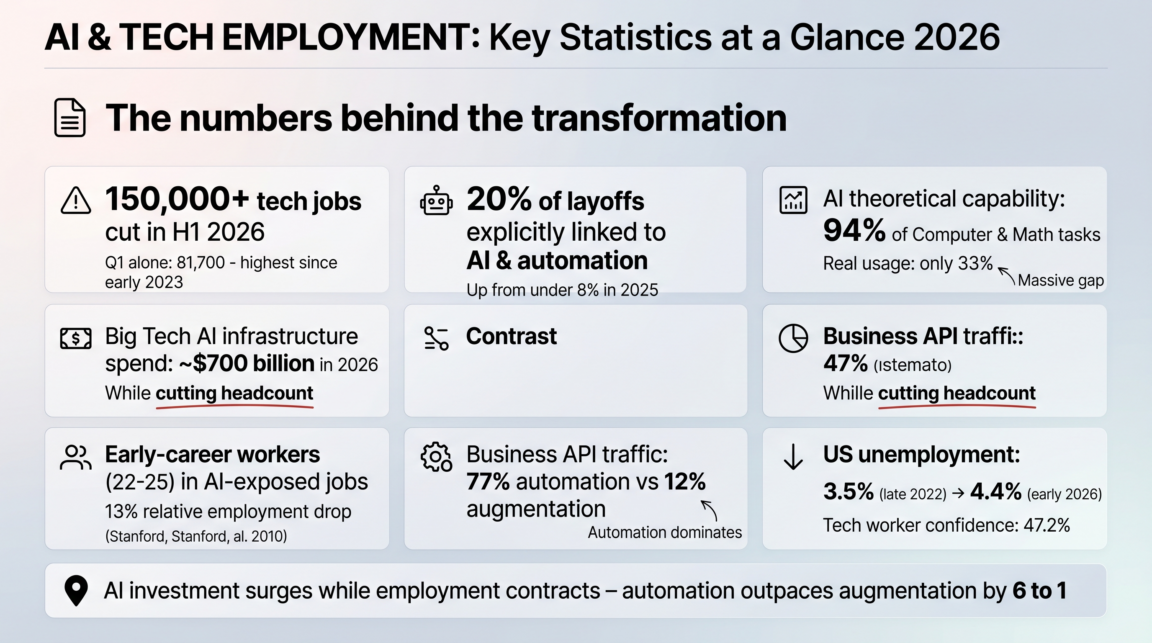
More than 150,000 tech jobs were cut in the first half of 2026, with Q1 alone seeing about 81,700, the highest quarterly figure since early 2023.
Roughly 20% of confirmed tech layoffs in early 2026 were explicitly linked to AI and automation, up from under 8% in 2025.
AI could theoretically handle 94% of Computer and Math tasks, yet real usage covers only 33%.
Big tech is on track to spend close to $700 billion on AI infrastructure in 2026 while cutting headcount.
Early-career workers aged 22 to 25 in the most AI-exposed jobs saw a 13% relative drop in employment, per Stanford.
On business API traffic, 77% of AI usage is automation versus just 12% augmentation.
US unemployment ticked up from 3.5% in late 2022 to 4.4% by early 2026, and tech worker confidence fell to 47.2%.
Where the Numbers Come From
These statistics blend two kinds of evidence. The first is layoff tracking. Layoffs.fyi, run by founder Roger Lee since 2020, and Crunchbase News both maintain running tallies of tech job cuts sourced from company announcements, SEC filings, and news reports. Statista compiles quarterly figures from the same data.
The second is usage and employment research. Anthropic’s March 2026 report, “Labor Market Impacts of AI,” measures how much of each job AI actually does using real Claude data. The Anthropic Economic Index tracks usage patterns over time. Stanford’s “Canaries in the Coal Mine,” by Erik Brynjolfsson and colleagues, analyzes ADP payroll records to see whether AI exposure is moving employment.
A quick caveat. Layoff trackers use different methods and scopes, so totals vary between them. The figures here are attributed to their source and treated as estimates, not precise counts.
The 2026 Layoff Wave
After easing in 2024 and 2025, tech layoffs came roaring back in 2026. Layoffs.fyi data compiled by Statista shows about 81,700 tech job cuts in the first quarter alone, the highest quarterly total since early 2023, with another 20,000 in the first six weeks of Q2. By mid-2026, various trackers put the running total above 150,000 across more than 500 companies.
That is a sharp reversal. The same data shows 2025 was relatively contained at roughly 27,000 to 37,000 cuts per quarter, and 2024 cuts steadily declined through the year. Crunchbase tallied around 127,000 US tech layoffs in 2025, while Layoffs.fyi counted about 122,000 across 257 companies, down from roughly 153,000 across 551 companies in 2024. Since 2020, total tech layoffs are approaching 900,000.
Year | Approximate Tech Layoffs | Notes |
2024 | About 153,000 | Across 551 companies, declining through the year |
2025 | About 122,000 to 127,000 | A relative easing, 257 companies |
2026 (H1) | 150,000-plus | Q1 alone about 81,700, sharp resurgence |
The companies doing the cutting read like a SaaS and enterprise tech roll call. Oracle cut at least 10,000 roles in April 2026, around 6% of its workforce, with reports the total could reach 30,000. ServiceNow trimmed sales and consulting roles. Amazon cut around 30,000 corporate and tech jobs starting in late 2025. Meta announced about 8,000 cuts, near 10% of staff. Microsoft, Cisco, and LinkedIn all joined in. The notable part is that many cut while reporting solid earnings.
The AI Employment Paradox
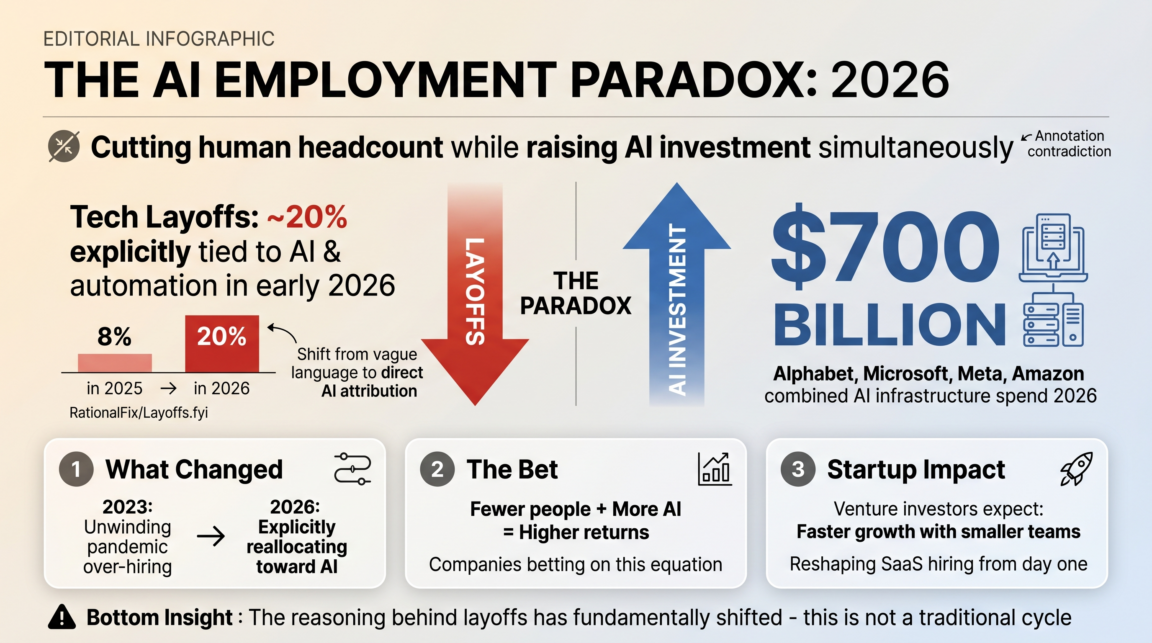
What makes 2026 different from past layoff cycles is the reason behind it. In 2023, companies were unwinding pandemic over-hiring. In 2026, they are explicitly reallocating toward AI.
The clearest sign is in how layoffs are described. A RationalFX analysis of Layoffs.fyi data found that roughly 20% of confirmed tech layoffs in early 2026 were explicitly tied to AI and automation by the companies themselves, up from fewer than 8% of announcements in 2025. The shift from vague language to direct AI attribution is itself a data point.
Meanwhile the spending only grows. Alphabet, Microsoft, Meta, and Amazon are together expected to spend close to $700 billion on AI infrastructure in 2026. So you get the paradox: firms cutting human headcount and raising AI investment at the same time, betting that fewer people plus more AI produces higher returns. In the startup world, venture investors increasingly expect companies to grow faster with smaller teams, which reshapes how SaaS startups hire from day one.
The Theoretical vs Real-World Gap
It is worth grounding the layoff panic in what AI can actually do at work, because the gap is large. Anthropic found that in Computer and Math occupations, AI could theoretically perform 94% of tasks, but observed usage covers only 33%. Office and Administrative work shows theoretical capability near 90% with real adoption well behind.
This matters for SaaS because coding is the heaviest AI use case by far, yet it still sits around a third of tasks at the occupation level. The lesson is that capability and deployment are not the same thing. AI can do far more than it is currently doing, which means much of the 2026 cutting is a bet on the future curve, not on what AI fully handles today.
How SaaS Teams Actually Use AI
Anthropic splits AI usage into augmentation, where AI helps a person, and automation, where AI completes the task alone. This split is the single most useful lens for SaaS leaders.
On consumer apps the balance is roughly even, with augmentation slightly ahead at around 52% versus 45% in recent data. But in business API traffic, the kind that powers SaaS products and internal automation, the picture flips hard: 77% of usage is automation against just 12% augmentation, and 97% of tasks lean automation-dominant on the API versus 47% on the consumer side. The share of hands-off directive use also rose from 27% in late 2024 to 39% in a later sample. Since businesses automate far more than individuals, the enterprise side is where labor effects are most likely to show first.
Usage Mode | Consumer (Claude.ai) | Business (API) |
Automation-leaning tasks | 47% | 97% |
Overall automation share | About 45% | 77% |
Overall augmentation share | About 52% | 12% |
Which Roles Are Most Exposed
At the occupation level, the most exposed jobs are squarely in the SaaS wheelhouse. Computer Programmers top Anthropic’s list at 75% task coverage, Customer Service Representatives follow as their work moves into API traffic, and Data Entry Keyers sit at 67%. These are exactly the functions, engineering, support, and operations, that fill a typical software company.
By broad category, theoretical exposure is highest in Computer and Math and Business and Finance, both above 94%, then Management at 91% and Office and Administrative at 90%. The least exposed work is physical and hands-on. Grounds Maintenance is lowest at 3.9%, with transportation, construction, and food service near the bottom. And 30% of US workers show zero observed AI coverage at all.
Is AI Really Causing the Layoffs?
This is where caution matters. Despite the headlines, the direct evidence linking AI to mass job loss is still thin. Anthropic found no systematic rise in unemployment for highly exposed workers since late 2022. Many 2026 cuts are framed around AI but are also about cost discipline and budget reallocation.
The exception is entry-level work. Stanford found that early-career workers aged 22 to 25 in the most AI-exposed jobs saw a 13% relative drop in employment, even after controlling for company-level shocks, with declines concentrated in roles where AI automates rather than assists. Anthropic’s own data echoes this faintly, with a roughly 14% fall in young-worker hiring into exposed jobs and no effect for older workers. A 2026 Motion Recruitment study likewise found AI slowing hiring for entry-level and general IT roles while demand for AI engineers stays hot and most tech salaries hold flat.
The broader mood reflects the unease. US unemployment rose from 3.5% in late 2022 to 4.4% by early 2026, and Glassdoor’s tech sector confidence index fell 6.8 percentage points year over year to 47.2%, the steepest drop of any industry.
Conclusion
For SaaS, the 2026 data tells a two-part story. On the surface, the layoff wave is real and accelerating, with over 150,000 tech jobs cut in the first half of the year and AI named as a driver far more openly than before. Underneath, the technology is not yet doing most of the work it theoretically could, covering only about a third of tasks even in its strongest category. The cuts are running ahead of the capability.
That gap is the key insight. Much of the current restructuring is a strategic bet that AI will close the distance between what it can do and what it does, not a response to AI already replacing whole teams. The clearest real signal is at the entry level, where hiring has measurably slowed in automation-heavy roles. For SaaS founders, that means rethinking how junior talent is hired and trained. For operators, it means knowing which of your tasks sit on the automation side of the line versus the augmentation side. The companies that thrive will be the ones that treat AI as leverage for their people rather than a simple swap for them, because the data does not yet support the swap.
FAQs
More than 150,000 tech jobs were cut in the first half of 2026 across over 500 companies, with roughly 81,700 eliminated in Q1 alone. That makes it the highest quarterly layoff figure since early 2023.
About 20% of confirmed early-2026 tech layoffs were explicitly linked to AI and automation, up from under 8% in 2025. Many additional cuts reflect budget shifts toward AI infrastructure rather than AI directly replacing those specific workers.
This is known as the AI employment paradox, where companies bet that fewer employees combined with more AI will generate higher returns. In 2026, big tech is projected to spend close to $700 billion on AI infrastructure even while reducing overall headcount.
Yes, the evidence strongly points to younger workers being most affected. Stanford research found a 13% relative employment drop for workers aged 22 to 25 in the most AI-exposed roles, while Anthropic data showed hiring of young workers into those roles fell about 14%, with older workers showing no clear effect.
Computer Programmers and Data Entry Keyers are among the most exposed roles, with AI capable of covering approximately 75% and 67% of their tasks respectively. Engineering, customer service, and data entry functions broadly sit at the highest risk across most software companies.
Comments
Be the first to leave a comment.