
The Security Layer That AI Products Are Missing
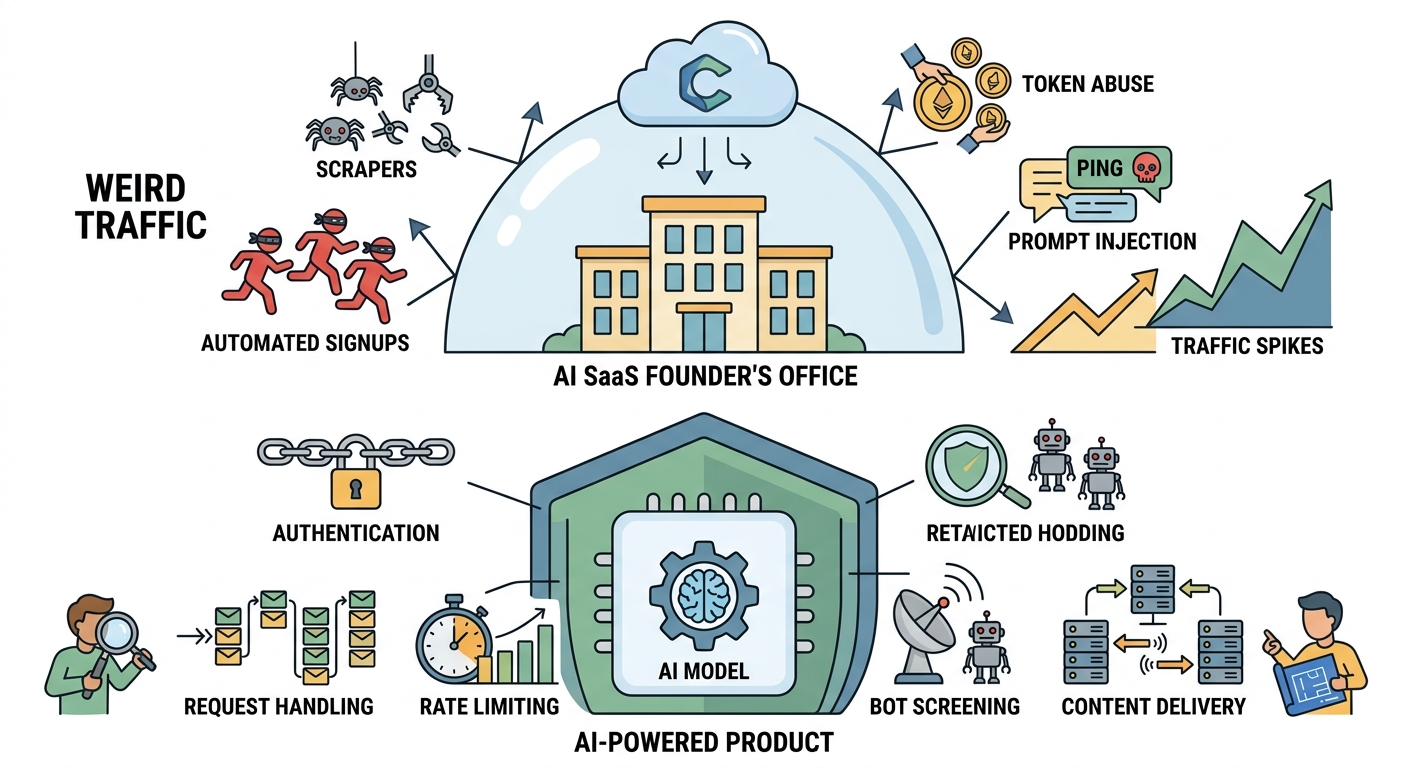
One of the most relevant 2026 signals is Cloudflare’s visible push into securing AI apps. AI products attract weird traffic patterns — scrapers, automated testing, token abuse, prompt injection attempts, fake signups, and traffic spikes from demos or product launches.
A public webinar announced by Cloudflare on securing public-facing AI apps shows the company is treating this as a commercial and technical priority.
Every SaaS founder who has shipped an AI-powered product in 2026 has encountered some version of this problem. Your API endpoint gets hammered by scrapers.
Your free trial gets abused by automated signups. Your token credits get drained by users running automated workflows that violate your terms. The weak spot is almost never the AI model itself — it is the layer around it.
Founders building AI wrappers, copilots, search tools, or customer-facing agents should pay attention. The weak spot is often not the model itself. It is the layer around it, which includes authentication, request handling, rate limiting, bot screening, and content delivery.
The Practical Security Stack for AI SaaS in 2026
Cloudflare’s Zero Trust push is directly relevant to SaaS teams that have grown beyond the early stage and are dealing with real abuse patterns. The principle — every request or user has to earn access, not just be inside the network — fits modern AI SaaS architecture more naturally than legacy perimeter security models, because AI SaaS products typically have no meaningful network perimeter to protect in the traditional sense.
Zero Trust, in this context, means every request or user has to earn access. You do not trust someone just because they are inside the network. That model fits modern startup work much better than old office-based assumptions.
The web in 2026 is full of machine visitors. Some are useful. Some are predatory. Some copy your content, overload your server, or probe your product for weaknesses.
For SaaS founders the actionable framework is straightforward: implement rate limiting by user and by API key at the Cloudflare layer before requests reach your application.
Add bot detection that distinguishes between legitimate AI agent traffic — which is growing rapidly in 2026 — and malicious automated traffic.
Build token usage monitoring that flags anomalous consumption patterns before they drain your compute budget.
The AI Bot Management Opportunity
The Cloudflare push into AI bot management is simultaneously a security product development story and a new SaaS infrastructure category being defined.
The fight over who gets to extract value from online content through automated means is one of the defining commercial disputes of the AI era — and Cloudflare is positioning itself as the infrastructure layer that decides how that fight plays out.
💬 Reddit — r/SaaS and r/webdev on Cloudflare AI app security: 🔗https://www.reddit.com/r/SaaS/search/?q=Cloudflare+AI+app+security+bot+abuse+2026
🐦 X/Twitter — founders discussing Cloudflare Zero Trust for AI products: 🔗https://x.com/search?q=Cloudflare+AI+SaaS+security+Zero+Trust+2026&f=live
💬 Quora — how to protect an AI SaaS product from bot abuse in 2026: 🔗https://www.quora.com/search?q=protect+AI+SaaS+product+bot+abuse+Cloudflare+2026
Quick Links:
Comments
Be the first to leave a comment.