
Harvey, the AI startup focused on legal and professional services, has been on a tear in 2026.
After raising $200 million at an $11 billion valuation in March 2026, Harvey announced in June that it is developing its own custom legal-specific AI models rather than relying solely on foundation models from OpenAI or Anthropic.
That project is now showing results, and August updates confirm the first versions of these custom models are being tested with partner law firms.
Why Legal AI Needs Its Own Models
General-purpose AI models are impressive, but legal work has very specific demands. Contracts, case law, regulatory filings, and litigation documents require deep domain understanding, precise language, and a very low tolerance for hallucination.
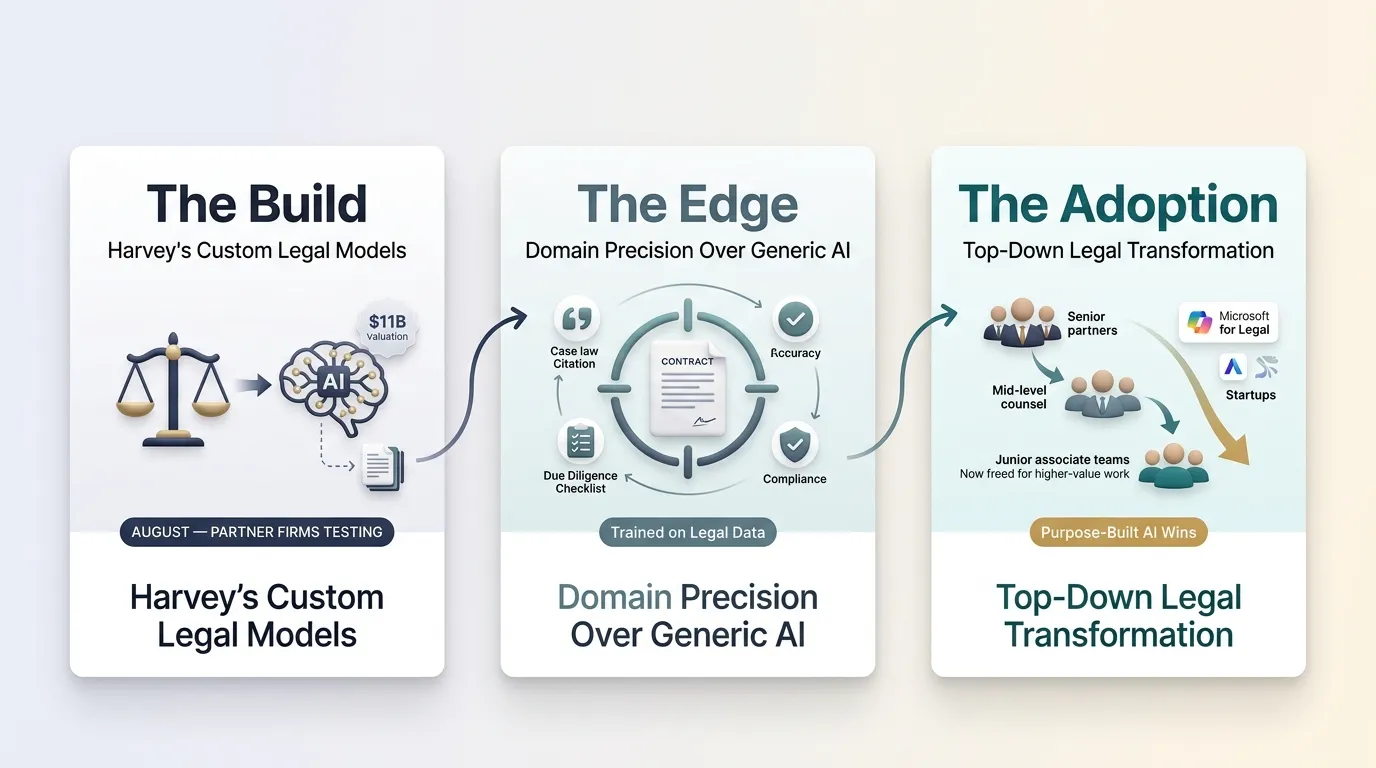
Harvey’s custom models are trained specifically on legal data, with heavy emphasis on accuracy over creativity. The models are designed to handle contract analysis, due diligence, compliance review, and litigation support with a level of precision that generic models struggle to match consistently.
Law firms using Harvey’s platform are reporting meaningful time savings on document-heavy tasks that previously required large junior associate teams.
The Legal AI Race Is Accelerating
Harvey is not alone in this space. Several other startups are competing for the legal AI market, and big players like Microsoft, through its Copilot for Legal product, are also pushing hard into this vertical.
But Harvey’s head start, its $11 billion valuation, and its decision to build proprietary models give it a strong moat. The legal industry is worth hundreds of billions of dollars globally and has historically been slow to adopt technology. AI is changing that faster than anyone expected.
Harvey’s trajectory through 2026 is being watched as a bellwether for how fast professional services industries will be transformed by purpose-built AI tools. The legal AI market is one of the few where the ROI case is so clear that adoption is happening from the top of the profession down rather than being resisted.
Quick Links:
Comments
Be the first to leave a comment.