

Social media has become part of daily life. Billions of people now use these platforms every single day. But exactly how many people use social media in 2026?
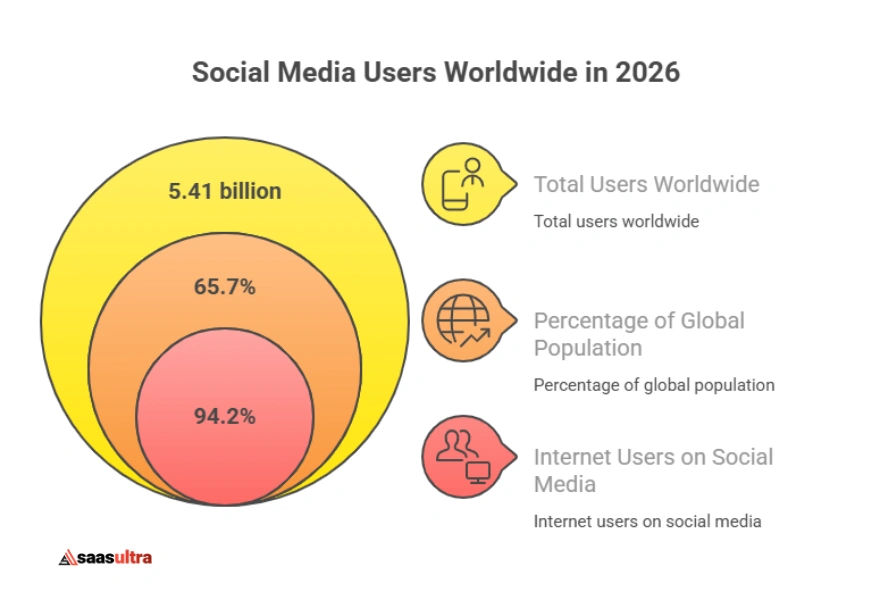
The answer might surprise you. Over 5.41 billion people actively use social media worldwide. This represents 65.7% of the entire global population. That means nearly two out of every three people on Earth have a social media account.
These numbers keep growing. In the past year alone, 241 million new users joined social media platforms. That equals about 8.2 new users every single second. Or 492 new users every minute. Or 29,520 new users every hour.
Quick Facts: Social Media Users in 2026
Before we dive deep, here are the essential numbers:
- Total Users Worldwide: 5.41 billion people
- Percentage of Global Population: 65.7%
- Internet Users on Social Media: 94.2% (9 out of 10)
- Year-Over-Year Growth: 4.1% (241 million new users)
- Average Time Spent Daily: 2 hours and 21 minutes
- Average Platforms Per User: 6.8 different platforms monthly
- Gender Split: 54.6% male, 45.4% female globally
The Complete Picture: Global Social Media Usage
Social media has reached every corner of the world. Today, 63 out of every 100 people use at least one social media platform. This makes social media a global phenomenon unlike anything in human history.
Internet Users vs. Social Media Users
Here is something fascinating. Among people who have internet access, 94.2% use social media. This means almost everyone online also uses social media. Only 6 out of 100 internet users do not have social media accounts.
The global internet population stands at 5.66 billion people. Out of these, 5.41 billion are active social media users. This penetration rate shows how essential social media has become to modern internet usage.
Adults and Social Media
Among adults aged 18 and older, more than four out of five people (80%+) use social media. This high adoption rate spans across age groups, professions, and geographic locations.
Also read about: Best Times to Post on Social Media: Facebook, Twitter, Instagram
Top Social Media Platforms by Users in 2026
Different platforms attract different numbers of users. Here is the complete breakdown of the biggest social media networks worldwide:
| Platform | Monthly Active Users | Global Rank | Primary Use |
| 3.07 billion | #1 | Social networking, groups | |
| YouTube | 2.9 billion | #2 | Video sharing, streaming |
| 2.8 billion | #3 | Messaging, calls | |
| 2.3 billion | #4 | Photos, Reels, shopping | |
| TikTok | 1.6 billion | #5 | Short videos, entertainment |
| 1.3 billion | #6 | Messaging (China-focused) | |
| Telegram | 950 million | #7 | Private messaging |
| Snapchat | 750 million | #8 | Ephemeral messaging |
| X (Twitter) | 660 million | #9 | News, discussions |
| 518 million | #10 | Visual discovery, shopping | |
| 500 million+ | #11 | Forums, communities | |
| 450 million+ | #12 | Professional networking | |
| Discord | 400 million | #13 | Communities, gaming |
| Quora | 400 million | #14 | Q&A, knowledge sharing |
Platform Leaders Explained
Facebook remains the undisputed king of social media. With over 3.07 billion monthly users, it has maintained its #1 position for over a decade. Nearly 40% of all social media users have a Facebook account.
YouTube comes in second with 2.9 billion users. People spend an average of 27 hours and 43 minutes on YouTube every month. This makes it the second most-used platform by time spent.
WhatsApp dominates the messaging space with 2.8 billion users. In many countries, WhatsApp has become the primary way people communicate. It has the highest daily open rate at 83.6% – meaning most users check WhatsApp every single day.
Instagram reached 2.3 billion users, driven by Reels and shopping features. The platform is especially popular with users aged 18-34.
TikTok has become the fastest-growing platform. It surpassed 1.6 billion users and continues to expand rapidly. Users spend over 55 minutes daily on TikTok on average.
Also read about: 25 Best Social Media Management Tools to Schedule Your Content
How Many People Use Social Media By Country
Social media adoption varies dramatically by country. Some nations have near-universal usage, while others lag behind.
Top Countries by Total Users
| Country | Social Media Users | Population Penetration | Rank |
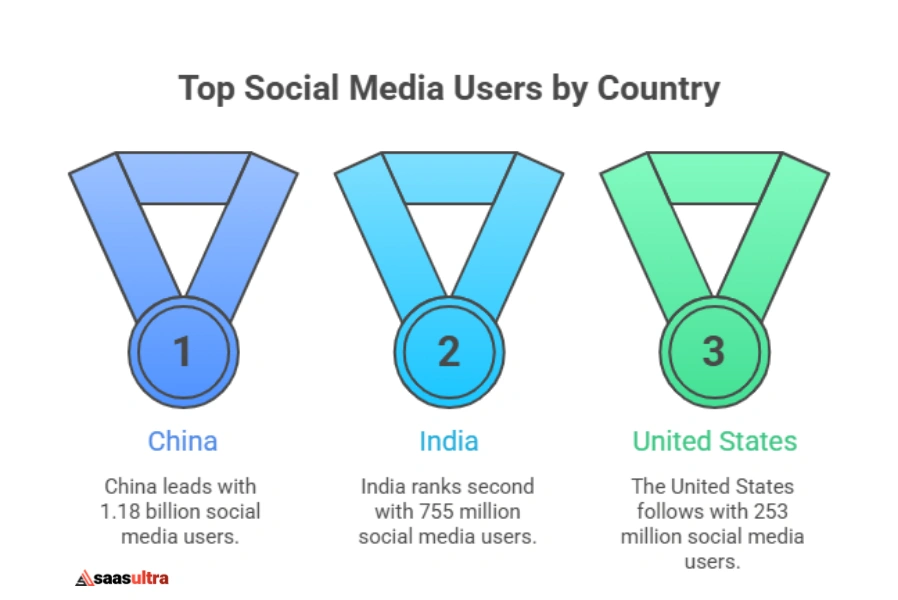
| China | 1.18 billion | 83.4% | #1 |
| India | 755 million | 53.5% | #2 |
| United States | 253 million | 73.0% | #3 |
| Indonesia | 185 million | 66.8% | #4 |
| Brazil | 152 million | 70.9% | #5 |
| Russia | 106 million | 73.4% | #6 |
| Mexico | 98 million | 75.2% | #7 |
| Japan | 97 million | 77.2% | #8 |
| Philippines | 89 million | 80.7% | #9 |
| Vietnam | 76 million | 77.8% | #10 |
Countries With Highest Penetration Rates
Some smaller countries have penetration rates exceeding 100%. This happens because many people use multiple accounts.
Highest Penetration Rates:
- United Arab Emirates: 102%+
- Saudi Arabia: 102%+
- South Korea: 95.8%
- Qatar: 99.7%
- Kuwait: 99.1%
- Bahrain: 98.4%
Regional Distribution
Social media usage is not evenly distributed across the world. Here is how users break down by region:
Users by Region:
- Asia: 60% of global users (3.24 billion people)
- Europe: 12% of global users (648 million people)
- Africa: 11.5% of global users (621 million people)
- South America: 8.6% of global users (465 million people)
- North America: 6.5% of global users (351 million people)
- Oceania: 1.4% of global users (76 million people)
Asia dominates because of massive populations in China, India, and Southeast Asia. Southern Asia alone contributes 16.5% of the world’s social media users.
How Much Time Do People Spend on Social Media?
Time spent on social media reveals how integrated these platforms have become in daily life.
Global Average: 2 Hours 21 Minutes Daily
The average person spends 2 hours and 21 minutes on social media every single day. This equals about 141 minutes daily. Over a year, this adds up to approximately 35 days and 15 hours.
Time Spent By Country
Different countries show wildly different usage patterns:
Countries With Most Daily Usage:
- Kenya: 4+ hours per day
- Philippines: 3 hours 53 minutes
- Brazil: 3 hours 41 minutes
- South Africa: 3 hours 33 minutes
- Colombia: 3 hours 28 minutes
Countries With Least Daily Usage:
- Japan: 46 minutes per day
- South Korea: 1 hour 8 minutes
- Germany: 1 hour 22 minutes
- Netherlands: 1 hour 27 minutes
- France: 1 hour 39 minutes
Time By Platform
Users spend different amounts of time on different platforms:
Average Monthly Time Spent:
- TikTok: 31 hours 47 minutes (most time spent)
- YouTube: 27 hours 43 minutes
- Facebook: 19 hours 26 minutes
- Instagram: 11 hours 20 minutes
- X (Twitter): 5 hours 8 minutes
TikTok leads because its short-form video format keeps users scrolling for hours. YouTube’s long-form content also generates significant watch time.
Social Media Demographics: Who Uses What?
Understanding who uses social media helps businesses and marketers reach the right audiences.
Age Distribution
Social media appeals to different age groups:
Users by Age Group:
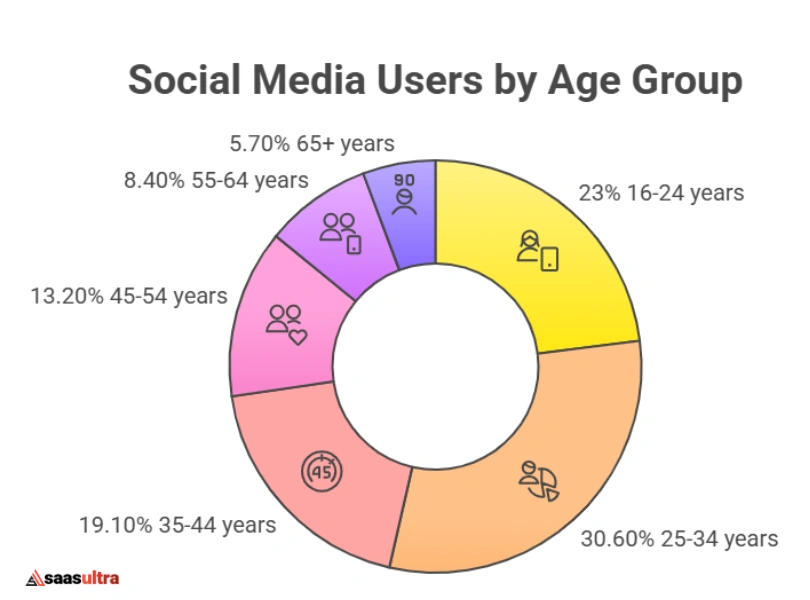
- 16-24 years: 23% of users (youngest, most active)
- 25-34 years: 30.6% of users (largest segment)
- 35-44 years: 19.1% of users
- 45-54 years: 13.2% of users
- 55-64 years: 8.4% of users
- 65+ years: 5.7% of users (smallest but growing)
The 25-34 age bracket dominates social media. These users are often professionals, parents, and heavy consumers. The 16-24 bracket shows the highest engagement rates, spending 3+ hours daily on platforms.
Gender Split
Globally, social media has more male users than female users:
Global Gender Distribution:
- Male users: 54.6%
- Female users: 45.4%
However, this varies significantly by region:
Gender Split by Region:
- North America: 50% female / 50% male (perfectly balanced)
- South America: 52% female / 48% male
- Western Europe: 50% female / 50% male
- Southern Asia: 34% female / 66% male (biggest gap)
- Southeast Asia: 49% female / 51% male
- Oceania: 50% female / 50% male
Southern Asia shows the largest gender gap. This reflects lower internet access for women in countries like India, Pakistan, and Bangladesh.
Gender Split by Platform
Different platforms attract different gender balances:
Female-Majority Platforms:
- Pinterest: 76% female users
- Instagram: 51% female users
- TikTok: 57% female users
Male-Majority Platforms:
- Reddit: 63% male users
- LinkedIn: 57% male users
- X (Twitter): 60% male users
- YouTube: 54% male users
How People Use Social Media (Purpose & Activities)
People use social media for many different reasons. Understanding these purposes helps explain the platform’s massive growth.
Top Reasons People Use Social Media
Primary Uses (2026 Data):
- Keeping in touch with friends/family: 48.2% of users
- Watching videos/entertainment: 43.7% of users
- Reading news and current events: 36.4% of users
- Finding content (memes, videos): 35.1% of users
- Filling spare time: 34.6% of users
- Following brands/products: 29.8% of users
- Researching products to buy: 27.3% of users
- Professional networking: 21.5% of users
- Following influencers: 19.2% of users
- Business/marketing purposes: 16.7% of users
Shopping and Commerce
Social media has become a major shopping channel. 27.3% of users actively research products on social platforms before buying.
Social Commerce Stats:
- 80% of e-commerce journeys start on social media
- 43% of users have bought something directly through social media
- Instagram and TikTok lead in social shopping
- Live shopping streams generate billions in sales
Content Consumption Patterns
Video content dominates social media in 2026:
Content Engagement Rates:
- Short-form video: 5.3% average engagement
- Long-form video: 4.1% average engagement
- Images with text: 1.9% average engagement
- Images alone: 1.6% average engagement
- Text-only posts: 0.6% average engagement
TikTok and Instagram Reels lead engagement rates at 5.3% because of their video-first approach.
Multi-Platform Usage: How Many Apps Do People Use?
Most social media users do not stick to just one platform. They spread their time across multiple apps.
Average: 6.8 Platforms Per User
The typical social media user engages with 6.8 different platforms each month. This means people have accounts on nearly 7 different social networks and use them regularly.
Platform Usage by Age:
- Ages 16-24: 7.5 platforms on average
- Ages 25-34: 7.1 platforms on average
- Ages 35-44: 6.5 platforms on average
- Ages 45-54: 5.9 platforms on average
- Ages 55-64: 5.2 platforms on average
- Ages 65+: 4.1 platforms on average
Younger users spread their attention across more platforms. Older users focus on fewer, more familiar networks.
Daily App Opening Rates
Some apps get opened more frequently than others:
Daily Open Rates (Percentage of Users Who Check Daily):
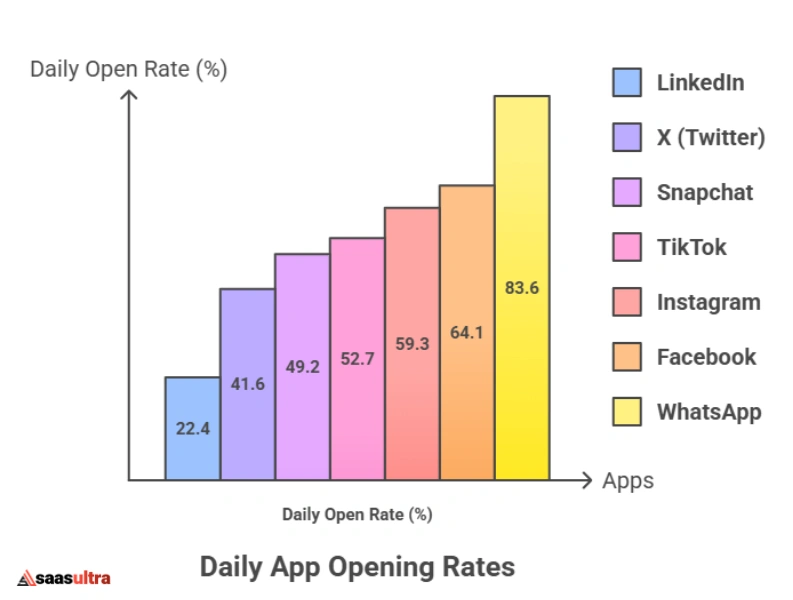
- WhatsApp: 83.6% (highest)
- Facebook: 64.1%
- Instagram: 59.3%
- TikTok: 52.7%
- Snapchat: 49.2%
- X (Twitter): 41.6%
- LinkedIn: 22.4%
WhatsApp’s messaging function makes it essential for daily communication. Social platforms like Facebook and Instagram follow closely.
Social Media Growth Trends (Historical Data)
Social media has grown exponentially over the past decade. Looking at historical data shows just how dramatic this growth has been.
Year-by-Year Growth
| Year | Total Users | Global Penetration | Year-Over-Year Growth |
| 2015 | 2.07 billion | 28.8% | – |
| 2016 | 2.31 billion | 31.7% | 11.0% |
| 2017 | 2.76 billion | 37.2% | 19.5% |
| 2018 | 3.20 billion | 42.3% | 15.9% |
| 2019 | 3.48 billion | 45.6% | 8.8% |
| 2020 | 3.96 billion | 51.2% | 13.8% |
| 2021 | 4.20 billion | 53.6% | 6.1% |
| 2022 | 4.59 billion | 58.0% | 9.3% |
| 2023 | 4.88 billion | 60.8% | 6.3% |
| 2024 | 5.04 billion | 62.3% | 3.3% |
| 2025 | 5.24 billion | 64.5% | 4.0% |
| 2026 | 5.41 billion | 65.7% | 3.2% |
Growth Is Slowing But Still Strong
Notice that growth rates have decreased from the 15-20% seen in 2017-2018. Growth now hovers around 3-4% annually. This slowdown happens because social media has already reached most internet users worldwide.
Future growth depends on:
- Increasing internet access in developing regions
- Smartphone adoption in Africa and parts of Asia
- New platforms attracting younger users
- Older demographics joining existing platforms
Mobile vs. Desktop Usage
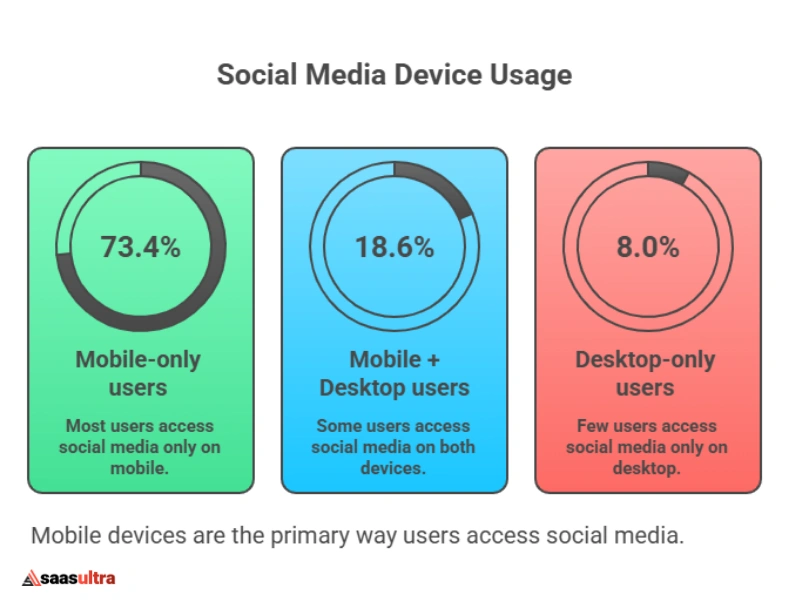
Social media is overwhelmingly a mobile-first experience in 2026.
Mobile Dominates: 92% of Users
92% of all social media users access platforms via mobile devices. This includes smartphones and tablets. Only 8% of users access social media exclusively on desktop computers.
Device Breakdown:
- Mobile-only users: 73.4%
- Mobile + Desktop users: 18.6%
- Desktop-only users: 8.0%
Mobile-first design has become essential. Platforms optimize for smaller screens, vertical video, and touch interfaces.
Mobile Internet Access
Smartphones have made internet access affordable in developing countries. This drives social media growth in regions like Africa, South Asia, and Southeast Asia.
Smartphone Penetration:
- Global smartphone users: 6.9 billion
- Percentage with social media: 78.4%
- Average phones per person: 1.2 devices
Many users in developing nations skip computers entirely. They access the internet exclusively through smartphones.
Insights From Reddit and Quora Users (2026)
Real users on discussion platforms share interesting perspectives on social media usage.
Reddit User Observations
Reddit users (500+ million on the platform) discuss social media trends actively:
Common Themes on Reddit:
- Complaints about fake content and bot accounts
- Mental health concerns (69% of adults report being affected)
- Preference for niche communities over mainstream platforms
- Privacy concerns pushing users toward alternatives
- Rise of “Dead Internet Theory” – belief that most content is AI-generated
Reddit itself has surged to 850+ million monthly active users. Users appreciate Reddit’s forum structure and anonymity over algorithm-driven feeds.
Quora User Discussions
Quora (400 million users) hosts detailed discussions about social media usage:
Key Quora Insights:
- AI-generated content declining quality on major platforms
- Users seeking authentic, expert-driven content
- Shift toward knowledge-sharing platforms
- Concerns about data privacy and tracking
- Growing interest in decentralized social networks
Quora users note that while total numbers grow, engagement quality often declines. Many users maintain accounts but engage less frequently.
Trend: Platform Fatigue
Both Reddit and Quora discussions reveal “social media fatigue”:
User Complaints:
- Too many ads interrupting content
- Algorithm changes reducing organic reach
- Privacy violations and data selling
- Mental health impacts from comparison culture
- Time-wasting and reduced productivity
This drives interest in alternatives like:
- Mastodon: 2 million+ users (decentralized)
- Bluesky: 26 million+ users (Twitter alternative)
- Discord: 400 million+ users (community-focused)
- Telegram: 950 million+ users (privacy-focused)
Social Media Advertising and Business Impact (2026)
Social media is not just for personal use. It has become a massive business ecosystem.
Global Ad Spend: $219 Billion
Companies will spend $219 billion on social media advertising in 2026. This represents nearly one-third of all digital advertising budgets worldwide.
Ad Spend by Platform:
- Facebook + Instagram: 55% of total spend ($120 billion+)
- TikTok: $20 billion+ (35% year-over-year growth)
- YouTube: $18 billion+
- LinkedIn: $8 billion+
- X (Twitter): $5 billion+
- Pinterest: $3 billion+
Business Usage Statistics
How Businesses Use Social Media:
- 43% of marketers use social media as their primary channel
- 72% of consumers discover brands through social media
- 89% of businesses report ROI from social media marketing
- 80% of e-commerce transactions start with social media research
B2B vs. B2C:
- B2C brands focus on Instagram, TikTok, Facebook
- B2B brands prefer LinkedIn, X (Twitter), YouTube
- LinkedIn generates highest B2B conversion rates
- Average cost per click on LinkedIn: $5.26
Influencer Marketing
Influencer marketing has exploded:
Influencer Economy Stats:
- Global influencer marketing spend: $24 billion in 2026
- Average influencer ROI: $5.78 for every $1 spent
- Nano-influencers (1K-10K followers) have highest engagement
- Micro-influencers (10K-100K) deliver best ROI
The Future: What’s Next for Social Media?
Social media will continue evolving. Here are the major trends shaping 2026 and beyond:
Emerging Trends
AI Integration:
- 41% of brands use AI for content creation
- AI chatbots handle customer service on social platforms
- AI-powered content recommendations improve engagement
- Concerns about AI-generated spam increasing
Short-Form Video Dominance:
- TikTok format copied by all major platforms
- Instagram Reels deliver 35% more engagement than posts
- YouTube Shorts competing aggressively
- Attention spans decreasing, favoring < 60 second videos
Social Commerce Growth:
- Live shopping streams becoming mainstream
- In-app purchases reducing friction
- Influencer recommendations driving direct sales
- AR/VR try-before-you-buy features expanding
Privacy and Decentralization:
- Users demanding more data control
- Decentralized platforms gaining traction
- End-to-end encryption becoming standard
- Regulations forcing transparency
Niche Communities Over Feeds:
- Users joining smaller, focused communities
- Discord and Reddit-style formats growing
- Algorithm fatigue pushing people toward curated groups
- Quality conversations valued over viral content
FAQs About Social Media Statistics
1. How many people use social media worldwide in 2026?
5.41 billion people use social media globally as of 2026. This represents 65.7% of the world’s total population. The number has grown by 241 million users in the past year, showing that social media continues expanding despite already reaching the majority of people on Earth.
2. What is the most used social media platform in 2026?
Facebook remains the #1 platform with 3.07 billion monthly active users. YouTube comes in second with 2.9 billion users, and WhatsApp ranks third with 2.8 billion users. However, TikTok is the fastest-growing platform and generates the highest engagement rates at 5.3% average per post.
3. How much time does the average person spend on social media daily?
The average person spends 2 hours and 21 minutes (141 minutes) on social media every day in 2026. This varies dramatically by country – Kenyans spend over 4 hours daily, while Japanese users average only 46 minutes. Younger users (ages 16-24) spend significantly more time at 3+ hours per day.
4. Which country has the most social media users?
China has the most users with 1.18 billion social media accounts. India ranks second with 755 million users, and the United States is third with 253 million users. However, the UAE and Saudi Arabia have the highest penetration rates at over 102% (meaning many people have multiple accounts).
5. What percentage of internet users have social media accounts?
94.2% of internet users have at least one social media account. Out of 5.66 billion people with internet access worldwide, 5.41 billion actively use social media platforms. This makes social media nearly universal among people who have internet connectivity.
Conclusion: Social Media Has Become Universal
Social media is no longer optional. It has become an essential part of modern life for billions of people worldwide.
Key Takeaways:
- Over 5.41 billion people use social media (65.7% of Earth’s population)
- Users spend 2+ hours daily across an average of 6.8 platforms
- Mobile devices account for 92% of all social media access
- Facebook, YouTube, and WhatsApp lead with 2.8-3.1 billion users each
- Growth continues at 3-4% annually, adding hundreds of millions of new users
- Social commerce, AI integration, and short-form video dominate trends
Whether you use social media personally, professionally, or both, understanding these statistics helps you make informed decisions. Social media shapes how we connect, learn, shop, work, and entertain ourselves.
The numbers show social media is here to stay. As technology improves and internet access expands, even more people will join these digital communities in the coming years.
Sources: Statista, World Population Review
Comments
Be the first to leave a comment.