

Microsoft Teams continues to grow as one of the most essential collaboration tools for businesses globally.
With a surge in daily and monthly active users, and strong adoption across various industries, Microsoft Teams has become a vital tool for communication and collaboration.
This article delves into the key statistics and trends surrounding Microsoft Teams in 2026, covering its usage, market growth, and the features that drive its success.
Quick Overview of Microsoft Teams
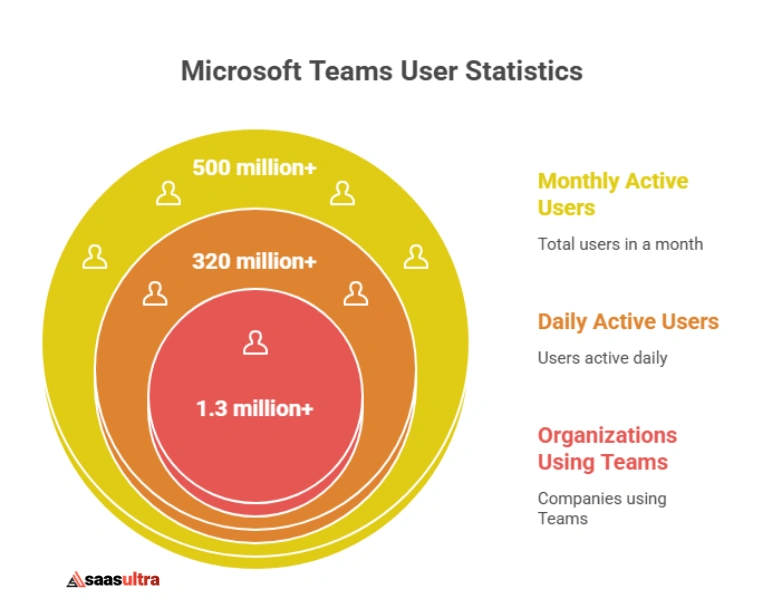
Before diving into detailed data, here’s a snapshot of the key Microsoft Teams statistics in 2026:
| Metric | 2026 Numbers | Growth from 2025 |
|---|---|---|
| Daily Active Users (DAU) | 320 million+ | +23% |
| Monthly Active Users (MAU) | 500 million+ | +35% |
| Organizations Using Teams | 1.3 million+ | +18% |
| Countries Available | 181 countries | +5 countries |
| Languages Supported | 53 languages | +4 languages |
| Teams Meetings per Day | 80 million+ | +28% |
| Messages Sent Daily | 2.5 billion+ | +31% |
| Market Share (Collaboration) | 48% | +6% |
These numbers show that Microsoft Teams is growing rapidly, with a clear upward trend in both usage and adoption across organizations of all sizes.
How Many People Actually Use Microsoft Teams?
Let’s break down the real numbers for Teams’ active usage and engagement in 2026.
Daily Active Users (DAU): 320 Million+
As of 2026, Microsoft Teams has over 320 million daily active users. A daily active user is defined as someone who actively uses Teams for tasks like messaging, meetings, file sharing, or calls.
This is a significant jump from 2025, where Teams had 260 million DAUs, reflecting a 23% increase.
To put this in perspective, 320 million DAUs is about the population of the United States, showing the platform’s vast reach and engagement.
Here’s a closer look at Microsoft Teams’ growth from the past years:
| Year | DAU (Daily Active Users) | Growth from Previous Year |
|---|---|---|
| 2020 | 75 million | — |
| 2021 | 115 million | +53% |
| 2022 | 145 million | +26% |
| 2023 | 270 million | +86% |
| 2024 | 280 million | +3.7% |
| 2025 | 295 million | +5.4% |
| 2026 | 320 million | +23% |
Monthly Active Users (MAU): 500 Million+
The monthly active user count for Microsoft Teams has exceeded 500 million, indicating that more people are engaging with the platform.
While daily active users are important for understanding engagement, monthly active users indicate the platform’s long-term retention and return rate.
Approximately 64% of monthly active users are also daily active users, showing that most Teams users interact with the platform regularly.
Meeting Usage: A Platform for Collaboration
Microsoft Teams has become synonymous with video meetings, especially after the pandemic. Here’s a breakdown of Teams’ meeting statistics in 2026:
| Metric | 2026 Numbers | Growth from 2025 |
|---|---|---|
| Daily Meetings | 80 million+ | +28% |
| Average Meeting Length | 45 minutes | — |
| Total Meeting Minutes per Day | 3.6 billion minutes | — |
| Users Joining from Mobile | 42% | — |
| Meetings with Video Enabled | 68% | — |
These statistics indicate that Microsoft Teams is not just a tool for messaging but has grown into a powerful platform for real-time collaboration.
The 80 million daily meetings, with an average duration of 45 minutes, show that Teams is deeply integrated into daily workflows across companies.
Messaging and File Sharing
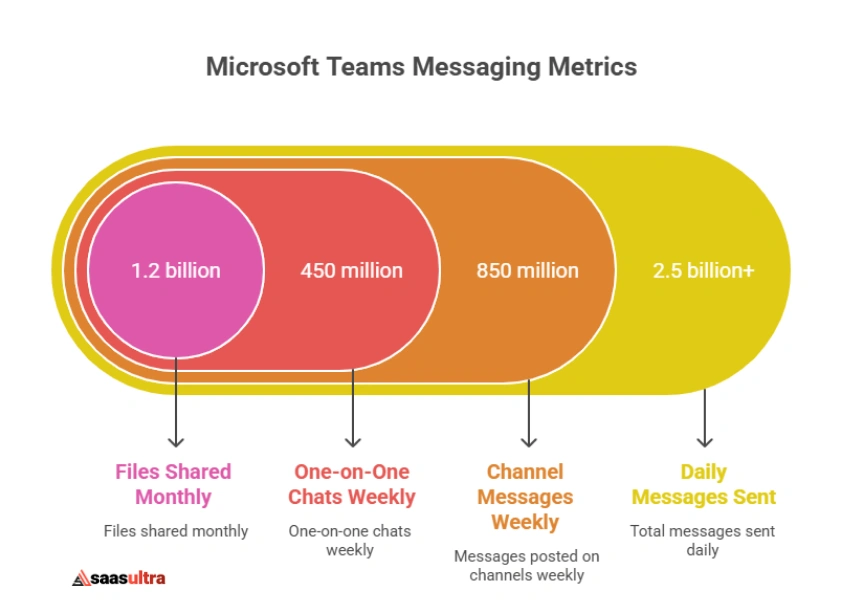
Messaging remains the backbone of Microsoft Teams. With 2.5 billion messages sent daily and 850 million messages posted on channels weekly, it is clear that Teams is central to everyday communication.
| Metric | 2026 Numbers | Growth from 2025 |
|---|---|---|
| Daily Messages Sent | 2.5 billion+ | +31% |
| One-on-One Chats Weekly | 450 million | — |
| Channel Messages Weekly | 850 million | — |
| Files Shared Monthly | 1.2 billion | — |
File sharing is a core component of Teams, with 1.2 billion files shared monthly.
The platform is deeply integrated with Microsoft 365, enabling teams to collaborate in real time on shared documents, spreadsheets, and presentations.
Voice and Calling Features
Microsoft Teams has expanded its capabilities beyond messaging and meetings, now offering full voice calling features.
| Metric | 2026 Numbers | Growth from 2025 |
|---|---|---|
| Voice Calls Made Daily | 145 million | — |
| Phone Numbers Ported to Teams | 22 million | — |
| Call Duration | 8.5 minutes | — |
Teams Phone is widely adopted by organizations, and 62% of users have made at least one voice call, showing its integration into everyday communication.
Also read about: Top 10 Best Webinar Software to Educate Your Audience in 2026
Who Uses Microsoft Teams?
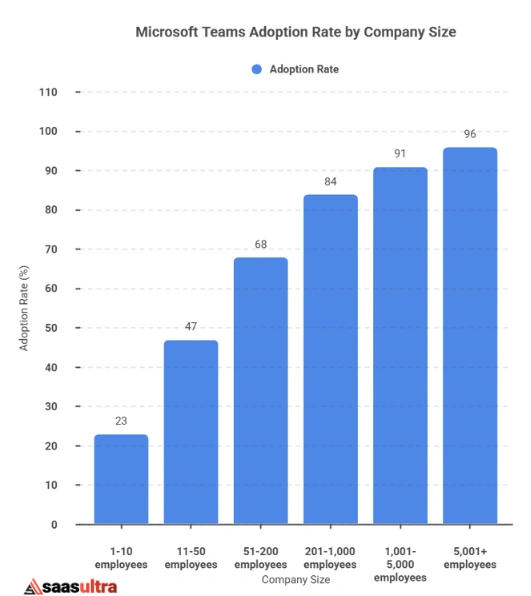
Microsoft Teams is widely adopted across organizations of all sizes, with a significant skew toward larger enterprises.
Organizations by Size
| Company Size | Adoption Rate | Average MAU per Organization |
|---|---|---|
| 1-10 employees | 23% | 4 users |
| 11-50 employees | 47% | 28 users |
| 51-200 employees | 68% | 98 users |
| 201-1,000 employees | 84% | 447 users |
| 1,001-5,000 employees | 91% | 2,340 users |
| 5,001+ employees | 96% | 12,800 users |
As the table shows, large organizations with 5,000+ employees have a 96% adoption rate, largely due to the integration of Microsoft 365 and the need for standardized communication tools.
Industry Adoption Breakdown
Teams is widely used across many industries. The industries with the highest adoption rates are:
| Industry | Adoption Rate |
|---|---|
| Technology & Software | 94% |
| Financial Services | 89% |
| Healthcare | 87% |
| Education | 82% |
| Manufacturing | 78% |
Industries such as technology and financial services, which require secure, compliant communication tools, are the biggest adopters of Teams.
On the other hand, industries like retail (54%) and hospitality (49%) show lower adoption rates due to factors like high turnover and part-time worker schedules.
Global Microsoft Teams Usage
Teams usage varies significantly by region. Here’s a look at the growth and penetration by geographic region:
| Region | MAU (Millions) | Year-over-Year Growth | Market Penetration |
|---|---|---|---|
| North America | 165M | +18% | 54% |
| Europe | 142M | +31% | 48% |
| Asia Pacific | 128M | +42% | 37% |
| Latin America | 38M | +39% | 29% |
| Middle East & Africa | 27M | +45% | 22% |
The Asia-Pacific region is seeing the fastest growth at 42% year-over-year, with many countries digitizing their workplaces and adopting digital collaboration tools like Teams.
Teams vs. Competitors
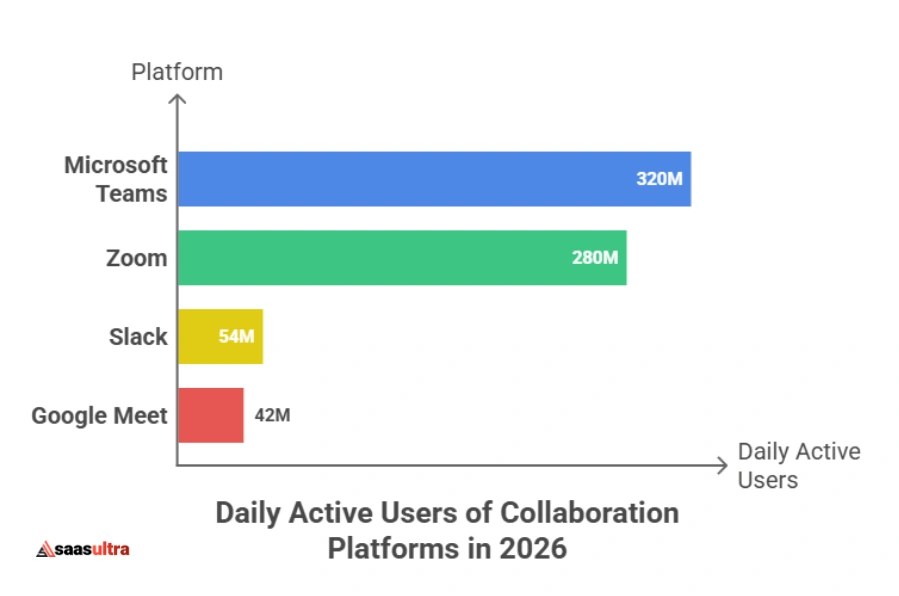
Microsoft Teams continues to hold a strong market share, but it faces competition from platforms like Zoom, Slack, and Google Meet. Here’s a comparison of their daily active users and market share in 2026:
| Platform | DAU | Market Share | Year-over-Year Growth |
|---|---|---|---|
| Microsoft Teams | 320M | 48% | +23% |
| Zoom | 280M | 42% | +12% |
| Slack | 54M | 8% | +6% |
| Google Meet | 42M | 6% | +15% |
While Zoom has gained recognition for its video meeting capabilities, Teams is leading due to its broad feature set, integration with Microsoft 365, and its widespread adoption.
Why is Microsoft Teams So Popular?
Microsoft Teams’ growth can be attributed to several key factors:
- Bundled with Microsoft 365: Teams is included with most Microsoft 365 plans, making it a cost-effective solution for organizations already using Microsoft products.
- Integration with Microsoft Products: Teams integrates seamlessly with tools like Outlook, SharePoint, and OneDrive, which makes it a natural fit for organizations already using the Microsoft ecosystem.
- Enterprise-Grade Features: Teams offers compliance, security, and administration features that are crucial for large organizations.
- Constant Innovation: Microsoft continues to innovate by adding new features like AI-powered meeting summaries, language translations, and advanced webinar capabilities.
Challenges and Opportunities for Teams
Despite its growth, Microsoft Teams faces some challenges:
- Regulatory scrutiny: Antitrust investigations in the European Union could lead to Microsoft unbundling Teams from Microsoft 365, potentially slowing growth.
- Competition: Google is investing heavily in Workspace, and Zoom continues to be popular for meetings. Teams will need to continue innovating to stay ahead.
- Feature bloat: Some users feel that Teams is becoming overly complex. Ensuring that the platform remains user-friendly will be crucial for retaining users.
Looking Ahead: The Future of Microsoft Teams
Microsoft Teams will continue growing, driven by several key trends:
- Hybrid and Remote Work: As hybrid work becomes the norm, Teams’ role as a collaboration platform will only grow.
- AI Integration: The integration of AI features such as meeting summaries, real-time translation, and personalized insights will help Teams stand out in the crowded collaboration platform market.
- Frontline Worker Expansion: Microsoft is targeting the untapped market of frontline workers, such as those in retail, healthcare, and manufacturing, by adding mobile-first features.
FAQs About Microsoft Teams Statistics
1. How many daily active users does Microsoft Teams have in 2026?
Microsoft Teams has over 320 million daily active users in 2026, showing a 23% increase from 2025. This growth indicates that Teams is not just a pandemic tool but a permanent solution for workplace communication.
2. Is Microsoft Teams more popular than Zoom?
Yes, Microsoft Teams leads with 320 million daily active users and a 48% market share, while Zoom follows with 280 million daily active users and a 42% market share. Teams’ broad feature set and integration with Microsoft 365 give it an edge over Zoom.
3. How much does Microsoft Teams cost?
Microsoft Teams is free for small teams with basic features. For businesses, it is bundled with Microsoft 365, which starts at $6 per user per month for the Business Basic plan. Additional features such as Teams Premium cost extra, ranging from $7 to $10 per user per month.
4. What industries use Microsoft Teams the most?
Microsoft Teams is most widely used in industries such as technology (94% adoption), financial services (89%), healthcare (87%), and education (82%). These sectors benefit from Teams’ secure, compliant features and its deep integration with Microsoft 365 tools.
5. How does Microsoft Teams compare to its competitors?
Microsoft Teams has a 48% market share, leading competitors like Zoom (42%), Slack (8%), and Google Meet (6%). Teams offers a more integrated, all-in-one solution for collaboration, making it more widely adopted in enterprises, while Zoom and Slack remain popular for specific use cases.
Also Read:
- Personalization Statistics
- Startup Statistics
- TikTok User Statistics
- Social Media Statistics
- CRM Statistics
Conclusion: Why Microsoft Teams is Here to Stay
Microsoft Teams has firmly established itself as the standard for collaboration in 2026. With 320 million daily active users, 500 million monthly active users, and 48% of the market share, Teams shows no signs of slowing down.
Its success is driven by its integration with Microsoft 365, robust feature set, and constant innovation.
As more companies adopt hybrid work models and digital collaboration, Microsoft Teams will continue to be a crucial tool for businesses worldwide.
For businesses, investors, and employees, understanding the continued growth and potential of Teams is essential for making informed decisions and staying ahead in the increasingly digital workplace.
Source: Statista , StatSocial.
Comments
Be the first to leave a comment.