

Intercom
- AI-powered chat automation
- In-app messaging support
- Proactive user engagement
- Customer data context
- Workflow automation tools
LiveChat
- Real-time chat system
- Customizable chat widgets
- Canned response shortcuts
- Visitor tracking insights
- Multi-channel integrations
Tidio

- AI chatbot Lyro
- Live chat integration
- E-commerce platform support
- Automated workflows setup
- Multi-channel messaging support
Live chat is not just a support channel anymore.
In 2026, it is where leads get qualified, where churning customers get saved, and where first impressions of your brand get formed in real time.
The tool you pick determines whether your team handles 40 conversations a day or 400 — and whether those conversations convert or disappear.
I have tested dozens of live chat tools across different team contexts.
This is the complete guide to what is actually working in 2026.
Why Live Chat Matters More Than Ever in 2026
The usage data makes a clear case:
- 41% of consumers prefer live chat as their first contact method, compared to 32% for phone and 23% for email.
- Live chat generates a 48% increase in revenue per chat hour compared to phone support, according to the American Marketing Association
- Response time under 1 minute increases customer satisfaction by 35%, while response times over 5 minutes drop conversion rates by 40%
- AI-powered chat now handles an estimated 55% to 70% of first-contact resolutions on platforms with mature AI deployment
The question is not whether to use live chat. It is which tool to use and what to configure it to do.
The Three Types of Live Chat Tools in 2026
Before choosing a tool, understand which category you actually need:
1. Standalone Live Chat Tools Purpose-built chat widgets that add real-time chat to your website or app. Simpler to set up, often cheaper, limited in scope.
Best for: small businesses, e-commerce, marketing teams focused on lead capture.
Examples: LiveChat, Tidio, Tawk.to, Chaport
2. Conversational Support Platforms Full-featured platforms where live chat is the centre of a broader support and engagement system. AI, ticketing, email, and chat all in one place.
Best for: SaaS companies, growing support teams.
Examples: Intercom, Front, Crisp
3. Full Help Desk Platforms With Live Chat All-in-one help desk platforms where live chat is one channel among many.
Best for: multi-channel enterprise teams.
Examples: Zendesk, Freshdesk, HubSpot Service Hub
The Top Live Chat Tools in 2026: Full Comparison Table
| Tool | Best For | Starting Price | AI Chatbot | Free Plan | G2 Rating |
| Intercom | SaaS / conversational | $29/seat/mo | ✅ Fin AI (best in class) | ❌ | 4.5/5 |
| LiveChat | Mid-market general | $20/agent/mo | ✅ | ❌ | 4.5/5 |
| Tidio | SMB and e-commerce | $0–$49/mo | ✅ Lyro AI | ✅ | 4.7/5 |
| HubSpot Live Chat | CRM-aligned teams | Free–$15/seat/mo | ✅ | ✅ | 4.4/5 |
| Zendesk Chat | Enterprise / multi-channel | $55/agent/mo (Suite) | ✅ | ❌ | 4.3/5 |
| Freshchat | Budget omnichannel | $0–$29/agent/mo | ✅ Freddy AI | ✅ | 4.3/5 |
| Front | B2B high-touch | $19/seat/mo | ✅ | ❌ | 4.7/5 |
| Crisp | SMB / startup | $0–$95/mo | ✅ | ✅ | 4.5/5 |
| Tawk.to | Free for solo/small | Free | ⚠️ Basic | ✅ | 4.6/5 |
| Gorgias | E-commerce (Shopify) | $10/mo | ✅ | ❌ | 4.6/5 |
Tool-by-Tool Breakdown
1. Intercom — Best for SaaS and In-App Support
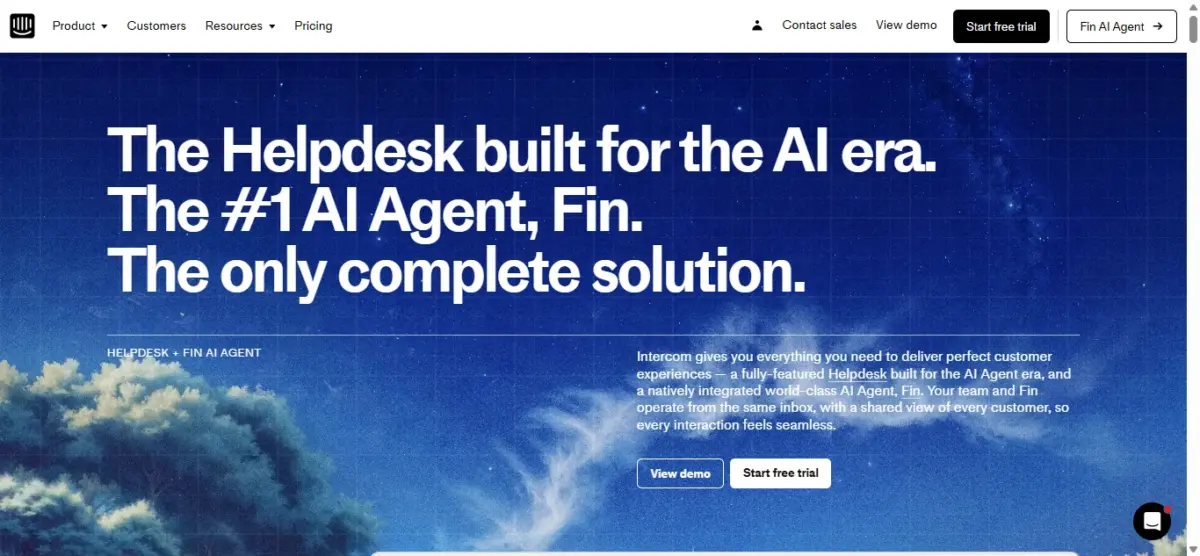
Intercom has evolved from a simple chat widget to one of the most complete customer communication platforms on the market. In 2026, its live chat capability is inseparable from its AI and support infrastructure.
What makes it stand out:
The live chat in Intercom is contextual by default. When a user opens the messenger inside your SaaS product, Intercom already knows their plan, what features they have used, how long they have been a customer, and whether they have submitted tickets before.
Agents do not need to ask for context — they have it before the conversation starts.
Intercom’s Fin AI handles front-line chat conversations with a 67% average resolution rate — the highest in the industry. It can issue refunds, change subscriptions, and handle multi-step workflows without agent involvement.
What it does not do: Intercom’s live chat pricing scales with usage in ways that can surprise teams. No phone support natively. SLA management requires the highest tier.
Best for: SaaS companies where support and product experience overlap. Not ideal for call centre or high-phone-volume environments.
2. LiveChat — Best Dedicated Live Chat Tool
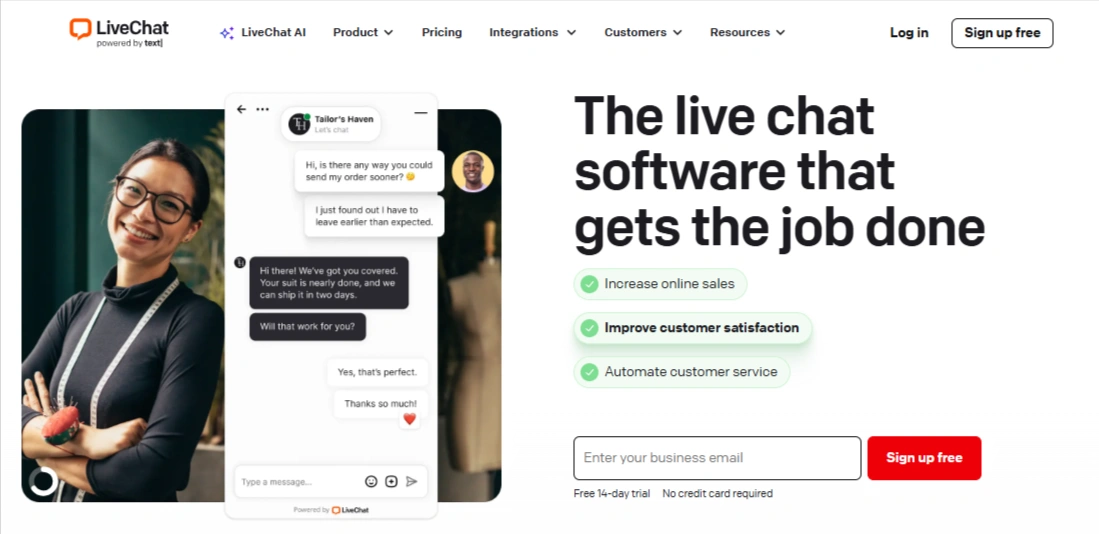
LiveChat is one of the largest live chat solutions on the market. Their history dates back to 2002 and today 37,000 customers use their product.
It is extremely powerful, with features that include omnichannel integration with tools like Facebook Messenger, rich and interactive messages, and a chatbot builder.
LiveChat includes real-time chat, customisable chat widgets, mobile-friendly design, canned responses for common questions, proactive chat invitations, file sharing, typing previews, and queue management to handle multiple inquiries efficiently.
Advanced features include AI chatbots for repetitive tasks, multilingual support for global users, and rich messaging with videos, GIFs, and interactive elements.
LiveChat connects with over 200 tools including WhatsApp, Mailchimp, Salesforce, and Shopify.
Pricing: Starter $20/agent/month, Team $41/agent/month, Business $59/agent/month.
Best for: Mid-market businesses that want a dedicated, full-featured chat tool with clean UX and strong integrations.
3. Tidio — Best for SMB and E-commerce
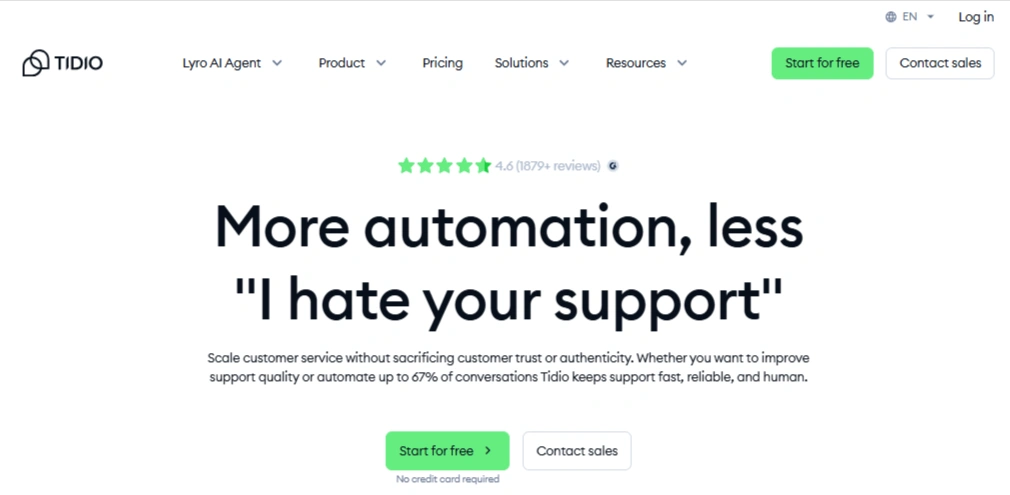
Tidio is an all-in-one customer support software suite comprising a help desk, live chat, chatbot automation, and AI agent features. Over 300,000 businesses across e-commerce, services, and other sectors use it.
Tidio’s Lyro AI chatbot handles first-tier questions effectively. The setup takes hours, not weeks, and the integration with Shopify and WordPress is seamless.
Pricing: Free plan available. Starter $29/month, Growth $59/month, Tidio+ from $749/month.
Best for: E-commerce brands, small service businesses, and bootstrapped SaaS companies that need live chat working fast with minimal complexity.
4. HubSpot Live Chat — Best for CRM-Integrated Teams
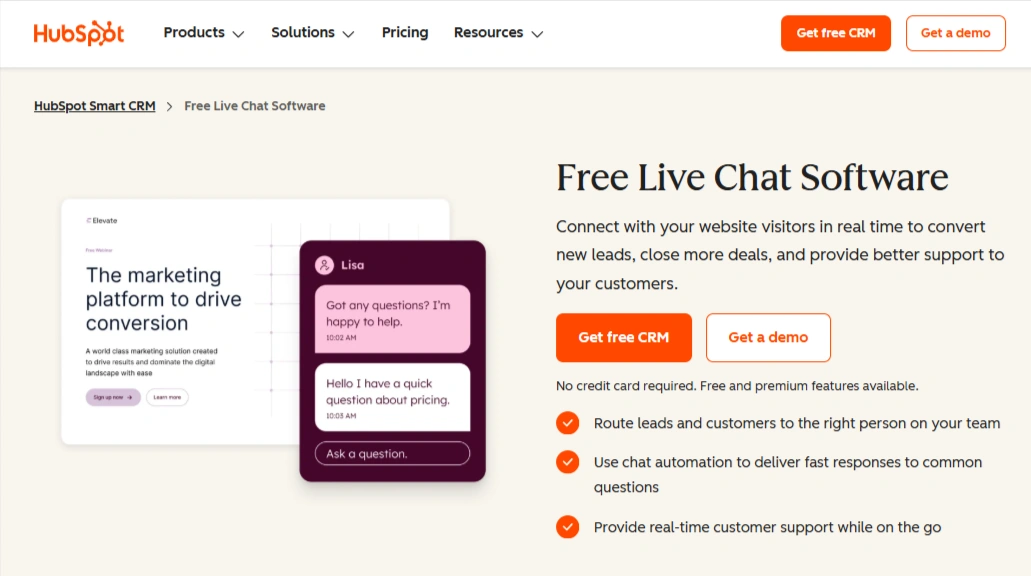
HubSpot’s live chat software is particularly strong at connecting with visitors across platforms like WhatsApp and Slack.
The integration with HubSpot CRM and AI-driven chatbots is invaluable for lead qualification, meeting scheduling, and answering frequently asked questions.
If you already use HubSpot CRM, adding live chat through Service Hub is the most natural decision.
Every conversation automatically creates a contact record, logs the interaction history, and feeds into the customer health score. This context makes every future conversation smarter.
Pricing: Free plan available (unlimited seats, basic chat). Starter $15/seat/month. Professional $90/seat/month.
Best for: Marketing and sales-led companies already in the HubSpot ecosystem.
5. Zendesk Chat (via Suite) — Best for Multi-Channel Enterprise
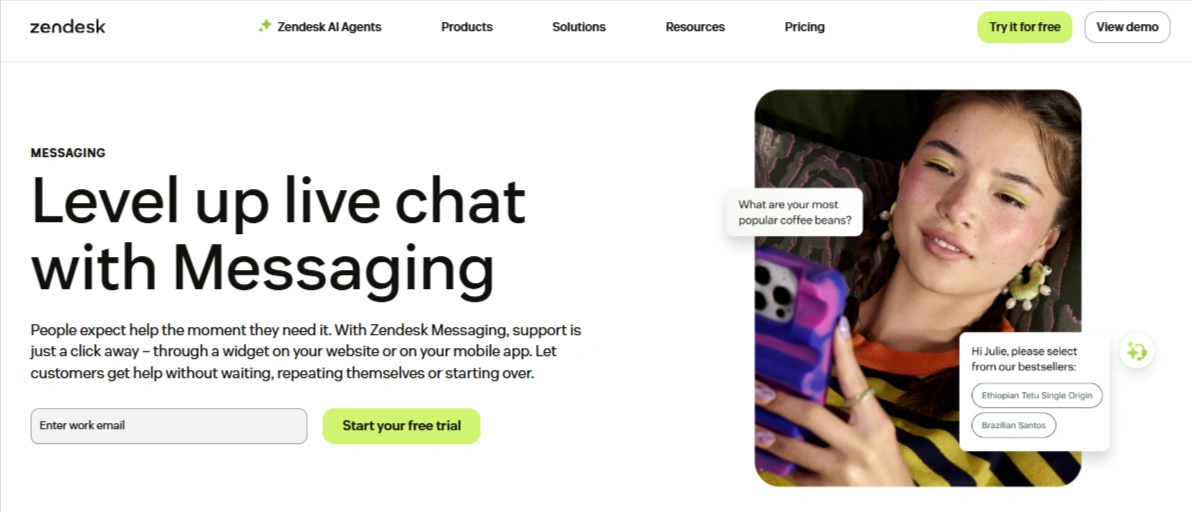
Zendesk leverages conversational AI and GenAI to automate and expedite the support process.
During live chat conversations, agents access omnichannel interaction histories, review existing customer data and bot-collected form responses, and collaborate with other agents to provide the best possible support.
Zendesk’s chat is not a standalone product — it is part of the Suite. For teams that need unified ticketing, phone, email, and chat all in one structured workspace, Zendesk Suite handles live chat well.
The trade-off is that the live chat UI itself is less modern and fluid than Intercom or LiveChat.
Best for: Enterprise teams already on Zendesk Suite that need chat as part of a broader multi-channel workflow.
Also Read about: Zendesk Review
6. Freshchat — Best Budget Omnichannel Chat
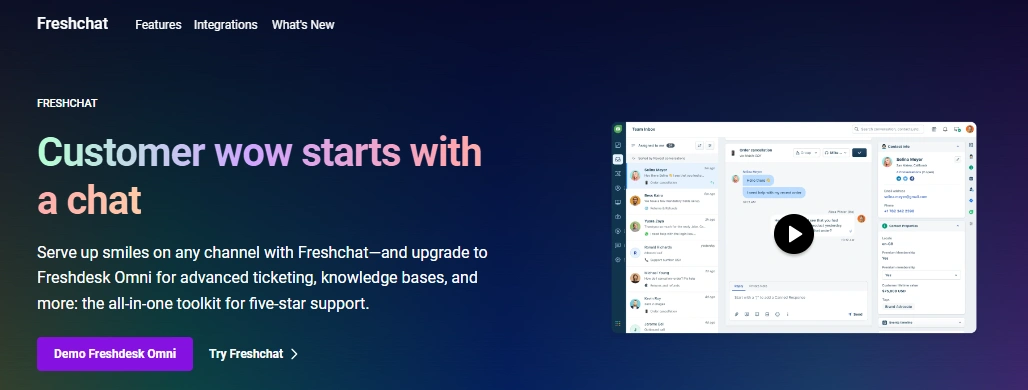
Freshchat is Freshworks’ dedicated messaging product, available as a standalone or as part of Freshdesk Omni. It handles web chat, WhatsApp, Facebook Messenger, Instagram, and email from a unified inbox.
Freddy AI handles common queries with 30% to 40% autonomous resolution. The free plan supports up to 10 agents with unlimited chat — a genuinely useful entry point for small teams.
Pricing: Free (up to 10 agents), Growth $19/agent/month, Pro $49/agent/month.
Best for: Budget-conscious teams that need omnichannel chat without paying Intercom or Zendesk prices.
Also read about: Freshdesk Review
7. Front — Best for B2B High-Touch Chat
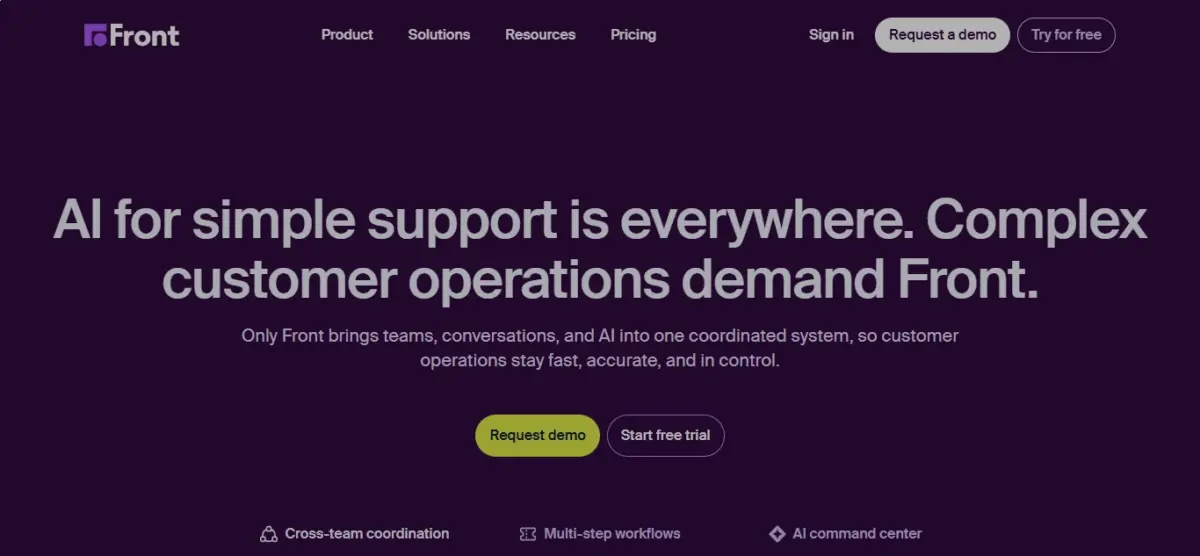
Front is a top choice for live chat because of its shared inbox feature, which allows your team to manage customer inquiries from multiple channels in one place — emails, SMS, and live chat messages without switching between different platforms.
Front’s AI agents handle routine inquiries while analytics tools provide insights into team performance. The platform is built for relationship-driven support where every customer matters individually.
Best for: B2B companies where support blends into account management and every conversation is with a high-value client.
8. Crisp — Best for Startups and Budget SaaS
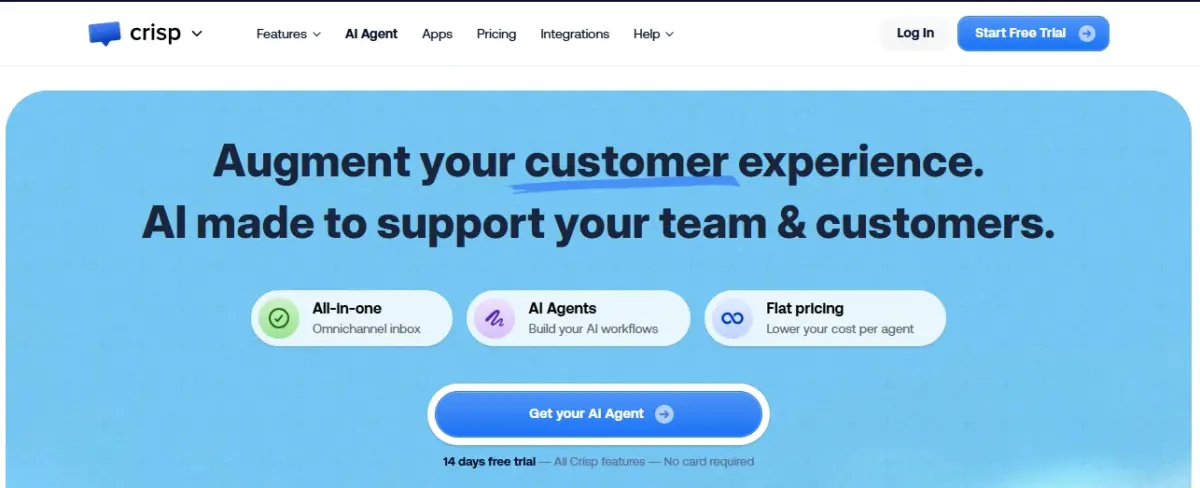
Crisp is a messaging-first platform that gives early-stage companies a genuinely capable live chat setup for free. The free plan supports 2 agents with unlimited chats. Paid plans start at $25/month per workspace.
The co-browsing feature (being able to see what a customer sees in real time) is available at lower price points than most competitors and is genuinely useful for SaaS onboarding support.
Best for: Startups under 10 agents that want feature-rich chat without enterprise pricing.
9. Tawk.to — Best Free Option
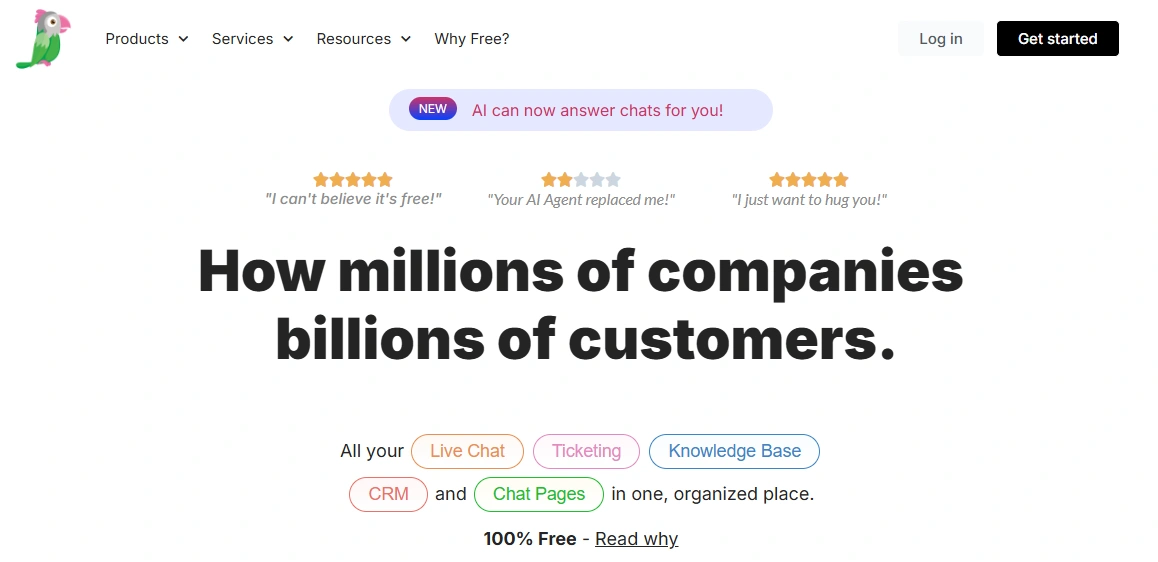
Tawk.to is completely free. No per-agent fee. No conversation limits. Revenue comes from optional paid add-ons and agent services.
The trade-off: less AI capability than paid alternatives, and the feature ceiling is lower. But for a solo founder or a 2-person team that needs live chat on their website today, Tawk.to is impossible to beat on value.
Pricing: Free. Optional remove-branding at $19/month. Hired agent service available.
Best for: Solopreneurs, bootstrapped startups, and small teams with minimal budget.
Live Chat for Sales Teams vs Support Teams
The tool that works for sales and the tool that works for support are often different.
For sales-focused live chat (lead capture, qualification, demo booking):
- HubSpot Live Chat is the strongest choice if you are in the HubSpot ecosystem
- Intercom’s outbound messaging and proactive triggers are excellent for pipeline generation
- LiveChat with its product card feature (showing products and prices inside the chat) is strong for e-commerce sales
For support-focused live chat (ticket deflection, resolution, customer service):
- Intercom Fin AI for SaaS teams prioritising autonomous resolution
- Freshchat for budget-conscious support teams
- Zendesk Suite for multi-channel enterprise teams
For both (sales and support from one tool):
- Intercom is the strongest unified platform for companies where support and sales overlap
- Front for B2B teams where every conversation is both a support and a relationship interaction
The AI Chat Layer: What Has Changed in 2026
In-app support, onboarding guidance, account-based routing, and tight CRM integration separate strong platforms from generic chat widgets. SaaS customers expect contextual help tied to their product usage, not disconnected FAQ bots.
The most important shift in live chat AI in 2026 is the move from reactive to proactive. Old chatbots waited for a question and looked up an answer. Modern AI agents proactively identify at-risk users, trigger outreach, and take actions inside systems without waiting to be asked.
Intercom’s Fin with Procedures, Zendesk’s AI agent with action capabilities, and Freshchat’s Freddy AI Agent are all moving in this direction. The gap between platforms is closing on basic resolution capability but widening on proactive action capability.
Key Features to Evaluate Before Choosing
Based on running live chat setups for multiple SaaS teams, these are the features that actually matter in practice:
- Proactive chat triggers — Can you start conversations based on user behaviour (time on page, scroll depth, exit intent, plan type)?
- AI resolution rate — What % of conversations does the AI actually resolve vs just respond to?
- Context depth — Does the chat window show agent context about who the user is before they type a word?
- Routing logic — Can you route chats to specific agents based on skill, language, or account tier?
- Mobile experience — Is the chat widget genuinely functional on mobile? (65%+ of support interactions now happen on mobile)
- Integration depth — Does it sync with your CRM, your ticketing system, and your product database?
Which Live Chat Tool to Pick: A Quick Decision Guide
| Your Situation | Best Tool |
| SaaS, in-app support needed, AI matters | Intercom |
| E-commerce on Shopify | Tidio or Gorgias |
| Already on HubSpot | HubSpot Live Chat |
| Budget is tight, need omnichannel chat | Freshchat |
| B2B with high-value clients | Front |
| Enterprise multi-channel | Zendesk Suite |
| Pure standalone chat tool | LiveChat |
| Zero budget, need something today | Tawk.to |
| Startup with minimal setup time | Crisp |
Key Takeaways
- 41% of consumers prefer live chat as their first contact method in 2026 — more than phone or email
- Intercom Fin AI leads on autonomous resolution rate (67%) and is the strongest choice for SaaS in-app chat
- LiveChat is the best dedicated standalone chat tool for general business use
- Tidio is the best SMB and e-commerce choice; Gorgias wins for Shopify-specific brands
- Tawk.to offers a fully functional free live chat solution — the only genuinely free option at scale
- Proactive triggers, AI resolution rate, and context depth are the three features that most separate strong live chat platforms from average ones
Frequently Asked Questions
1. What is the best live chat software for a small business in 2026?
Tidio is the strongest choice for small businesses — it has a functional free plan, Lyro AI handles common questions automatically, and the setup takes hours. For small SaaS companies, Freshchat’s free plan (up to 10 agents) is also strong.
2. Does live chat actually improve conversions?
Yes. Research consistently shows that businesses adding live chat see 20% to 40% improvements in conversion rates from website visitors. The mechanism is simple: immediate answers to purchase-blocking questions remove hesitation.
3. Is AI live chat good enough to replace human agents?
For Tier 1 queries (password resets, billing questions, how-to questions, tracking updates), AI resolution is mature and cost-effective. For complex technical issues, emotionally sensitive situations, and high-value enterprise relationships, human escalation remains essential.
4. What is the difference between live chat and a chatbot?
Live chat involves a real human agent responding in real time. A chatbot is an automated system using rules or AI to respond without human involvement. Modern platforms blend both — AI handles the first interaction and escalates to a human when it cannot resolve the issue.
5. Which live chat tool is completely free?
Tawk.to is completely free with no per-agent fees and no conversation limits. HubSpot Live Chat and Freshchat both offer meaningful free plans. Tidio’s free plan supports basic chat for smaller operations.
Also Read:
Conclusion
In 2026, live chat is no longer just a support tool—it is a critical part of sales, customer experience, and retention.
Platforms like Intercom, Zendesk, and Freshchat show that the real difference lies in how well they combine AI, context, and proactive engagement.
The best choice depends on your business model. SaaS teams benefit from AI-first conversational tools, e-commerce brands need fast and simple chat setups, and enterprise teams require structured, multi-channel systems.
Focus on real needs—AI resolution, context, and automation—not just pricing, and you will pick a tool that actually drives results.
Comments
Be the first to leave a comment.