

Artificial intelligence in marketing is no longer a competitive advantage — it is the baseline. In 2026, 91% of marketers actively use AI in their workflows, 93% of CMOs report measurable ROI from generative AI, and the global AI marketing market has surpassed $47 billion. The conversation has shifted entirely from “should we adopt AI?” to “how do we implement it better than our competitors?”
What makes 2026 different from previous years is the depth of integration. AI is no longer confined to chatbots and basic automation. It now powers audience segmentation, predictive analytics, dynamic content creation, real-time personalisation, send-time optimisation, creative testing, and even strategic decision-making. The marketers who understand these numbers will allocate budgets more effectively, adopt the right tools faster, and outperform competitors who are still experimenting.
This guide compiles 60+ verified statistics from Statista, Gartner, Salesforce, and other authoritative sources to give you the most comprehensive, data-driven picture of AI in marketing as it stands right now.
AI Marketing Market Size and Growth: The Numbers Behind the Revolution
The first thing to grasp about AI in marketing in 2026 is the sheer scale of investment flowing into this space. This is not a niche technology being tested by early adopters. It is a multi-hundred-billion-dollar infrastructure layer that now underpins virtually every marketing function across every industry.
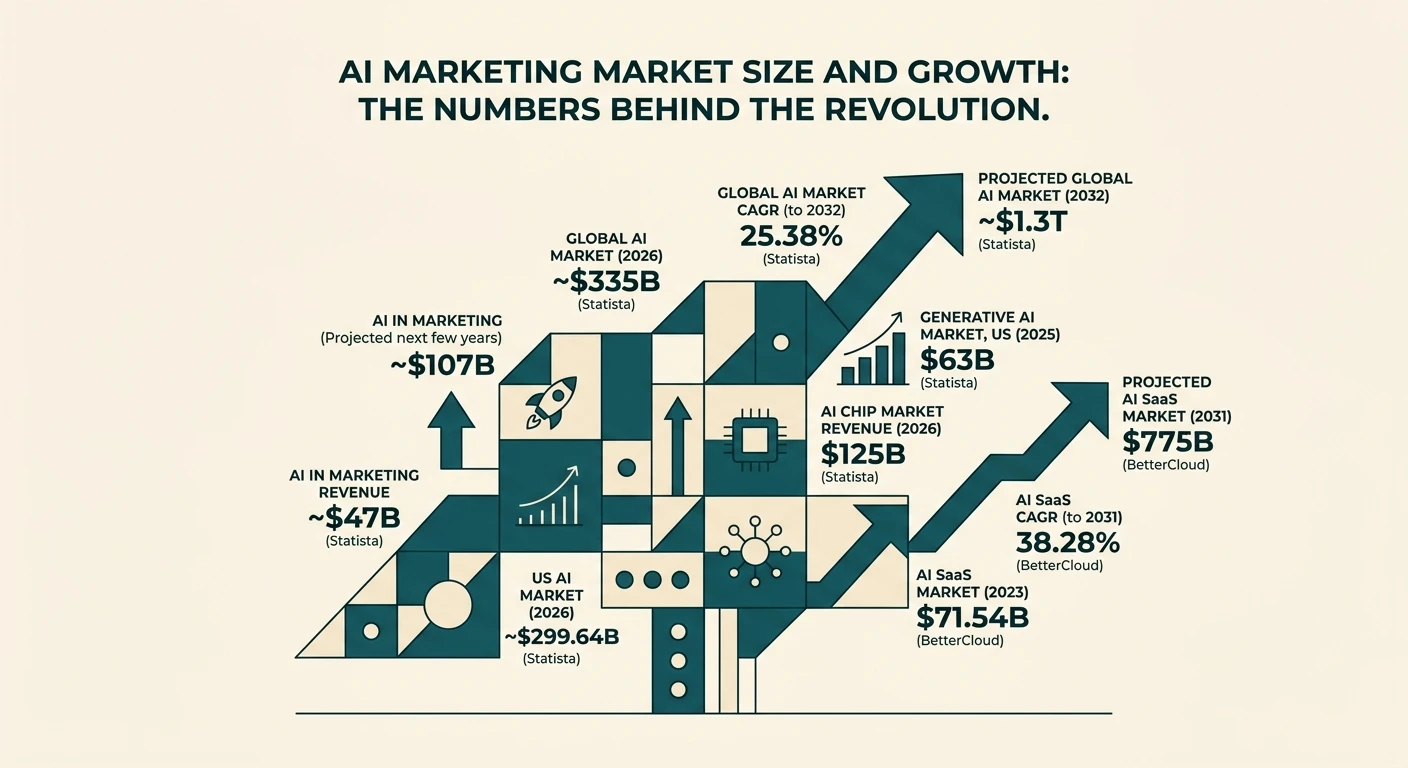
The global AI market is valued at approximately $335 billion in 2026, growing at a 25.38% compound annual growth rate toward $1.30 trillion by 2032 (Statista). Within marketing specifically, AI-related revenue stands at roughly $47 billion and is climbing toward $107 billion within the next several years. The US AI market alone is forecast at $299.64 billion in 2026, making it the single largest national market for AI technology. The AI chip market — the hardware layer powering all of this — is expected to generate $125 billion in revenue in 2026 (Statista).
To narrow the lens even further, the AI SaaS market is growing at a 38.28% CAGR, from $71.54 billion in 2023 to a projected $775 billion by 2031 (BetterCloud). Generative AI specifically — the category that includes tools like ChatGPT, Jasper, Claude, and Midjourney — represents a $63 billion market in the US alone, with exponential growth projected through 2031 (Statista).
Metric | Value | Source |
Global AI Market (2026) | ~$335B | Statista |
AI in Marketing Revenue (2026) | ~$47B | Statista |
US AI Market (2026) | ~$299.64B | Statista |
AI SaaS Market (2023) | $71.54B | BetterCloud |
AI SaaS Market (Projected 2031) | $775B | BetterCloud |
Generative AI Market, US (2025) | $63B | Statista |
AI Chip Market Revenue (2026) | $125B | Statista |
Global AI Market CAGR to 2032 | 25.38% | Statista |
AI SaaS CAGR to 2031 | 38.28% | BetterCloud |
What’s driving this growth? Three converging forces. First, the cost of AI tools has dropped dramatically — what required six-figure enterprise contracts in 2023 is now available for $50–$500 per month. Second, the performance gains are undeniable and measurable, which makes budget justification straightforward. Third, competitive pressure: when 91% of your competitors are using AI, not using it puts you at a structural disadvantage.
AI Adoption in Marketing: From Experiment to Infrastructure
The adoption curve for AI in marketing has moved faster than virtually any technology shift in the history of the industry. What took social media a decade to achieve — near-universal adoption — AI accomplished in roughly three years.
According to Jasper’s State of AI Marketing 2026 report, 91% of marketers now actively use AI in their workflows. Averi AI’s benchmarks report puts the number at 89% specifically for generative AI in content creation. Salesforce reports that 63% of marketers use generative AI tools, while the broader figure including all AI applications (automation, analytics, segmentation) reaches well above 80% across most surveys. 66% of marketers now use AI on most or all of their projects — not just occasionally, but as a default part of how they work.
On the investment side, 92% of businesses plan to invest in generative AI (Digital Marketing Institute), and 64% of marketing teams increased their AI spending in 2026 (Sopro.io). Adobe’s research found that 67% of small and medium businesses now use AI in their marketing, while 60% of marketers across all company sizes use AI tools daily. Perhaps most telling is this number from Averi AI: the percentage of marketers who create blog content without any AI assistance dropped from 65% to just 5% in two years. That is not gradual adoption — that is a wholesale transformation of how content gets made.
Adoption Metric | Percentage | Source |
Marketers actively using AI | 91% | Jasper AI |
Marketers using generative AI for content | 89% | Averi AI |
Marketers using AI on most/all projects | 66% | Averi AI (Q1 2026) |
Businesses planning to invest in generative AI | 92% | Digital Marketing Institute |
Marketing teams that increased AI spending in 2026 | 64% | |
SMBs using AI in marketing | 67% | Adobe |
Marketers using AI tools daily | 60% | Adobe |
Blog creation without AI (2024 vs 2026) | 65% → 5% | Averi AI |
Companies deploying AI-enabled apps by 2026 | 80%+ | Vena Solutions |
Organisations managing AI spend specifically | 63% (→96% projected) | Zylo |
The tools are being applied across the entire marketing workflow. 62% of marketers use AI for brainstorming and ideation, 53% for summarising research and data, 44% for writing first drafts, and growing percentages for audience segmentation, send-time optimisation, ad creative generation, and predictive analytics. This is no longer about one tool or one use case. AI has permeated the entire stack.
ROI and Performance: The Financial Case for AI in Marketing
If adoption rates tell you how widely AI is being used, the ROI data tells you why. The financial case for AI in marketing is not just positive — it is overwhelming enough to make non-adoption a genuine strategic risk.
Companies report an average ROI of 300% from AI-driven marketing initiatives, with cost per acquisition dropping by 37% and conversions increasing by 37% simultaneously (Eminence, 2026). Even simple AI integrations — things like automated subject-line testing or basic personalisation — save campaigns more than $300,000 annually for mid-market companies.
The numbers get more impressive as you look at specific applications. AI-driven send-time optimisation increases email revenue by 41%. AI-powered audience segmentation improves campaign ROI by an average of 52% (Averi AI). AI chatbots increase sales by 67% for businesses that deploy them (Flowlyn). And 86% of sales teams using AI report positive ROI within their first year of implementation (Sopro.io).
At the executive level, the confidence is striking: 93% of CMOs report clear, measurable ROI from generative AI investments (The Rank Masters, 2026). AI-optimised content is linked to 32% higher engagement rates across channels (The Digital Elevator). And among sales teams specifically, 83% of those using AI saw revenue growth, compared to just 66% of teams without AI tools (Salesforce).
ROI Metric | Value | Source |
Average ROI from AI-driven marketing | 300% | Eminence |
Cost per acquisition reduction | 37% | Eminence |
Conversion rate increase | 37% | Eminence |
Annual savings from simple AI integrations | $300K+ | Eminence |
Email revenue increase (send-time optimisation) | 41% | Statista |
Campaign ROI improvement (AI segmentation) | 52% | Averi AI |
Sales increase from AI chatbots | 67% | Flowlyn |
Sales teams with positive AI ROI in year one | 86% | |
CMOs reporting clear generative AI ROI | 93% | The Rank Masters |
Engagement increase from AI-optimised content | 32% | The Digital Elevator |
Revenue growth — AI sales teams vs non-AI | 83% vs 66% | Salesforce |
What’s particularly important about these numbers is the consistency. Whether you look at email, content, advertising, sales enablement, or customer service, AI is delivering measurable performance improvements in every category. The era of “AI is promising but unproven” is definitively over.
AI-Powered Content Creation: The Production Revolution
Content creation is where AI’s impact on marketing is most visible and most debated. The numbers tell a story of radical transformation in how marketing content gets produced — and raise legitimate questions about what comes next.
According to Averi AI’s 2026 Benchmarks Report, 94% of marketers plan to use AI for content creation, and 89% already do so actively. Among those users, 87% report improved productivity, 80% report measurable efficiency gains, and 86% say AI saves them more than one hour daily on creative tasks (DesignRush, Averi AI). The average time saved per individual piece of content is 2.5 hours (Whitehat SEO).
The scope of AI-assisted creation extends far beyond blog posts. Social media content and email are the two most common outputs created with generative AI, followed by ad copy, video scripts, and landing pages. Nearly two-thirds of B2C companies plan to rely primarily on AI-assisted content creation going forward (Content Marketing Institute). An SE Ranking analysis found that AI-generated content now accounts for 17.3% of all indexed web pages — and that percentage is climbing rapidly. Some forecasts predict that up to 90% of online content could be AI-generated by the end of 2026.
The productivity gains are reshaping team structures. Marketing departments that previously needed five writers to produce 20 articles per month can now produce the same volume with two writers using AI assistance. But here’s the critical nuance: the data also shows that pure AI content without human editing, strategic direction, and original insights performs significantly worse than AI-assisted content that combines machine speed with human expertise. Google’s algorithms are increasingly sophisticated at identifying and deprioritising thin, repetitive AI-generated content.
Content Creation Metric | Value | Source |
Marketers planning to use AI for content | 94% | Averi AI |
Marketers already using AI for content | 89% | Averi AI |
Productivity improvement reported | 87% | DesignRush |
Efficiency gains reported | 80% | DesignRush |
AI saves >1 hour daily on creative tasks | 86% | Averi AI |
Average time saved per content piece | 2.5 hours | Whitehat SEO |
AI-generated content as % of indexed pages | 17.3% | SE Ranking |
B2C companies relying on AI-assisted creation | ~66% | CMI |
AI used for brainstorming/ideation | 62% | Averi AI |
AI used for summarising research | 53% | Averi AI |
AI used for writing first drafts | 44% | Averi AI |
AI-Driven Personalisation: From Segment to Individual
Personalisation has always been the promise of digital marketing. AI has finally made it operational at scale — and the numbers show that consumers both expect it and reward it.
92% of businesses now leverage AI-driven personalisation to fuel growth (Involve.me). This is not just inserting a first name into an email subject line. We are talking about dynamic content blocks that adapt based on behaviour, predictive product recommendations, individualised send times, custom landing pages, and real-time offer optimisation. The results are substantial: personalised AI-driven campaigns deliver 29% higher open rates and 41% higher click-through rates in email (The Loop Marketing). Brands using AI personalisation see revenue lifts of 34% on average (Emarsys).
McKinsey’s research, widely cited across the industry, found that 80% of business leaders observed higher consumer spending when experiences were personalised. Yet despite the evidence, adoption is uneven. Only about 50% of marketers personalise beyond basic demographic segments, and 61% of companies express concern about inaccurate data affecting their personalisation quality.
The most advanced implementations use AI to move beyond segmentation entirely, treating each customer as a segment of one. Predictive models analyse past behaviour, browsing patterns, purchase history, and contextual signals (time of day, device, location) to determine not just what to show, but when, where, and how to present it. The gap between companies that do this well and those still relying on static segments is widening rapidly — and it shows up directly in revenue performance.
Personalisation Metric | Value | Source |
Businesses using AI-driven personalisation | 92% | |
Open rate increase (personalised emails) | 29% | The Loop Marketing |
CTR increase (personalised emails) | 41% | The Loop Marketing |
Revenue lift from AI personalisation | 34% | Emarsys |
Business leaders seeing higher spend with personalisation | 80% | McKinsey |
Marketers personalising beyond basic demographics | ~50% | HubSpot |
Companies concerned about data accuracy | 61% | |
AI-driven audience segmentation ROI improvement | 52% | Averi AI |
AI in Email Marketing: The Highest-ROI Channel Gets Smarter
Email marketing was already the highest-ROI channel in the marketing stack at $36–$45 per dollar spent (Statista, DMA.org). Add AI to the equation and those numbers climb even higher — which is why 63% of email marketers now use AI in some capacity and 89% expect that 75% of email operations will be AI-driven by the end of 2026.
AI-driven send-time optimisation alone increases email revenue by 41%. Personalised subject lines — which AI can generate and test at a scale impossible for human teams — boost open rates by approximately 50% and improve click-through rates by 42%. Automated email sequences, which represent just 2% of total email volume, generate 37% of all email-driven revenue (Statista). Welcome emails achieve open rates above 60%, abandoned-cart emails hover around 50%, and a three-email cart-recovery sequence increases orders by 69%.
The combination of AI personalisation and automation is where the real leverage sits. AI determines what to send, when to send it, and to whom — all based on individual-level behavioural data. The top 10% of AI-optimised email workflows generate $16.96 in revenue per recipient, compared to an average of $1.94 for standard workflows. That is an 8.7x performance gap driven almost entirely by AI-enabled optimisation.
On Reddit’s r/Emailmarketing (February 2026), a practitioner captured the shift well: “AI didn’t replace my team — it gave us back 10 hours a week. We spend that time on strategy now, not writing variations of the same welcome email.” Another commenter added: “The brands that let AI handle the mechanical parts and keep humans on the strategic parts are the ones crushing it.”
AI Chatbots and Conversational Marketing: The Always-On Sales Force
The chatbot and conversational AI market has exploded in scale and sophistication. The global chatbot market was valued at $7.76 billion in 2024, and the broader conversational AI market is projected to reach $41.39–$61.69 billion by 2030–2032 (Statista, Jotform). Growth rates sit at 23.3–23.7% annually, driven by improvements in natural language processing, multimodal capabilities, and integration with CRM and marketing automation platforms.
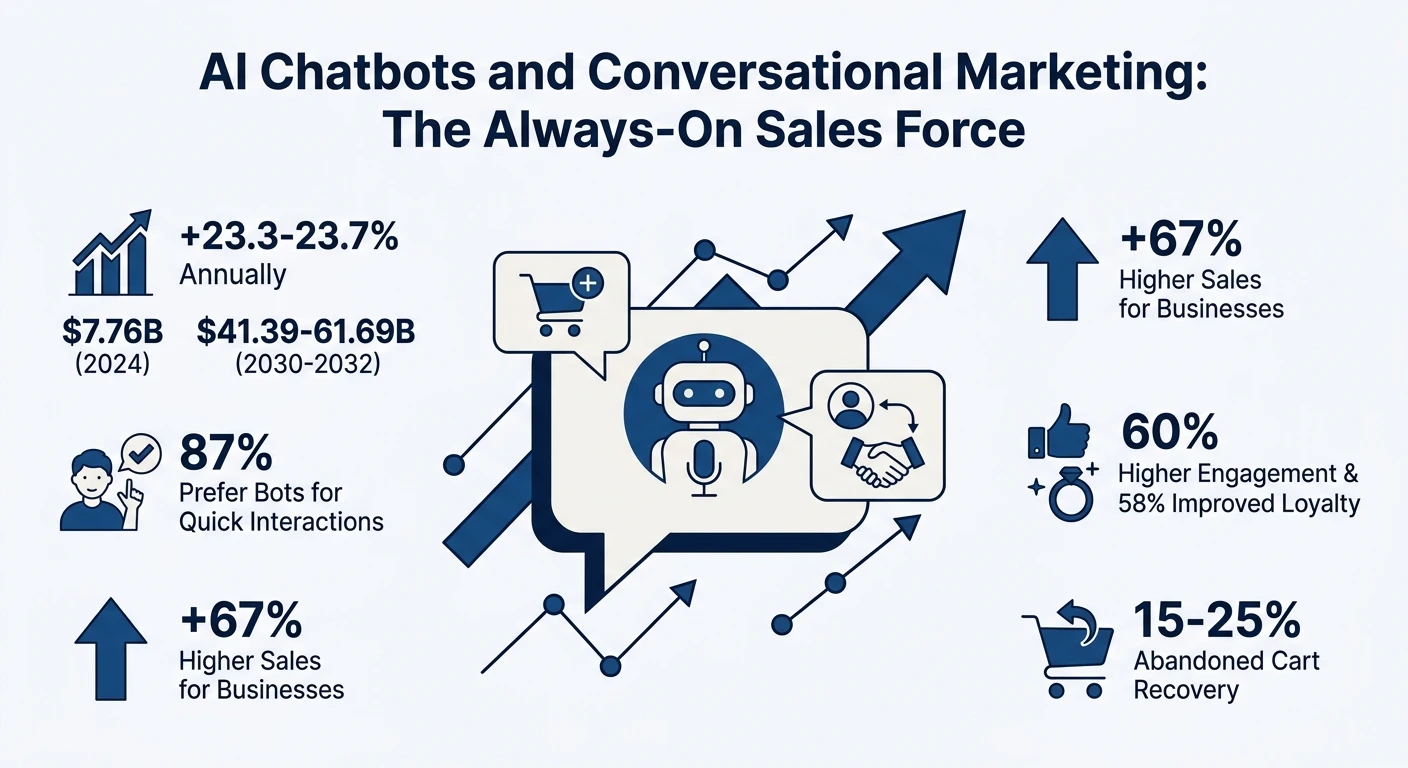
The impact on marketing and sales is measurable and significant. 87% of consumers now prefer bots for quick interactions (Master of Code). AI chatbots increase sales by 67% for businesses that deploy them (Flowlyn). 60% of marketers saw higher engagement and 58% saw improved customer loyalty after adopting AI-driven conversational tools (Emarsys). Abandoned cart recovery through automated chatbot messages and follow-up sequences has become a standard ecommerce practice, with AI-powered messages recovering 15–25% of otherwise lost sales.
Chatbot/Conversational AI Metric | Value | Source |
Global chatbot market (2024) | $7.76B | Statista |
Conversational AI market (projected 2030) | $41.39B | Statista |
Conversational AI market (projected 2032) | $61.69B | Jotform |
Annual growth rate | 23.3–23.7% | Statista |
Consumers preferring bots for quick interactions | 87% | Master of Code |
Sales increase from chatbot deployment | 67% | Flowlyn |
Higher engagement after AI chatbot adoption | 60% | Emarsys |
Improved customer loyalty after adoption | 58% | Emarsys |
Abandoned cart recovery rate (AI messages) | 15–25% | Industry benchmarks |
What’s changed in 2026 is the quality of these interactions. Earlier chatbots were essentially glorified FAQ pages with a conversational interface. Today’s AI-powered chatbots understand context, remember previous interactions, handle complex multi-turn conversations, and can escalate to humans seamlessly when needed. For many brands, the chatbot is now the first and most frequent customer touchpoint — handling everything from product recommendations to order tracking to upselling.
AI in Advertising: Smarter Targeting, Better Creative, Lower Costs
AI has transformed digital advertising from a manual, rules-based discipline into an automated, predictive system. The impact shows up across every advertising metric — targeting precision, creative performance, cost efficiency, and conversion rates.
Meta’s internal data (reported by Reuters) indicates the company is pushing toward full automation of creative generation and targeting by the end of 2026. Google’s Performance Max campaigns already use AI to optimise across all Google inventory simultaneously. And the results are compelling: AI-driven ad campaigns achieve 37% lower cost per acquisition and 37% higher conversion rates compared to manually optimised campaigns (Eminence).
Retargeting — one of the earliest AI applications in advertising — continues to deliver outsized results. AI-powered retargeting ads achieve 10x higher click-through rates and 70% higher conversion rates compared to standard display ads. Video advertising, increasingly powered by AI creative tools, is projected to exceed $236 billion globally in 2026, with AI-generated product demonstration videos boosting conversion rates by 40% (SellersCommerce).
The creative side of advertising is being reshaped just as fundamentally. AI tools now generate ad copy variations, create visual assets, produce short-form video ads, and test thousands of creative combinations simultaneously. Businesses using AI-driven video marketing see an 82% increase in ROI compared to traditional video creation. The speed advantage is dramatic — what previously took a creative team two weeks to produce (concept, shoot, edit, test) can now be generated, tested, and optimised in hours.
AI and Marketing Jobs: Transformation, Not Elimination
One of the most discussed topics around AI in marketing is its impact on employment. The data suggests a transformation of roles rather than wholesale elimination — though the nature of marketing work is changing rapidly.
A Validity prediction widely cited in 2026 forecasts that AI will reshape email marketing jobs specifically by automating content creation, requiring marketers to refocus on strategy, quality assurance, and brand voice. Across the broader marketing function, the pattern is similar: routine production tasks are being automated, while strategic, creative, and relationship-oriented tasks are becoming more valuable.
According to Canva’s 2026 marketing AI report, AI is driving “creative velocity” — the speed at which teams can move from idea to execution. This means marketing teams are not necessarily shrinking, but they are restructuring. Roles are shifting from “content producer” to “content strategist and editor,” from “campaign builder” to “campaign architect and analyst,” and from “data gatherer” to “insight interpreter.”
The skills that matter most in 2026 marketing have shifted accordingly. Prompt engineering, AI tool selection and integration, data interpretation, strategic thinking, and brand stewardship are now more valuable than pure content production skills. On X, marketing leaders have been vocal about this shift, with one widely-shared post noting: “The marketer who can brief an AI effectively and edit its output with brand expertise is 10x more productive than someone writing everything from scratch — and that gap is only growing.”
AI Marketing Challenges: What the Data Says About the Risks
For all the positive ROI data, AI in marketing comes with genuine challenges that the statistics illuminate clearly.
61% of companies using AI-driven personalisation express concern about inaccurate data affecting their results (Involve.me). This is not a trivial issue — personalisation built on bad data doesn’t just fail to improve performance, it actively damages customer relationships. A recommendation engine that suggests irrelevant products or a chatbot that provides incorrect information erodes trust faster than a generic experience would.
AI hallucination — where AI systems generate plausible-sounding but factually incorrect content — remains a significant risk for customer-facing applications. While the hallucination rate has decreased substantially since 2023, it has not been eliminated. Brands that deploy AI-generated content without human review expose themselves to reputational risk, compliance issues, and customer confusion.
Cost management is another emerging challenge. 66.5% of IT leaders experienced unexpected SaaS charges in 2025, often driven by new AI features or usage-based pricing models (Zylo). Organisations now spend an average of $55.7 million on SaaS annually (up 8% YoY), and a significant portion of that increase is attributable to AI-premium pricing tiers. 62% of SaaS platforms have introduced AI-premium tiers, with buyers budgeting 25–35% higher for AI-enhanced products (McKinsey 2026 Software Pricing Report).
On Reddit’s r/marketing (March 2026), a candid thread about AI challenges received significant engagement. The top-voted comment stated: “AI generates the first draft in 10 minutes that used to take 3 hours. But the editing, the strategy, the brand voice — that’s still 100% human. Anyone who thinks AI replaces the human layer is going to produce mediocre work at scale.” Another commenter highlighted the differentiation problem: “When every competitor uses the same AI tools to produce the same type of content, the only moat left is original data, real expertise, and genuine perspective.”
AI Marketing by Channel: Where the Impact Is Greatest
AI’s impact varies across marketing channels, with some functions seeing near-total transformation and others experiencing more incremental change. Understanding where AI delivers the most leverage helps marketers prioritise their implementation roadmap.
Channel | AI Adoption Rate | Key AI Application | Performance Impact |
Email Marketing | 63% | Send-time optimisation, subject lines, dynamic content | +41% revenue, +29% open rate |
Content Marketing | 89–94% | Drafting, ideation, summarisation | 2.5 hours saved per piece, 32% higher engagement |
Paid Advertising | 70%+ | Creative generation, targeting, bidding | -37% CPA, +37% conversion |
Social Media | 65% | Caption writing, scheduling, trend analysis | 34% higher video conversion |
SEO | 60% | Content optimisation, keyword clustering, technical audits | 32% higher engagement from AI-optimised content |
Chatbots/Conversational | 55% | Customer support, lead qualification, sales | +67% sales, 87% consumer preference |
Analytics/Attribution | 50% | Predictive modelling, anomaly detection | 52% ROI improvement from AI segmentation |
Sources: Statista, Averi AI, Salesforce, Eminence, Emarsys, Flowlyn
The pattern is clear: AI adoption is highest in content-heavy and data-heavy functions, where the combination of production speed and analytical precision creates the most leverage. The channels with lower AI adoption (analytics, conversational) tend to require more complex integration work, but they also represent the areas where early adopters gain the biggest competitive advantages.
What Reddit and X Are Saying About AI in Marketing in 2026
The practitioner-level conversation about AI in marketing in 2026 is more nuanced and honest than the vendor marketing might suggest.
On Reddit’s r/marketing (February 2026), a widely-discussed thread titled “What’s your honest take on AI in marketing after using it for a year?” produced revealing responses. The top-voted answer captured the consensus: “It’s genuinely transformative for the mechanical parts of marketing — first drafts, data analysis, A/B testing, campaign setup. But the strategic parts, the brand-building, the creative leaps — those are still entirely human. The best marketers in 2026 are the ones who know which parts to delegate to AI and which parts to own.”
Another popular thread on r/DigitalMarketing (March 2026) focused on the AI differentiation problem. As one commenter put it: “Everyone has access to the same tools. ChatGPT, Jasper, Claude, Midjourney — they’re democratised. So the competitive moat isn’t the AI tool. It’s the quality of your inputs — your data, your strategy, your brand understanding, your customer insight. AI amplifies whatever you feed it, including mediocrity.”
On X, the conversation has bifurcated into two camps. Optimists highlight productivity gains and revenue impact, frequently sharing case studies of AI-driven campaigns outperforming manual ones. Skeptics focus on the quality and authenticity challenges, with several viral threads arguing that AI-generated content is creating a “sea of sameness” that actually makes human-created, original content more valuable — not less.
A widely-shared X post from a marketing agency founder in January 2026 captured the tension perfectly: “The paradox of AI in marketing: it makes production 10x faster but differentiation 10x harder. Speed is no longer a moat. Thinking is.”
The Future: Where AI Marketing Is Heading Beyond 2026
While this article focuses on current statistics, the trajectory data points toward several clear directions for the next two to three years.
Gartner identifies five key trends shaping the future of AI in marketing: autonomous AI agents that execute multi-step campaigns without human intervention, GenAI-powered personal technology that reshapes consumer channels, privacy-first AI that operates within increasingly strict data regulations, AI-driven creative that matches or exceeds human creative quality, and predictive AI that moves from forecasting to prescribing specific actions.
The most significant near-term shift is the rise of AI agents — autonomous systems that don’t just assist marketers but actually execute tasks end-to-end. In 2026, these agents are still largely supervised, but the trend toward greater autonomy is unmistakable. Klaviyo’s 2026 trends report specifically identifies “autonomous orchestration growth” as a defining theme, where AI systems manage entire customer journeys from first touch to conversion without manual intervention at each step.
Privacy-driven personalisation is another trajectory that will intensify. With GDPR enforcement tightening, third-party cookies disappearing, and consumer expectations around data privacy increasing, AI systems must deliver personalisation using first-party and zero-party data rather than invasive tracking. The companies that build this capability now will have a structural advantage as privacy regulations continue to expand globally.
Key Takeaways: What These Numbers Mean for Your 2026 Strategy
After analysing 60+ data points across the AI marketing landscape, the strategic implications are clear.
If you are a marketing leader: AI adoption is effectively universal at 91%. The competitive advantage now lies entirely in implementation quality, not adoption itself. Prioritise the highest-ROI applications first — audience segmentation (52% ROI improvement), email send-time optimisation (41% revenue lift), and AI-powered personalisation (34% revenue lift). Budget for AI-premium pricing tiers in your marketing SaaS stack, and expect costs to rise 25–35% as vendors add AI features.
If you are a content marketer: AI has compressed the production cycle from days to hours. Use AI for brainstorming, first drafts, and summarisation — that’s where 62%, 44%, and 53% of marketers are already applying it. But differentiate with original research, proprietary data, expert perspectives, and editorial quality. The 17.3% of web content that is AI-generated is climbing toward 90%, which means human-informed, original content becomes the scarce — and therefore most valuable — asset.
If you are in sales: 83% of AI-enabled sales teams see revenue growth versus 66% without AI. The ROI arrives within the first year for 86% of teams. AI chatbots increase sales by 67%. If your team is not using AI for lead qualification, predictive scoring, and automated follow-up, you are leaving measurable revenue on the table.
For everyone: Maintain human oversight for strategy, brand voice, quality assurance, and customer-facing communications. AI hallucination risk has decreased but not disappeared. The gap between “AI-assisted” and “AI-dependent” marketing is the difference between competitive advantage and reputational risk. Use AI to amplify human expertise, not to replace human judgment.
The AI marketing revolution in 2026 is not approaching — it has arrived, it is measurable, and the brands that understand these numbers are the ones capturing disproportionate growth. The question is no longer whether AI will transform your marketing. It’s whether you’ll be the one doing the transforming, or the one being disrupted.
About this article: Statistics were compiled from Statista, Gartner, Digital Marketing Institute, Jasper AI State of AI Marketing 2026, Averi AI 2026 Benchmarks Report, Salesforce State of Marketing, Sopro.io, Eminence, Adobe, Emarsys, McKinsey, Zylo 2026 SaaS Management Index, Flowlyn, The Rank Masters, The Digital Elevator, Content Marketing Institute, DMA.org.uk, and community discussions on Reddit (r/marketing, r/DigitalMarketing, r/Emailmarketing) and X. All figures were verified against primary sources as of March 2026.
By 2026, studies show that over 80% of marketing professionals are actively using at least one AI-powered tool in their campaigns. This represents a dramatic increase from just a few years prior, reflecting how deeply artificial intelligence has become embedded in the modern marketing stack.
AI is being used across nearly every facet of marketing, including content creation, predictive analytics, personalized email campaigns, chatbots, ad targeting, and SEO optimization. Marketers are leveraging AI to automate repetitive tasks and make data-driven decisions faster than ever before.
AI has taken over the marketing stack because it now powers core functions like audience segmentation, real-time personalization, campaign optimization, and customer journey mapping with minimal human input. The sheer volume of AI-driven touchpoints means most marketing workflows are either fully automated or heavily augmented by artificial intelligence.
Yes, data consistently shows that businesses using AI in their marketing efforts report significantly higher ROI, with some studies citing revenue increases of 20-30% attributed to AI-driven personalization and automation. AI helps reduce wasted ad spend while improving conversion rates through smarter targeting.
Absolutely, AI marketing tools have become far more accessible and affordable by 2026, with many platforms offering scalable pricing that suits small business budgets. Small businesses are using AI for tasks like social media scheduling, email personalization, and customer insights without needing a large marketing team.
Comments
Be the first to leave a comment.