
The Deal That Reshapes the AI Market Competitive Map
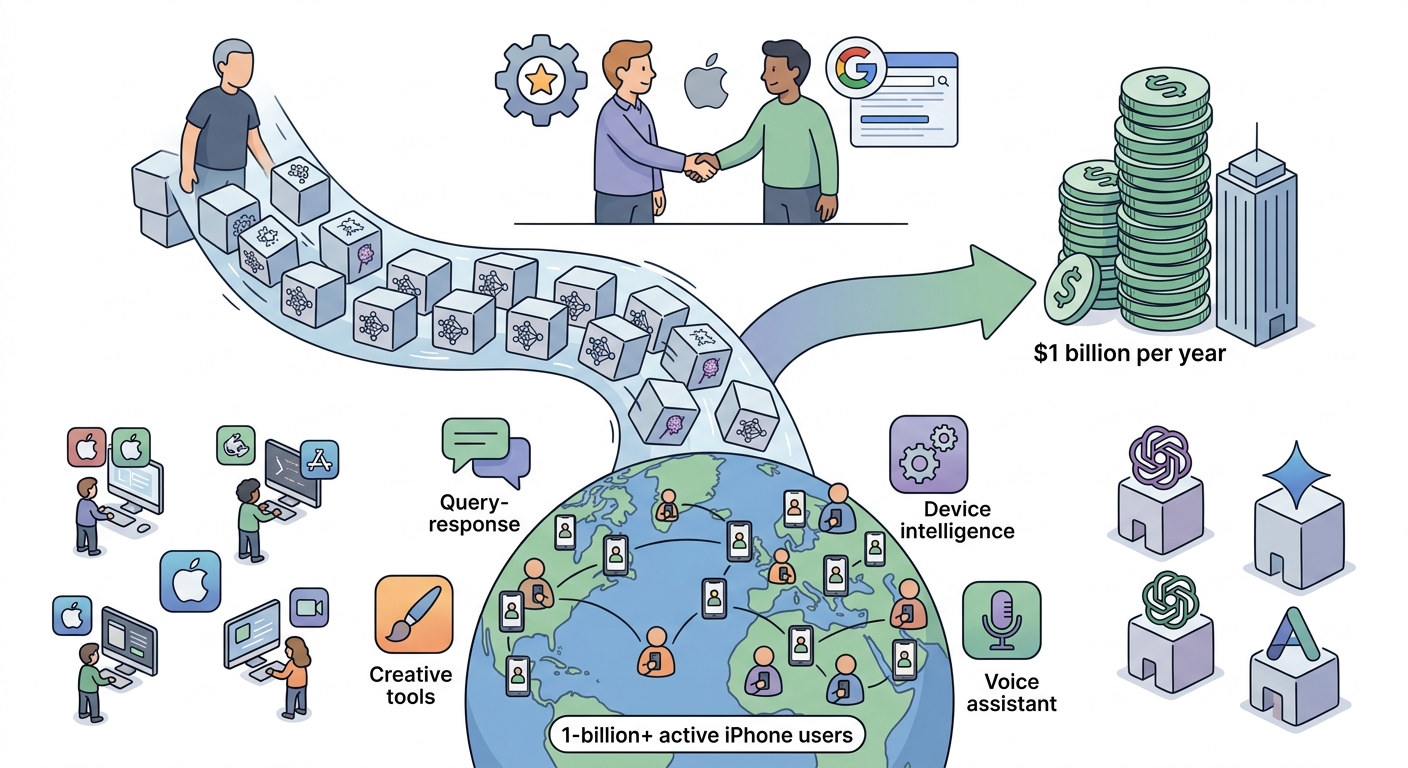
Apple and Google jointly announced on January 12, 2026 that the next generation of Apple Foundation Models will be built on a custom 1.2-trillion-parameter Google Gemini model. Apple is reportedly paying around $1 billion per year for it.
$1 billion per year from Apple to Google for AI model access is the largest AI licensing deal in history — and it reshapes the competitive dynamics of the AI tools market in ways that SaaS developers building on iOS need to understand.
The first implication is distribution. When Apple’s default AI assistant is powered by Gemini, Gemini gains daily active exposure to the 1-billion-plus active iPhone users worldwide.
Every Siri query, every Apple Intelligence feature, every AI-powered app interaction becomes a Gemini touchpoint. For Google, this is not just $1 billion in annual revenue — it is access to the world’s largest and most valuable installed base of AI-capable devices.
The Extensions Opening for Third-Party SaaS
iOS 27 opens Siri to Claude, ChatGPT, and other third-party AI through a new Extensions system. There is even chatter that users may get to choose which model powers Apple Intelligence, with Gemini, Claude, and ChatGPT all in the frame.
The Extensions system is where the direct SaaS opportunity sits. If iOS 27 allows third-party AI models to power Siri interactions — and the leaks consistently suggest this is coming — then SaaS companies building specialised AI capabilities for specific domains have a direct channel to iOS users through Siri Extensions.
A legal SaaS that builds a Siri Extension giving lawyers quick contract analysis through a voice query is reaching its target audience through the platform’s default interaction layer. That distribution advantage is the kind that takes years and enormous marketing budgets to replicate through app store discovery alone.
The Privacy Architecture Every Developer Should Understand
All Gemini queries route through Apple’s Private Cloud Compute architecture, the same hardware-isolated server stack that handles Apple Intelligence today. Apple says queries are anonymized, not stored, and never used to train future Google models.
This privacy architecture is the answer to the question every enterprise developer building on iOS AI capabilities will be asked by their clients. Data processed through Apple’s Private Cloud Compute does not leave Apple’s architecture unprotected, is not stored, and is not used for model training.
For SaaS companies serving healthcare, legal, or financial clients with strict data handling requirements, this architecture makes building on iOS AI capabilities significantly more viable than building on direct cloud AI APIs.
💬 Reddit — r/iOSProgramming on Apple Google Gemini deal and Siri Extensions: 🔗https://www.reddit.com/r/iOSProgramming/search/?q=Apple+Google+Gemini+$1+billion+Siri+Extensions+2026
🐦 X/Twitter — developers discussing Apple Gemini deal implications: 🔗https://x.com/search?q=Apple+Google+Gemini+$1+billion+iOS+27+developers+2026&f=live
💬 Quora — how does Apple Google Gemini deal affect SaaS developers building on iOS: 🔗https://www.quora.com/search?q=Apple+Google+Gemini+deal+SaaS+developers+iOS+27+2026
Quick Links:
Comments
Be the first to leave a comment.