
Meta’s acquisition of AI agent startup Manus has been dismantled after China’s regulators forced the two companies apart. What started as one of the biggest AI deals of late 2025 has ended in a messy, months-long separation.
Meta announced the acquisition of Manus in December 2025 for over $2 billion. Manus builds general-purpose AI agents capable of handling research, coding, and data analysis without step-by-step human input. The startup had reportedly crossed $100 million in annualized revenue within eight months of launch.
It originally began in China as Butterfly Effect, with offices in Beijing and Wuhan, before relocating its headquarters to Singapore in mid-2025.
Why China Blocked the Deal
That Chinese origin is what triggered the reversal. China’s National Development and Reform Commission (NDRC) opened a review almost immediately after the deal was announced, and by March 2026 had barred Manus co-founders Xiao Hong and Ji Yichao from leaving the country while the investigation continued.
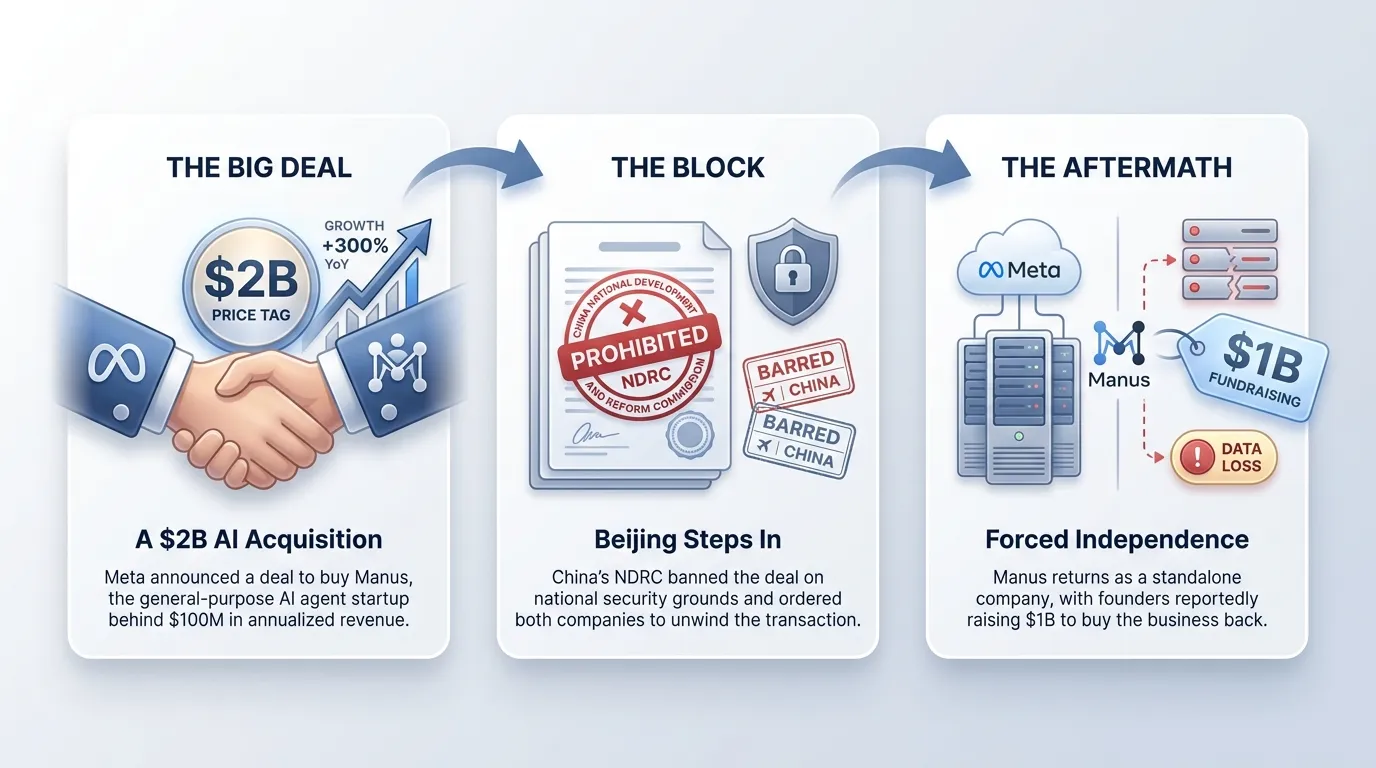
On April 27, the NDRC issued a one-line order banning the acquisition on national security grounds and instructing both companies to unwind the transaction.
The reversal proved complicated. By the time the order came down, Meta had already merged Manus’s staff and technology into its own systems, and investors including Tencent, Hongshan, and ZhenFund had already been paid out.
Meta responded by cutting Manus off from its internal data systems in June and telling employees to migrate any Manus-based projects onto Meta’s own infrastructure.
Manus Goes Independent Again
On August 11, Manus confirmed it will resume operating as an independent company, though it warned some users may lose data generated during its time under Meta. The company’s founders are now reportedly trying to raise around $1 billion to buy the business back outright.
The case adds to a growing pattern of cross-border AI deals unraveling after the fact, as both Washington and Beijing tighten scrutiny on foreign investment in AI.
Even a fully closed and operationally integrated acquisition, it turns out, isn’t safe from being pulled apart months later if national security concerns catch up with it.
Quick Links:
Comments
Be the first to leave a comment.