
The AI development tools market has quietly become one of the fastest-growing segments in software. When a production chatbot gives a wrong answer, the old approach — check the prompt, fix it, redeploy — breaks down completely when the application involves an AI agent making dozens of tool calls in sequence.
That gap between “what happened” and “why it was wrong” is exactly the problem LLM observability platforms are built to solve. And the market for solving it is growing at a speed that few enterprise software categories have ever matched.
According to Research and Markets, the global LLM Observability Platform Market was valued at $2.69 billion in 2026 and is projected to reach $9.26 billion by 2030, growing at a CAGR of 36.2%. Dataintelo puts the 2025 baseline even higher at $3.2 billion, projecting growth to $24.8 billion by 2034 at a CAGR of 25.4%.
A separate estimate from Market.usforecasts the market reaching $8.075 billion by 2034 at a CAGR of 31.8%. The exact figures vary by methodology, but every major research firm agrees on the direction: this market is roughly doubling every two to three years, driven primarily by enterprise AI agent adoption.
The context for that growth matters. Gartner estimated in August 2025 that 40% of enterprise applications will embed task-specific AI agents by end of 2026, up from less than 5% in 2025 — an 8× increase in just 12 months.
The Agentic AI Institute’s 2026 report found that 72% of enterprises now have agentic AI in production, yet a massive 60% governance gap exists because most lack formal observability practices. These numbers are the demand signal that Langfuse and LangSmith are both racing to capture.
The Two Platforms: Funding, Scale, and Ownership
The financial context behind both platforms reveals how seriously the market views this problem.
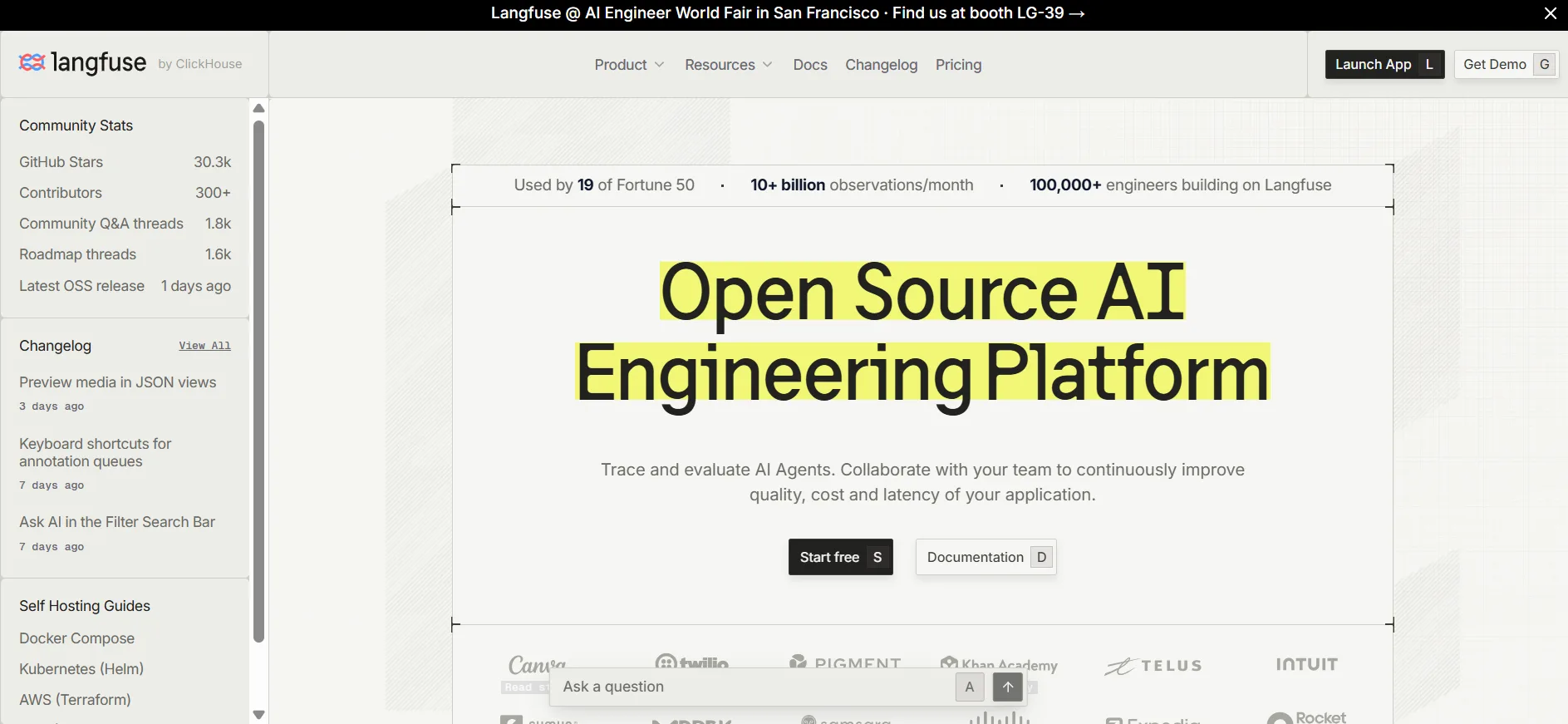
Langfuse was acquired by ClickHouse in January 2026, announced alongside ClickHouse’s $400 million Series D funding round, which valued ClickHouse at $15 billion. The acquisition was strategically logical: ClickHouse’s columnar database already powered Langfuse’s backend, and the deal made that partnership permanent. Critically, Langfuse’s MIT open-source licence was confirmed as unchanged at acquisition — meaning the entire platform remains free to self-host with no software licence cost.
By the time of the ClickHouse acquisition, Langfuse had reached the following scale metrics as published on its press page:
29,444 GitHub stars, making it the most widely adopted open-source LLM engineering platform
50 million+ SDK installs per month
6 million+ Docker pulls
Trusted by 19 of the Fortune 50 companies and 63 of the Fortune 500
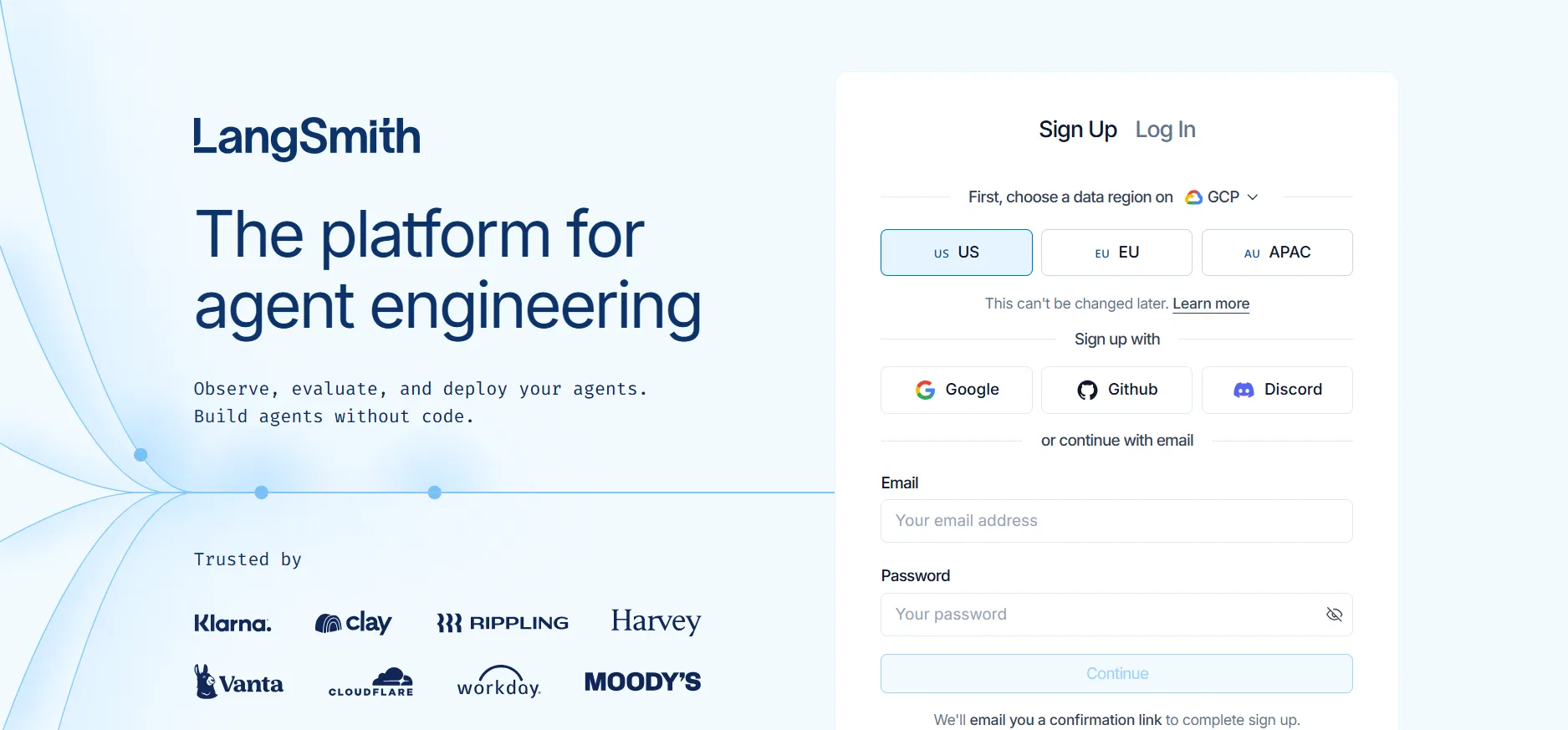
LangSmith is built and owned by LangChain Inc., which raised a $125 million Series B in October 2025 at a $1.25 billion valuation — making it a unicorn. The round was led by CapitalG and Sapphire Ventures. LangSmith is a proprietary, closed-source platform. Self-hosting is available but requires an Enterprise contract; there is no free self-hosting path equivalent to Langfuse’s MIT model.
The funding gap between the two parent organisations is worth noting: ClickHouse (Langfuse’s parent) is valued at $15 billion on a $400 million round, while LangChain is valued at $1.25 billion on a $125 million round. This does not determine product quality, but it does indicate the scale of infrastructure investment behind each platform’s backend.
Performance Statistics: SmithDB vs. Langfuse’s ClickHouse Backend
The most significant technical event in the LangSmith product story in 2026 was the launch of SmithDB — a purpose-built, Rust-based data layer built specifically for agent observability workloads, announced at LangChain’s Interrupt 2026 event in May. LangChain’s own performance claims for SmithDB are striking:
Performance improvement=up to 12× to 15× faster than previous LangSmith backend
P50 trace tree load time: 92 milliseconds (down from what took seconds before SmithDB)
P50 single run load time: 71 milliseconds
Full-text search: 400 milliseconds end-to-end
SmithDB now handles 100% of LangSmith’s US Cloud ingestion
These are meaningful numbers. In production AI agent monitoring, a trace tree that previously took several seconds to load would slow down debugging loops significantly. The SmithDB architecture — built on Rust and DataFusion — was designed specifically for the nested, multi-modal, long-running nature of 2026 agent traces, where a single agent run can involve hundreds of tool calls, images, and sub-agents running in parallel.
Langfuse’s backend runs on ClickHouse, which is the same technology that ClickHouse’s $15 billion business is built on. In May 2026, Langfuse added full-text search powered by ClickHouse’s native FTS engine, cutting searches that previously took close to 20 seconds down to under 0.5 seconds — a 40× improvement on that specific operation.
While direct P50 latency comparisons between the two platforms are not available from independent benchmarks, both companies have invested heavily in backend performance during 2025–2026, and both now claim sub-second response times on core tracing workloads.
Agent Adoption Context: Why These Performance Numbers Matter
The performance investment both platforms have made only makes sense when you understand how dramatically agent complexity has grown. The Digital Applied 2026 enterprise AI data report found that 80% of enterprise applications shipped or updated in Q1 2026 now incorporate some form of agentic AI, up from much lower levels in 2024.
The GoGloby AI adoption statistics report found that 88% of enterprises use AI tools, but only 23% have successfully scaled agent deployments, and just 12% report clear ROI from AI agents.
That gap between deployment and measurable ROI is precisely the observability problem. Teams are running agents in production without the tools to understand why outputs degrade, which tool calls fail, and which prompt changes improve performance.
LangChain’s own State of Agent Engineering report found that customer service is the most common agent use case at 26.5%, followed by research and data analysis at 24.4% — together representing over half of all production agent deployments.
Digital Applied’s data on observability investment is particularly telling: enterprises are spending an average of $310,000 per year on AI agent observability at mid-market level, rising to $2.4 million per year for Fortune 500 companies. This spend is what Langfuse and LangSmith are competing to capture.
Pricing Statistics: A Direct Comparison
Understanding the true cost of each platform requires looking beyond headline prices, because both have pricing mechanics that compound in ways that are easy to underestimate.
Langfuse Cloud Pricing (June 2026):
Plan | Monthly Cost | Included Units | Users | Data Retention |
Hobby | Free | 50,000 units/month | 2 | 30 days |
Core | $29/month | 100,000 units | Unlimited | 90 days |
Pro | $199/month | Custom volume | Unlimited | 3 years |
Enterprise | $2,499/month | Custom | Custom | Custom |
Langfuse’s pricing unit is defined as:
Total Units=Traces+Observations+Scores
This means a single agent run that generates 1 trace, 40 tool-call observations, and 10 evaluation scores consumes 51 units, not 1. For tool-heavy agent pipelines, this adds up quickly. Overage on paid plans is billed at $8 per 100,000 additional units. Critically, all paid Cloud plans include unlimited users, which is a significant advantage for larger teams compared to LangSmith’s per-seat model.
LangSmith Pricing (June 2026):
Plan | Monthly Cost | Included Traces | Users | Retention (Base/Extended) |
Developer | Free | 5,000 traces/month | 1 | 14 days |
Plus | $39/seat/month | 10,000 base traces | Unlimited | 14 days / 400 days |
Enterprise | Custom | Custom | Custom | Custom |
For a team of five developers on the Plus plan, the baseline monthly cost is:
5 seats×$39=$195/month
This is before any trace overage and before the critical extended retention mechanic. LangSmith automatically upgrades traces to extended retention when automated evaluators add feedback to them.
Extended retention costs more and extends data storage to 400 days — but this happens without explicit user action, which means evaluation-heavy pipelines can generate unexpectedly large bills. This is one of the most important billing mechanics to understand before choosing LangSmith for production evaluation workflows.
Evaluation Capability: What the Feature Gap Means in Numbers
LLM evaluation is arguably the most important differentiator between the two platforms in 2026, and both companies shipped significant evaluation updates in the past year.
Langfuse made its LLM-as-a-judge evaluation engine fully open-source under MIT in June 2025, accessible to all self-hosted users on version v3.65.0 or later at zero licence cost. In May 2026, Langfuse launched Code Evaluators — Python or TypeScript functions written directly in the UI that run deterministic checks such as JSON schema validation, regex matching, and tool argument verification. These run with no token cost and no judge model call required, making them significantly cheaper for high-volume evaluation pipelines.
The GitHub Actions CI/CD integration, launched in May 2026 via the langfuse/experiment-action, enables automated regression gates: a deployment fails automatically when experiment scores drop below a defined threshold.
This turns evaluation from a post-launch review into a pre-deployment gate, and it is the feature most frequently cited by engineering teams that have switched from ad-hoc prompt testing to continuous evaluation.
LangSmith’s evaluation suite includes few-shot correction — where human-labelled corrections on evaluator outputs are automatically fed back as few-shot examples to improve evaluator calibration over time.
It also includes built-in templates for Security, Safety, and Quality evaluations, and Boolean, Categorical, and Continuous feedback types. The evaluation features are mature and well-integrated into the LangSmith workflow, but they come with the retention upgrade mechanic described above.
Open Source vs. Closed Source: The Data Sovereignty Statistics
The open-source vs. closed-source dimension has concrete financial and compliance implications.
Langfuse’s MIT licence means any organisation can deploy the full platform on its own infrastructure at zero software licence cost. The recommended minimum production deployment requires a VM with 4 CPU cores and 16 GiB RAM, running ClickHouse, PostgreSQL, Redis, and S3-compatible storage.
On GKE, EKS, or AKS, a standard Kubernetes deployment with Helm covers this configuration. The only paid tiers for self-hosted Langfuse are the Enterprise Edition add-ons: audit logs, SCIM provisioning, dedicated support, and SLAs.
For compliance, Langfuse Cloud holds four certifications: SOC 2 Type II, ISO 27001, GDPR, and HIPAA. LangSmith Cloud holds three: SOC 2 Type II, GDPR, and HIPAA. The missing ISO 27001 certification on LangSmith is a concrete differentiator for enterprises whose procurement process specifically requires it — particularly in financial services, healthcare, and government sectors where ISO 27001 is a standard procurement checkbox.
LangSmith’s self-hosted option exists but requires an Enterprise contract. SmithDB for self-hosted LangSmith was in early access only as of May 2026, not yet generally available, which means self-hosted LangSmith deployments do not yet benefit from the 12–15× performance improvements that US Cloud customers see.
Framework Adoption: Where Each Platform Leads
The integration question is practical rather than philosophical, and the data helps clarify it. Langfuse lists native integrations across more than a dozen frameworks including LangChain, LangGraph, OpenAI Agents SDK, Pydantic AI, CrewAI, AutoGen, DSPy, Haystack, LlamaIndex, and others. It is also natively OpenTelemetry (OTel) compatible at the SDK level, meaning any framework that emits OTel traces works with Langfuse without custom instrumentation.
LangSmith added OpenTelemetry support in 2026 via the langsmith[otel] package and LANGSMITH_OTEL_ENABLED=true environment variable, making it no longer exclusively a LangChain tool. However, its tightest integration remains with LangGraph.
In LangSmith, a LangGraph application gets zero-configuration tracing — every node, edge, and state transition is captured automatically just by setting an environment variable, with no added instrumentation code. No other framework gets this level of automatic coverage in LangSmith.
The practical question for teams is setup effort. LangGraph applications use LangSmith with near-zero friction. Applications built on CrewAI, Pydantic AI, or direct OpenAI API calls typically need less custom instrumentation in Langfuse than in LangSmith, because Langfuse’s broader native integrations cover those frameworks more completely out of the box.
Quick Links:
Key Statistics Summary
The most important data points from this entire comparison in one place:
The LLM observability market is valued at $2.69B in 2026, growing at 36.2% CAGR to $9.26B by 2030. ClickHouse acquired Langfuse as part of a $400M, $15B-valuation funding round. LangChain raised $125M at $1.25B valuation in October 2025. Langfuse has 29,444 GitHub stars, 50M+ SDK installs per month, and is trusted by 63 Fortune 500 companies. SmithDB delivers 12–15× performance improvements, with trace trees loading at P50 of 92ms.
Langfuse search dropped from ~20 seconds to under 0.5 seconds after the ClickHouse FTS upgrade. Enterprise observability spend ranges from $310K (mid-market) to $2.4M per year (Fortune 500). Gartner projects AI agent adoption growing from 5% to 40% of enterprise applications in a single year. Langfuse holds 4 compliance certifications; LangSmith holds 3, with ISO 27001 being the gap.
Comments
Be the first to leave a comment.