
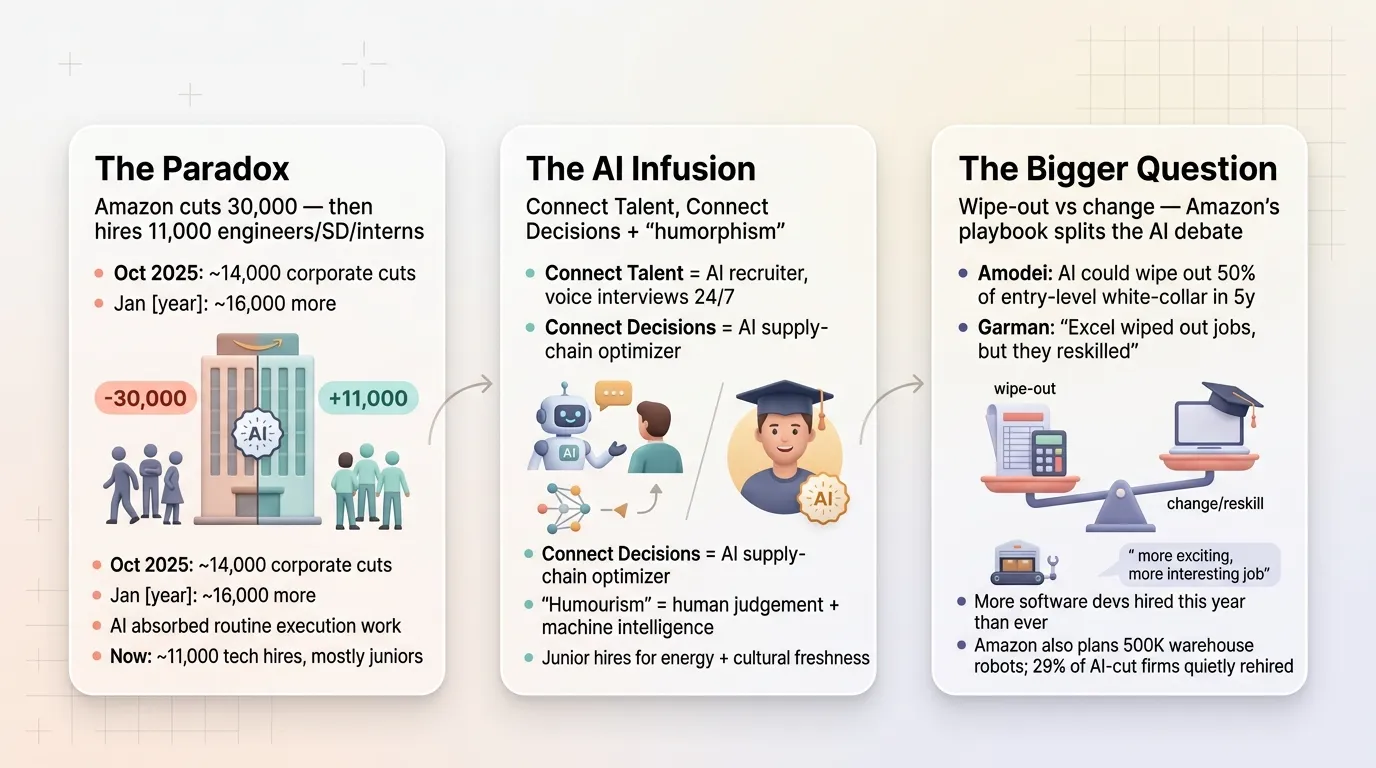
In one of the most striking and paradoxical corporate stories of 2026, Amazon — the world’s largest e-commerce and cloud computing empire — has announced plans to hire approximately 11,000 engineers, software developers, and interns this year, just months after completing one of the most sweeping corporate restructurings in its history.
Between late 2025 and January 2026, Amazon eliminated nearly 30,000 corporate jobs in two waves: approximately 14,000 roles in October 2025 and a further 16,000 positions announced in January 2026. The juxtaposition of mass layoffs followed almost immediately by significant fresh hiring has ignited a fierce and deeply consequential debate: is AI actually replacing human workers — or is the reality far more complicated, and far more nuanced, than the headlines suggest?
The answer, as Amazon’s own behaviour reveals, is neither a simple yes nor a reassuring no. It is something in between — and understanding what that means for millions of workers worldwide has never been more urgent.
Why Amazon Cut 30,000 Jobs — and Why It Is Now Hiring Again
Amazon’s CEO Andy Jassy has been candid about the reasoning behind the restructuring. In internal and public communications, he acknowledged that AI is already automating routine tasks that previously required large corporate teams — including coding, debugging, system maintenance, documentation, and administrative work.
The company framed the cuts as part of a fundamental structural reset, not a simple cost-cutting exercise. As AI tools absorbed an increasing share of routine execution work, the argument went, large layers of middle management and generalist technical roles had become redundant. Amazon was not getting smaller — it was getting leaner and more selective.
The rehiring of 11,000 people tells the other half of that story. Amazon is not replacing the roles it cut. It is redefining them. The new hires are concentrated almost exclusively in high-skill technical categories — software engineers, cloud architects, AI specialists, and interns with the agility to learn fast and work alongside AI systems rather than simply performing tasks that AI can now handle.
AWS CEO Matt Garman captured the philosophy bluntly, calling the idea of replacing junior employees with AI “one of the dumbest things I’ve ever heard” — arguing that entry-level hires bring energy, cultural freshness, and a willingness to learn that no AI system replicates.
“They come in with an energy and excitement, a new view on things,” Garman said. “If you just have the exact same people you’ve had for the last 15 years, you don’t get that.”
📺 Watch: Why Amazon Is Hiring 11,000 Junior Employees
Amazon has simultaneously rolled out two powerful new AI recruitment and operations tools that illuminate exactly how deeply automation is now embedded in its own business model. Amazon Connect Talent is an AI recruiter capable of autonomously scheduling and conducting voice interviews with job candidates, around the clock, with no human in the loop — effectively automating a significant portion of the HR function.
Amazon Connect Decisions is an AI-powered supply chain tool that analyses data patterns to optimise purchasing and logistics decisions at scale. The company has branded its broader philosophy around this human-AI integration as “humorphism” — a blending of human judgement and machine intelligence designed to make workflows more intuitive and more productive simultaneously.
The Bigger Question: Is AI Creating Jobs or Destroying Them?
The tension at the heart of Amazon’s story mirrors a debate that is dividing the world’s most powerful voices in artificial intelligence. Anthropic CEO Dario Amodei has publicly predicted that AI could wipe out half of all entry-level white-collar jobs within five years — a projection that has alarmed workers, policymakers, and economists alike.
Garman, running a company that sits at the very centre of the AI boom as Amazon’s cloud division AWS powers much of the industry’s training and inference infrastructure, pushed back directly and forcefully on that framing.
“‘Wipe out’ and ‘change’ are different,” Garman told journalist Casey Newton. “Excel wiped out all of the jobs of people who were hand-calculating things — but those people then learned how to use a computer, and there you go, now they had a job again.”
He pointed to software engineering as the most instructive data point available: despite AI automating enormous swathes of routine coding work, “there are more software developers being hired this year than ever before in history.”
His conclusion was resolute: the mathematical logic of mass unemployment from AI simply does not hold, because if half of all jobs were genuinely wiped out, the entire economy collapses — and with it, the market for the AI products themselves.
But Garman’s optimism sits in unmistakable tension with Amazon’s own trajectory. Alongside the 11,000 fresh hires, the company has publicly stated plans to replace half a million warehouse and logistics roles with robots in the coming years.
Amazon CEO Andy Jassy has explicitly written that AI “will reduce our total corporate workforce” in the years ahead — a statement that is difficult to square with Garman’s upbeat message about AI creating more jobs than it destroys.
As a broader industry trend reinforces, 29% of companies that cut staff citing AI have already quietly rehired for similar roles, according to Forbes — suggesting that the narrative of clean AI-driven efficiency gains is frequently messier in practice than in the boardroom presentations that justify the layoffs in the first place.
What is clear is that the definition of a “job” at Amazon — and at virtually every major technology company — is changing faster than at any point in corporate history. Engineers are spending less time writing and debugging code, and more time directing AI agents, validating outputs, and thinking about product architecture and customer outcomes.
“If you look at what your job was two years ago, and what your job is going to be in two years, it’s going to be vastly different,” Garman told employees directly. “You’re going to have a job — you’re going to have probably a more exciting and interesting job. But you’re going to have to be willing to learn.”
For the tens of thousands of Amazon employees who received layoff notices in 2025 and early 2026, that reassurance may ring hollow. But for the 11,000 now being brought in to help shape what comes next, it represents the clearest signal yet of what the AI economy is actually beginning to look like in practice. 💼🤖
Quick Links:
Comments
Be the first to leave a comment.