

There is a debate that comes up constantly in SaaS strategy conversations — should you build a product that works for everyone or one that goes deep for a specific industry? The horizontal vs vertical SaaS question has been argued both ways for years. In 2026 the data has a pretty clear answer, even if the full picture is more nuanced than a simple winner-takes-all conclusion.
This article pulls together the current growth rate data, market size figures, and structural analysis to give you an honest comparison of how the two models are performing right now — and where each one makes more sense as a strategic choice. All data sourced from primary research published in 2025 and 2026.
Here is the full breakdown.
What Is the Difference Between Vertical and Horizontal SaaS?
Horizontal SaaS
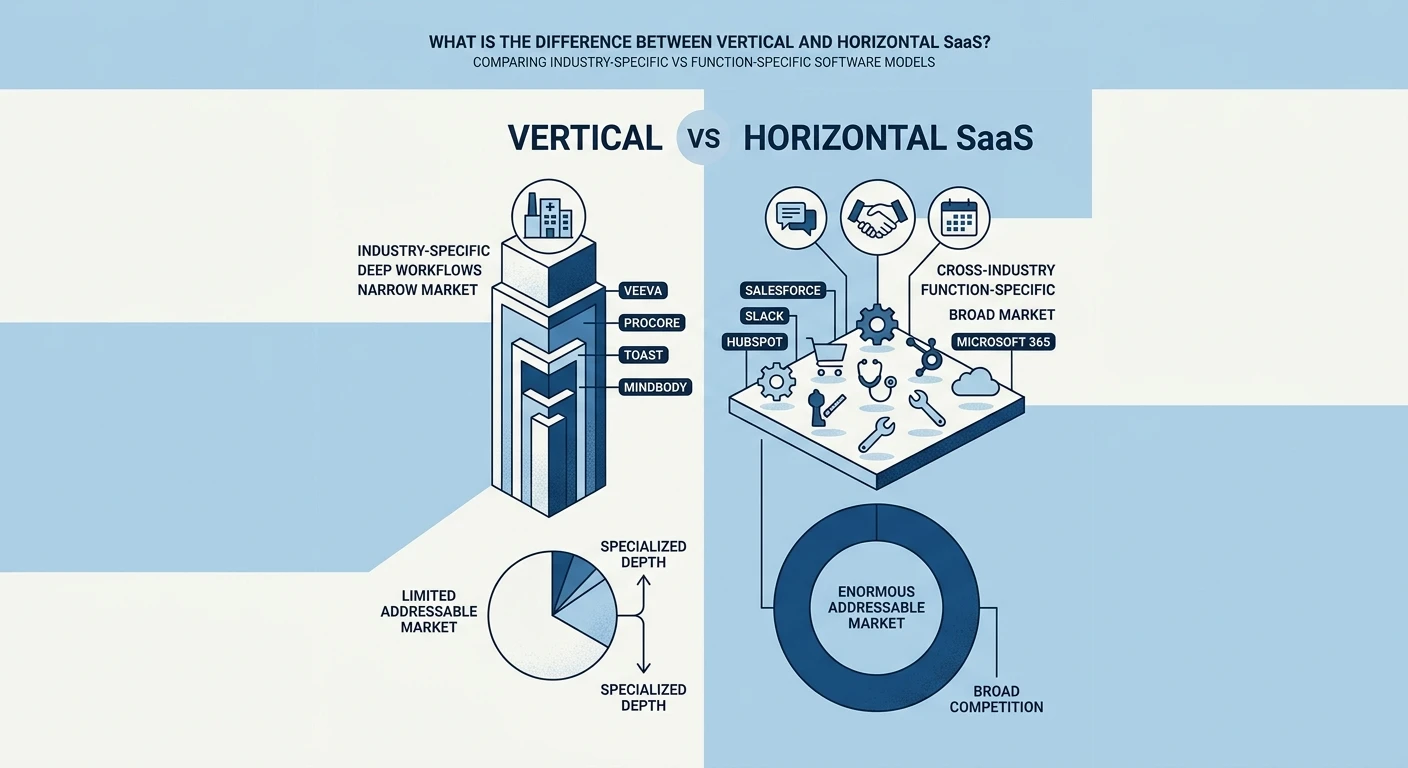
Horizontal SaaS products are built to serve a specific function across all industries. Salesforce works for a healthcare company, a manufacturing firm, and a media agency. Slack is used by startups, law firms, and government departments. HubSpot serves anyone who needs marketing automation regardless of what they sell.
The appeal of horizontal SaaS is obvious — the addressable market is enormous. If your product does something useful, theoretically every company in the world is a potential customer. The challenge is that the competition is equally broad. You are competing against well-funded giants in most horizontal categories, and differentiation on a feature level gets harder over time as every competitor adds the same capabilities.
Vertical SaaS
Vertical SaaS products are built specifically for one industry or market segment. Veeva Systems for pharmaceuticals. Toast for restaurants. Procore for construction. Mindbody for fitness businesses. These products understand the specific workflows, compliance requirements, terminology, and data structures of their target industry in ways that horizontal tools never quite match.
The appeal of vertical SaaS is depth over breadth — a product that really understands how a restaurant operates will always beat a generic business management tool for restaurant owners, even if the generic tool has more features on paper. The challenge is that the addressable market is smaller and growth eventually hits a ceiling within the vertical.
The Growth Rate Data — What 2026 Shows
Vertical SaaS Is Growing Faster
The headline finding from 2026 data is straightforward. Vertical SaaS companies report a median growth rate of 31% compared to 28% for horizontal SaaS companies. That three-percentage-point gap might sound small but at scale and over multiple years it compounds into a meaningful competitive and valuation difference.
This outperformance is consistent across multiple data sources and multiple years — it is not a 2026 anomaly. Vertical SaaS has been growing faster than horizontal for several consecutive years as the structural advantages of the model become increasingly apparent.
Why the Gap Exists
Higher win rates. A vertical SaaS product that genuinely understands its target industry wins evaluations against horizontal alternatives at a significantly higher rate — because the buyer can see immediately that the product was built for their context rather than adapted to it. Fewer deals lost to generic competitors means more efficient growth.
Lower churn. Vertical SaaS companies consistently report lower churn than horizontal ones. The reason is switching costs — a restaurant using a vertical POS and management system has workflows, staff training, menu data, and reporting all built around that specific product. Switching to a horizontal alternative means rebuilding all of that. The friction is high and customers stay longer.
Higher NRR. Lower churn combined with industry-specific expansion paths — compliance upgrades, seasonal features, regulatory reporting modules — drives higher net revenue retention in vertical SaaS than in most horizontal categories where expansion mechanisms are more generic.
Referral density. Industries are communities. Restaurant owners talk to other restaurant owners. Construction project managers share software recommendations with peers at other firms. Word-of-mouth referral spreads faster and more reliably within a defined vertical than across the broad horizontal market — which translates directly to lower CAC.
Market Size — Vertical SaaS by Industry
Healthcare SaaS
Healthcare is the largest and fastest-growing vertical SaaS market. The health cloud SaaS market is projected to reach $452.4 billion by 2029, growing at a CAGR of approximately 26% — double the overall SaaS market growth rate.
The drivers are structural and durable. Electronic health record digitization is still ongoing in many markets. Telehealth infrastructure built during the pandemic created ongoing demand for connected digital health tools. AI-assisted diagnostics and clinical decision support are creating entirely new software categories. And the regulatory complexity of healthcare creates meaningful moats for vendors that understand the compliance landscape.
Healthcare vertical SaaS also benefits from the stickiness that comes with clinical workflow integration. When a hospital system’s patient records, scheduling, billing, and clinical documentation are all running on one vertical platform, the switching cost is enormous — which produces the kind of GRR and NRR metrics that horizontal SaaS companies rarely achieve.
FinTech and Financial Services SaaS
Financial services is another high-growth vertical SaaS market driven by regulatory complexity, data intensity, and the high cost of legacy financial infrastructure. Revenue from AI data services for Machine Learning Operations tools in financial services is projected to nearly quadruple between 2024 and 2028.
FinTech SaaS companies targeting specific segments — wealth management, insurance, lending, payments — consistently report higher retention and higher ACV than comparable horizontal financial tools. The specificity of financial regulation means that a product built specifically for, say, community banks understands compliance requirements and workflow nuances that a generic business banking tool never will.
Restaurant and Hospitality SaaS
Restaurant technology is one of the most mature vertical SaaS markets — companies like Toast, Olo, and SevenRooms have demonstrated that the restaurant industry, despite being notoriously difficult to sell to, supports high-value SaaS businesses with strong retention once adoption is achieved.
The restaurant vertical is interesting because the product scope is so much broader than a horizontal equivalent. A restaurant vertical SaaS provider needs to handle POS, inventory, staff scheduling, reservation management, online ordering, loyalty programs, and kitchen display systems — all in one integrated product. No horizontal tool does all of this well, which creates genuine defensibility.
Construction and Real Estate SaaS
Construction is one of the least digitized major industries globally — which makes it one of the highest opportunity vertical SaaS markets. Procore, Autodesk Construction Cloud, and a growing ecosystem of point solutions are serving an industry that has historically run on spreadsheets, paper, and phone calls.
The digitization curve in construction is still in relatively early stages — which means growth rates for construction vertical SaaS companies are high and the competitive intensity is lower than in more mature verticals. Real estate SaaS is at a similar stage, with property management, transaction management, and market intelligence tools all seeing strong adoption from an industry that is modernizing later than most.
Legal and Compliance SaaS
Legal vertical SaaS is growing rapidly driven by two forces — the increasing cost of legal services making in-house technology investment more attractive, and the growing complexity of regulatory compliance creating demand for specialized compliance management tools.
Legal SaaS companies benefit from extremely high switching costs — migrating a law firm’s case management system or a corporate legal department’s contract management platform is a massive undertaking that most firms will avoid unless a product is genuinely failing them. This produces some of the highest retention rates in any SaaS vertical.
Where Horizontal SaaS Still Wins
Despite the growth rate data favouring vertical SaaS, horizontal is not going away — and for good reasons.
Total Addressable Market
The most obvious advantage of horizontal SaaS is market size. Salesforce’s TAM is every company in the world that has customers and a sales team. Veeva’s TAM is pharmaceutical and life sciences companies. Both have built enormous, valuable businesses — but the ceiling for Salesforce is orders of magnitude higher than for Veeva.
For founders with genuinely scalable ambitions — building toward a public company with tens of billions in market cap — horizontal SaaS provides the addressable market that makes that outcome possible. The largest vertical markets top out at hundreds of billions. The largest horizontal categories are measured in trillions.
Network Effects and Data Advantages
Many horizontal SaaS products develop data network effects that vertical competitors cannot replicate. A horizontal marketing analytics platform with millions of users across thousands of industries has benchmark data that a vertical equivalent for any single industry cannot match. A horizontal collaboration tool with billions of messages has language model training data that vertical communication tools cannot access.
These data advantages compound over time and become structural moats that are very difficult for vertical competitors to overcome even with deeper industry-specific functionality.
Speed of Iteration
Horizontal SaaS companies can iterate faster on core features because they have more customers using more use cases providing more feedback simultaneously. A vertical SaaS company serving restaurants gets product feedback from restaurant operators. A horizontal project management tool gets feedback from thousands of different work contexts — and the pattern recognition across those contexts often produces better core product decisions faster.
The Hybrid Model — Horizontal Platform, Vertical Applications
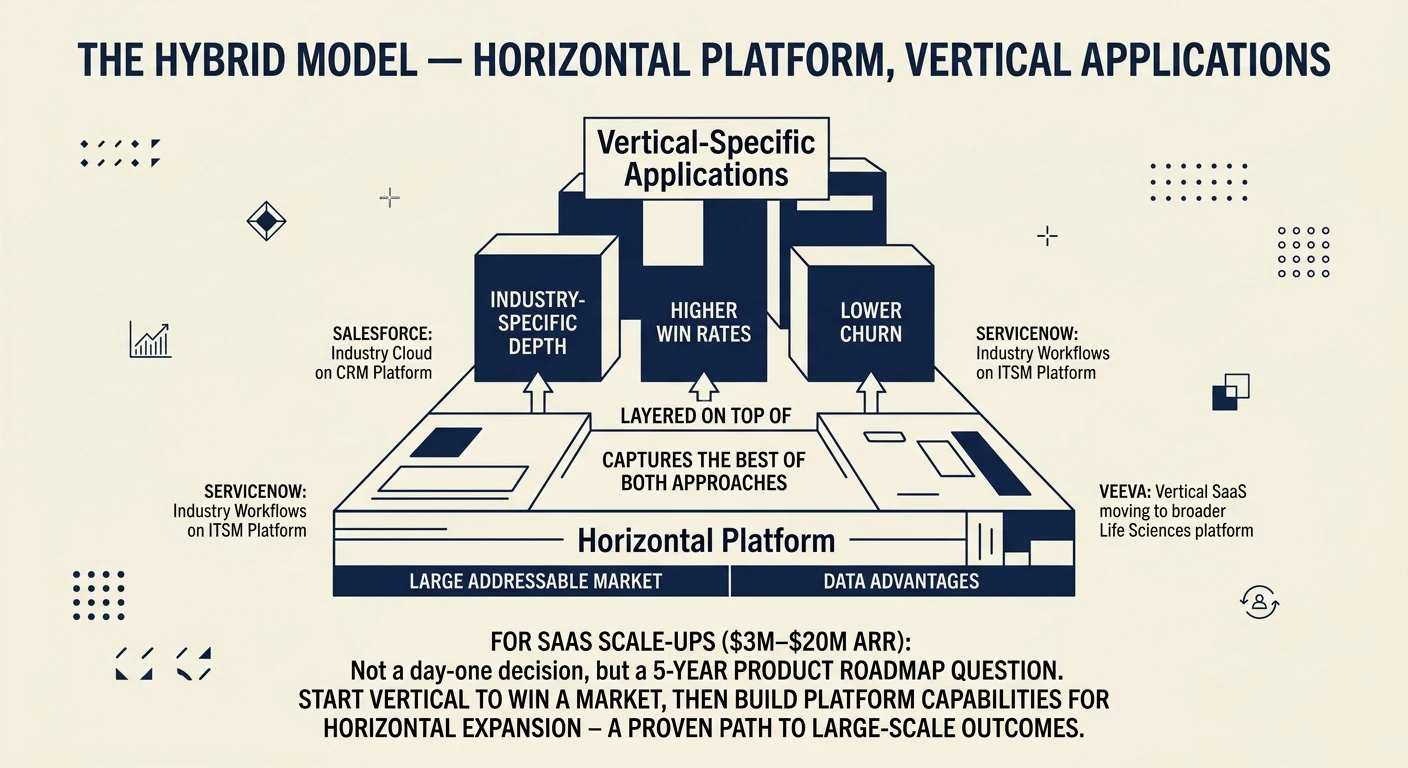
The most sophisticated strategic evolution in the SaaS market right now is the hybrid model — companies that build a horizontal platform and then layer vertical-specific applications on top of it.
Salesforce does this with its industry cloud products — vertical-specific configurations and features built on the horizontal CRM platform. ServiceNow does it with industry workflows built on top of its horizontal IT service management platform. Veeva itself started as vertical SaaS and is now building a broader platform that can expand into adjacent life sciences verticals.
This model captures the best of both approaches. The horizontal platform provides the large addressable market and data advantages. The vertical applications provide the industry-specific depth, higher win rates, and lower churn that pure horizontal competitors cannot match.
For SaaS companies at the scale-up stage with $3M–$20M ARR, this strategic direction is worth thinking about seriously — not as a day-one decision but as a five-year product roadmap question. Starting vertical to win a specific market and then building platform capabilities that allow horizontal expansion is a proven path to large-scale outcomes.
Comparing the Two Models — The Key Metrics
Metric | Horizontal SaaS | Vertical SaaS |
Median growth rate (2026) | 28% | 31% |
Total addressable market | Very large | Defined by vertical size |
Typical churn rate | 5–12% | 2–7% |
Typical NRR range | 95–110% | 100–120% |
CAC payback period | 12–24 months | 8–18 months |
Win rate vs competition | Lower (more competitors) | Higher (fewer competitors) |
Expansion revenue mechanisms | Generic (seats, tiers) | Industry-specific (compliance, regulatory) |
Switching cost | Low to medium | Medium to very high |
Referral density | Low (broad market) | High (tight industry community) |
Path to $100M ARR | Faster if it works | Slower but more predictable |
Which Should You Build in 2026?
The honest answer is that it depends on what you are trying to build and what you know.
Build vertical SaaS if:
You have deep domain expertise in a specific industry — you understand the workflows, the compliance requirements, the terminology, and the buying patterns better than any outsider would
The target industry is underserved by existing software — high spreadsheet and legacy system usage is a signal
You want more predictable growth with lower churn and higher win rates
The vertical is large enough to build a meaningful business — healthcare, financial services, construction, legal are all multi-billion dollar vertical opportunities
Build horizontal SaaS if:
You have a genuinely novel approach to a universal problem that transcends any specific industry
You are competing in a category where network effects and data advantages are more important than industry-specific depth
Your target customer is defined by a role or function rather than an industry — developers, marketers, CFOs — rather than by what industry they work in
You have the funding and team to compete in a category with established, well-funded horizontal incumbents
Consider the hybrid model if:
You are already at $5M+ ARR in a specific vertical and starting to see customers asking for capabilities that your current vertical focus does not cover
Your platform has genuine modularity that would allow vertical-specific applications to be built on top of a shared core
You have a customer base diverse enough across use cases that a platform strategy would serve them better than continuing to go deeper in one vertical dimension
Conclusion
The 2026 data gives vertical SaaS a clear edge on the metrics that matter most for building a durable, efficient SaaS business — growth rate, churn, NRR, and CAC payback. A 31% median growth rate versus 28% for horizontal, combined with structurally lower churn and higher retention, makes a compelling quantitative case for the vertical model for founders who have genuine industry expertise to build on.
But the horizontal model is not losing. It is just playing a different game — bigger market, more competition, lower win rates, but a ceiling that vertical SaaS can never reach. The largest SaaS companies in the world by market cap are almost all horizontal — because the total addressable market is what ultimately determines how big a business can become.
The most interesting strategic trend to watch is the hybrid model — horizontal platforms with vertical application layers. This is where the most sophisticated SaaS companies are heading, suggesting that the vertical-versus-horizontal question will eventually become less relevant as the best platforms figure out how to be both.
For founders choosing a direction in 2026 — if you have deep domain expertise in an underserved industry, go vertical. You will win more, churn less, and build faster to your first $10M ARR than any horizontal competitor starting from scratch in your market. Then decide what to do with the platform you have built once you own the vertical.
We will update this analysis as new growth-rate data become available through 2026.
FAQs
Vertical SaaS targets a specific industry or niche, such as healthcare or construction, with tailored features built for that sector. Horizontal SaaS serves businesses across multiple industries with general-purpose tools like CRM, HR, or accounting software.
Vertical SaaS is gaining momentum because it solves highly specific pain points that generic software cannot address, leading to stronger customer retention and less competition. Niche industries are willing to pay premium prices for solutions built around their unique workflows and compliance requirements.
Horizontal SaaS still dominates overall market share due to companies like Salesforce, Microsoft, and HubSpot serving massive audiences. However, Vertical SaaS is winning in growth rate and investor interest as underserved industries increasingly demand specialized solutions.
Vertical SaaS companies compete by offering deep industry expertise, pre-built integrations with sector-specific tools, and faster time-to-value for niche users. Their focused approach makes it difficult for broad horizontal platforms to replicate the same level of industry-specific functionality.
Many investors currently favor Vertical SaaS because it offers higher net revenue retention, lower churn, and clearer product-market fit within defined industries. While Horizontal SaaS has larger addressable markets, Vertical SaaS is seen as a more defensible and scalable bet in the current economic climate.
Comments
Be the first to leave a comment.