
Anthropic has confirmed that Claude will embed invisible watermarks into AI-generated text starting August 2, 2026. The move places Anthropic alongside Google, Microsoft, Meta, and OpenAI in a broader industry shift toward AI content transparency, one that SaaS teams building on these models should understand.
What Anthropic Actually Announced
New Claude models launched on or after August 2, 2026 embed a machine-readable, invisible signal directly into generated text. According to Anthropic’s own Help Center documentation, the mark does not change the meaning, quality, or readability of the output. It applies across every surface where Claude runs, the API, Claude.ai, Claude Code, Claude Cowork, Claude Tag, and cloud partner platforms including AWS, Google Cloud, and Microsoft Foundry.
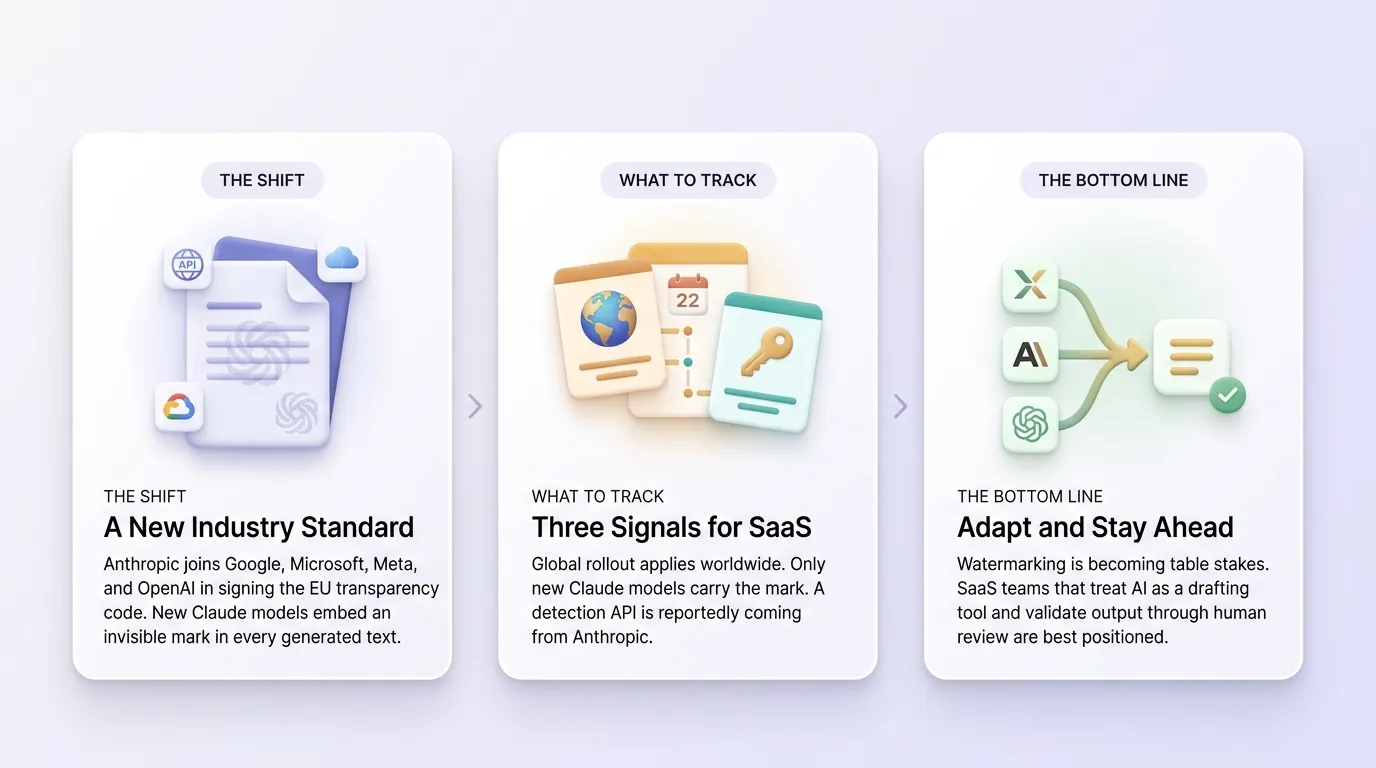
The trigger is the EU AI Act’s Article 50(2), which requires generative AI providers to mark output in machine-readable form. Anthropic signed the EU’s Code of Practice on Transparency of AI-Generated Content, a voluntary framework that nearly 200 companies have now joined, including direct competitors.
Why This Matters Beyond Compliance
For SaaS companies building products on top of Claude’s API, or using Claude internally for content and code generation, three things are worth tracking:
Global rollout, not EU-only. Anthropic applied the watermark worldwide rather than geo-fencing it to European users. If your SaaS product uses Claude’s API regardless of your company’s location, this affects your output.
Older models are exempt, for now. The watermark only applies to models launched on or after August 2, 2026. Anthropic says it’s working to extend marking to earlier models during the law’s transition period, but there’s no confirmed timeline yet.
A detection API is reportedly coming. According to industry coverage, an Anthropic engineer confirmed a self-serve text detection API is in development, alongside confirmation that the underlying model itself has no awareness it’s being watermarked. This means third parties, not just Anthropic, will eventually be able to check whether text came from a supported Claude model.
Industry Context: This Is a Pattern, Not an Outlier
Google has watermarked AI-generated images since 2023 through SynthID and has since extended similar technology to text. OpenAI has reportedly had text-watermarking capability for years but has held off deploying it, citing internal concerns about false positives and competitive pressure.
With Anthropic, Google, Meta, Microsoft, and OpenAI all now signed onto the same EU code, watermarking is rapidly becoming table-stakes infrastructure across the major model providers rather than a differentiator any single company owns.
What SaaS Teams Should Actually Do
If you’re building AI-content tools: understand that watermark signals can degrade through heavy editing, paraphrasing, translation, or when mixed with substantial human-written content. If your product’s value proposition depends on producing genuinely original, edited output rather than raw model completions, this shift doesn’t meaningfully change your risk profile.
If you’re evaluating model providers for a new integration: watermarking policy is becoming a real comparison point alongside pricing and context window size, worth factoring into vendor evaluation going forward, especially for any product operating in or serving EU markets.
If you’re using AI internally for content or code: this doesn’t change how you should already be validating AI output, human review, editing, and fact-checking remain the actual safeguard, watermarking is a downstream transparency mechanism, not a quality control system.
Youtube: Anthropic to watermark AI-generated text
Youtube: Claude Will Put Invisible Watermarks On AI Text And Images—And The Internet Isn’t Happy
X: https://www.threads.com/@cnn/post/Db7r0TCD1yt/video-anthropic-said-it-will-add-invisible-watermarks-to-text-generated-by-future/
Bottom Line
This isn’t Anthropic acting alone, it’s the AI industry converging on a shared transparency standard under regulatory pressure, with practical implications that extend well past the EU.
SaaS companies building on any major AI model provider should expect similar disclosure infrastructure to become standard across the board, not just at Anthropic.
Quick Links:
Comments
Be the first to leave a comment.