
The Shift That Changes How Product Pages Work
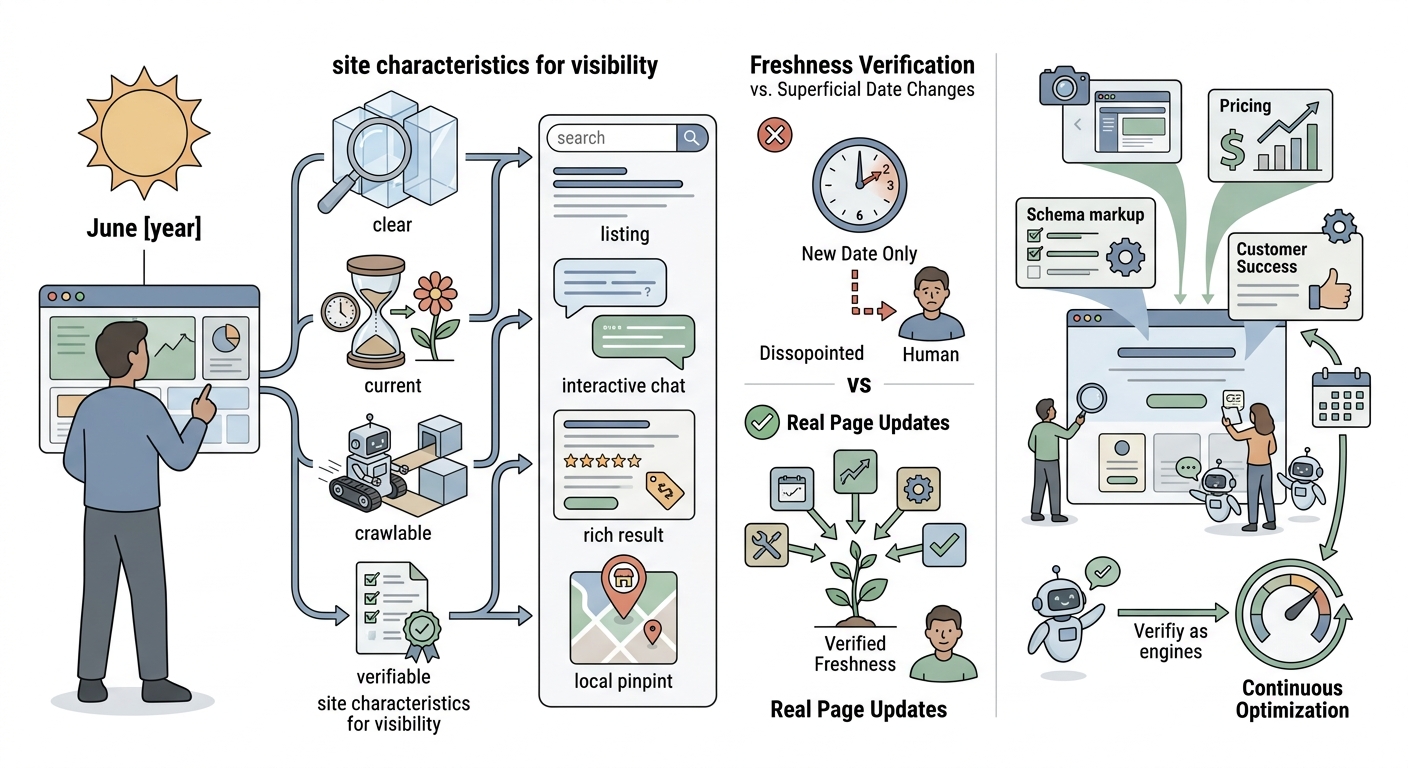
Technical SEO trends in June 2026 show that your site must be clear, current, crawlable, and verifiable if you want to be seen in search results, AI answers, rich results, and local discovery. Freshness now needs real page updates, not just a new date.
You benefit more when you refresh facts, examples, schema, links, screenshots, and intent match. Machines do not like ambiguity. Freshness now affects not just news content but also commercial, educational, and local pages.
The most important technical SEO insight from June 2026 for SaaS companies is that changing a page’s date without changing its content does not signal freshness to Google’s quality systems. This was always technically true but the enforcement is now more rigorous.
SaaS product pages that have been sitting with the same feature descriptions, the same pricing tables, and the same screenshots since 2024 are signalling staleness — even if the date was recently updated.
For SaaS companies, the practical response is treating product page maintenance as a monthly operational task rather than a one-time launch activity.
New feature screenshots, updated pricing information, refreshed customer case study references, and schema markup that reflects current product specifications are all genuine freshness signals that Google’s quality evaluation systems can verify independently of the date stamp on the page.
The Entity Validation Requirement
Entity validation matters more than keyword stuffing. Search systems want to know who you are, who wrote the page, what you sell, and how those things connect. Structured data, crawl control, and internal linking help machines trust your pages, meaning better chances of being indexed, quoted, summarised, and cited. EEAT is now technical as well as editorial.
EEAT being technical as well as editorial is the framing that should change how SaaS engineering and marketing teams collaborate on website maintenance. Structured data implementation is not a marketing task that can be deferred — it is the technical layer that makes editorial authority machine-verifiable.
A SaaS company with genuinely expert founders and genuine product credibility that has not implemented Organisation schema, Author schema on blog content, and Product schema on feature pages is letting its genuine authority go unverified by the systems that could be surfacing it in AI answers and rich results.
💬 Reddit — r/SaaS and r/TechSEO on technical freshness signals for product pages: 🔗 https://www.reddit.com/r/TechSEO/search/?q=technical+freshness+SaaS+product+page+SEO+2026
🐦 X/Twitter — SaaS marketers discussing technical SEO freshness requirements: 🔗 https://x.com/search?q=technical+SEO+freshness+SaaS+product+page+2026&f=live
💬 Quora — how often should SaaS companies update their product pages for SEO: 🔗 https://www.quora.com/search?q=SaaS+product+page+update+frequency+SEO+freshness+2026
Quick Links:
Comments
Be the first to leave a comment.