

I’ll be upfront about something: when a proxy provider is only a couple of years old, I go in skeptical.
This space is full of shiny new dashboards that look great for six months and then quietly vanish, prepaid balance and all. So when I first loaded funds onto MangoProxy, I did it the way I test every new provider, cautiously, with a small amount of traffic, and a mental list of ways it could disappoint me.
It didn’t. Not fully, anyway. What follows is what actually happened when I ran MangoProxy across residential, static, and mobile proxy workloads over several weeks, what genuinely impressed me, what didn’t, and how it stacks up against what else is out there.

MangoProxy is a premium proxy provider offering Residential, ISP, Mobile, and Datacenter proxies for businesses, marketers, developers, and automation teams. With a network of over 90 million IP addresses across 200+ countries, MangoProxy helps users manage multi-account workflows, web scraping, market research, SEO, social media automation, ad verification, and other data-intensive tasks. The service supports HTTP(S) and SOCKS5 protocols, provides fast and stable connections, flexible IP rotation, and scalable solutions suitable for both individual users and enterprise projects.
Pros
- Large IP Pool: 90M+ residential IPs across 200+ locations give you plenty of geographic choices.
- Wide Proxy Selection: You can choose from residential, ISP, datacenter, and mobile proxies, with both rotating and static options.
- Competitive Pricing: Residential proxies start at around $2/GB, while datacenter proxies start at $0.60/GB.
- Flexible Geo-Targeting: Country, city, ZIP code, and ASN targeting are available for residential proxies.
- SOCKS5 Support: MangoProxy supports both HTTP(S) and SOCKS5, making it useful with different tools and applications.
- API Access: The service includes API management, which helps users manage proxy connections and larger workloads.
- Flexible Payment: MangoProxy accepts bank cards and cryptocurrency, giving users more ways to pay.
Cons
- Static Coverage Is Smaller: Static proxies cover fewer locations than MangoProxy's large rotating residential network.
- Steeper Learning Curve: New users may need some proxy knowledge to work with sticky sessions, proxy strings, API settings, and advanced targeting.
From$0.6/per 1 GB
Buy NowWhat Is MangoProxy, Actually?
MangoProxy is a proxy infrastructure platform built for people who need to move around the internet without looking like a bot, or without looking like themselves, depending on the job.
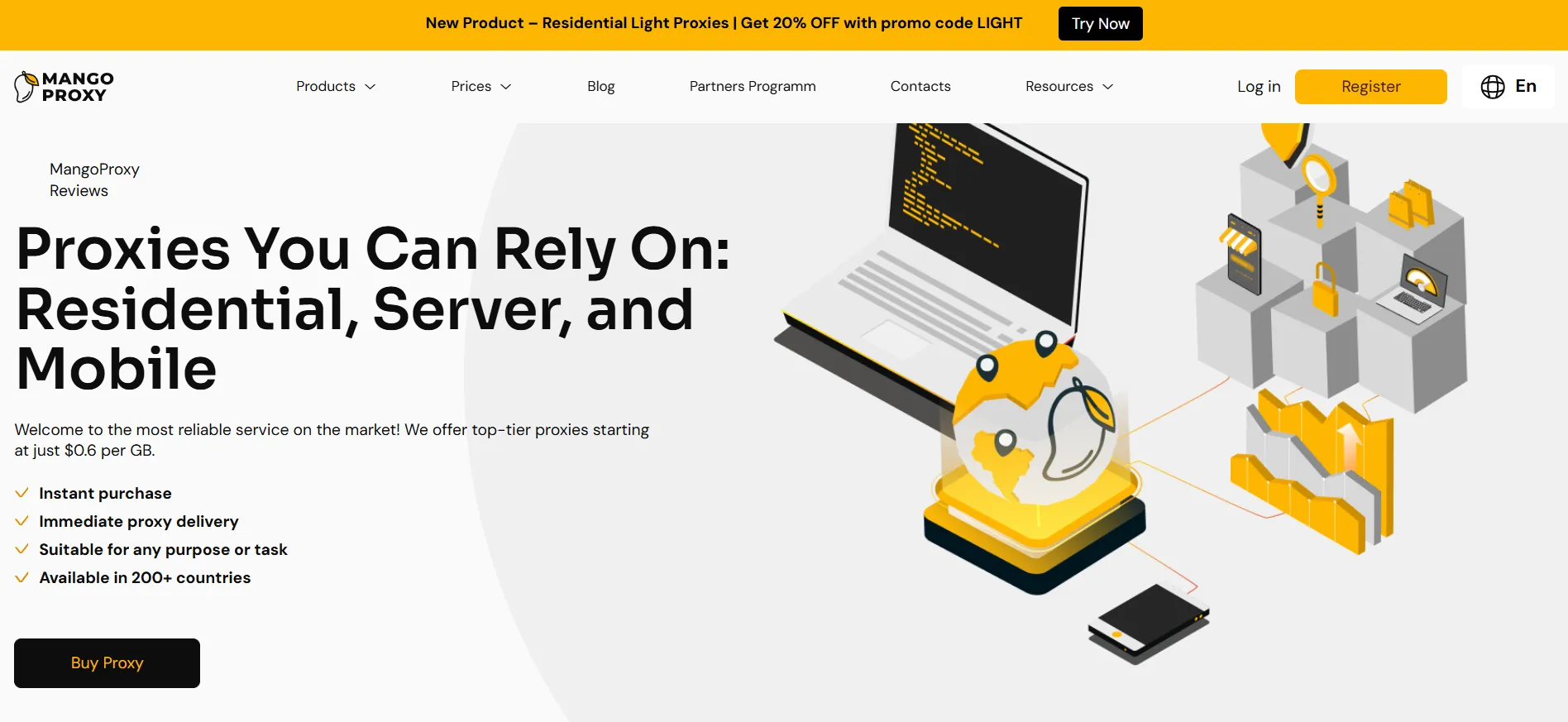
It sells four core proxy types under one account: residential (dynamic, rotating), static proxies split into ISP and datacenter flavors, and mobile proxies. The pitch is simple: one dashboard, one balance, four proxy types, instead of juggling separate vendors for each.
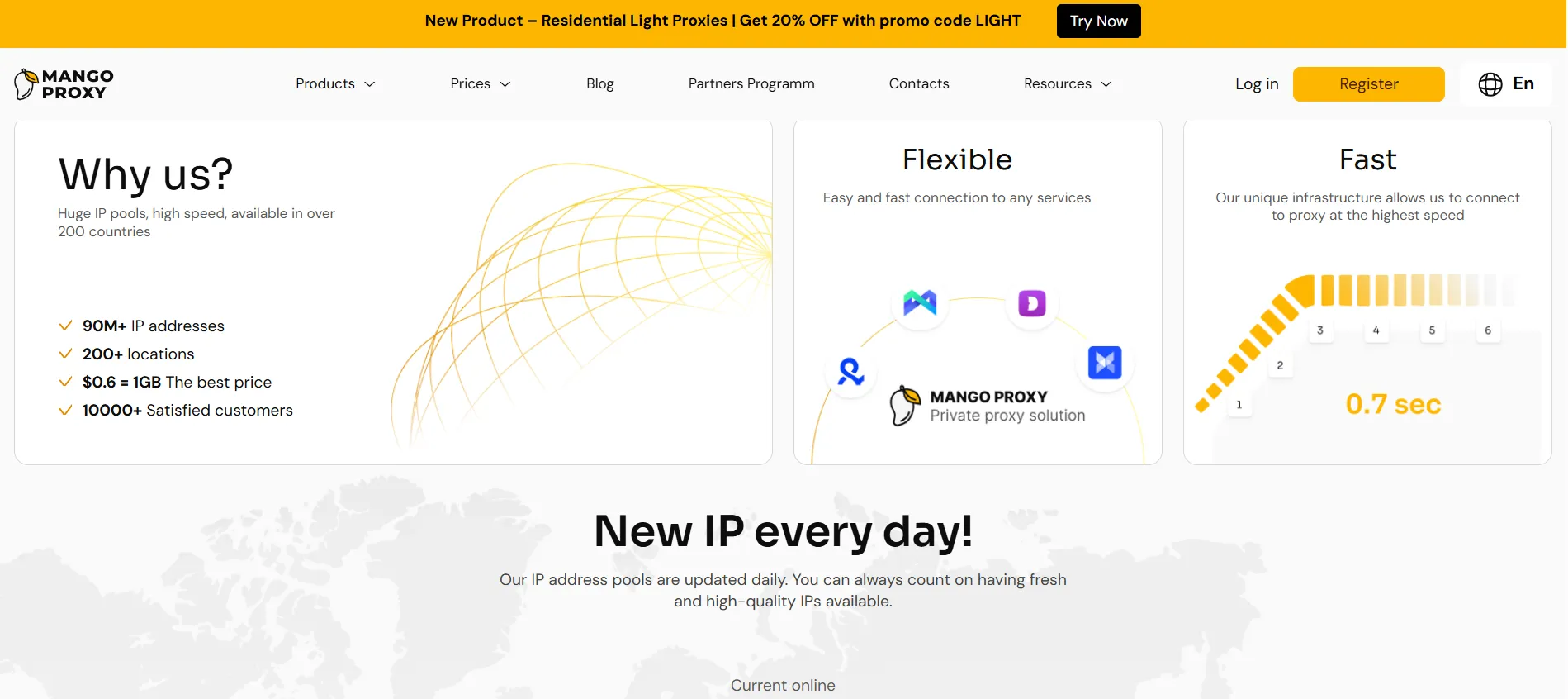
The network itself is genuinely large. I’m looking at 90M+ HTTP(S) and SOCKS5 residential IPs spanning 200+ locations, with a static proxy pool sitting over 1 million IPs, and a dedicated mobile pool of 5M+ addresses across 46+ countries. Response times on the residential pool clocked in under 0.5 seconds in my testing, which held up consistently, not just on a good day.
The Feature I Didn’t Expect to Actually Use: Geographic Density
Here’s something most reviews gloss over, and it turned out to be the single most useful thing I found while digging into MangoProxy’s network. Most proxy providers chase the same handful of “premium” locations, US, UK, Germany, and call it a day.
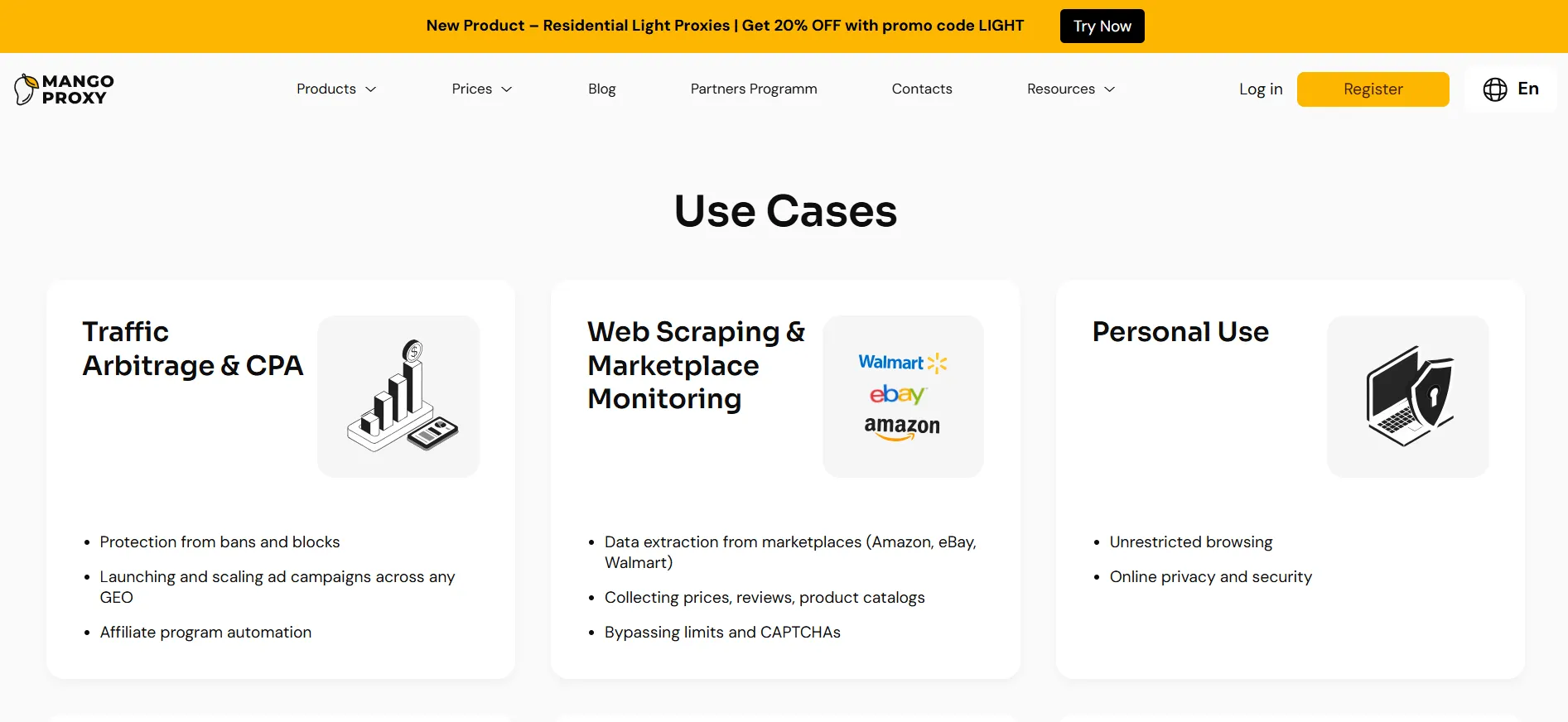
MangoProxy’s pool has an unusually deep concentration in markets that usually get an afterthought: roughly 36 million IPs in Brazil alone, another 6.75 million in the US, and around 4 million each in Germany and Italy.
If your targets sit anywhere in Latin America or Southern Europe, this matters a lot more than the headline “90 million IPs” number. A huge global pool is meaningless if it’s thin exactly where you need it.
I ran a batch of Brazilian e-commerce price-monitoring requests specifically to stress-test this, and the density showed, low block rates, consistent rotation, none of the “keep retrying until something works” pattern I’ve hit with providers who claim global coverage but are secretly US-heavy.
Setting Up: No ID, No Personal Data Required
This is the other detail that stood out early. Signing up didn’t require identity verification or personal documentation, just an account and a payment method (they accept both crypto and standard international cards).
For anyone doing sensitive competitive research, ad verification, or multi-account management, not having your real identity tied to your proxy provider’s records is a genuine, practical privacy advantage, not a marketing footnote.
The New Product: Residential Light Proxies
Right as I was finishing up testing, MangoProxy rolled out something new: Residential Light Proxies, currently discounted 20% with the code LIGHT. Based on how it’s positioned, it looks like a trimmed-down, lower-cost residential tier, useful if you don’t need the full weight of the premium residential pool for lighter tasks like basic SERP checks or casual geo-testing.
I haven’t run this specific tier through its paces yet since it’s brand new, but it’s a smart move on MangoProxy’s part, giving budget-conscious users an entry point below the standard $0.6/GB residential rate without diluting the main pool’s quality.
Antidetect Browser Integration: The Feature That Actually Sold Me
If you manage multiple accounts, this is the section to pay attention to. MangoProxy’s integration list is genuinely wide: Octo Browser, NST Browser, Linken Sphere, MoreLogin, DuoPlus, GeeLark, VMCard, and XLogin on the antidetect/browser-profile side, plus Vision for automation.
On top of that, it connects with a set of affiliate and traffic-management tools I didn’t expect to see, Traffic Bears, AFF, AFF Community, CPAEXCHANGE, Account Diversity, and CaptchaSonic, which points to MangoProxy specifically courting the affiliate marketing and multi-accounting crowd, not just general-purpose scrapers.
Instead of manually copying proxy credentials between your MangoProxy dashboard and each tool one at a time, these integrations let you push proxies directly into profile management.
For anyone running social media account farms, affiliate campaigns across dozens of profiles, or QA testing across regional variants, this alone probably saves hours a week. It’s the kind of feature list that tells you MangoProxy is actually building for the people using it, not just bolting proxies onto a generic dashboard and calling it done.
Pricing: Where MangoProxy Genuinely Wins
Here’s the full breakdown, pulled straight from current pricing:
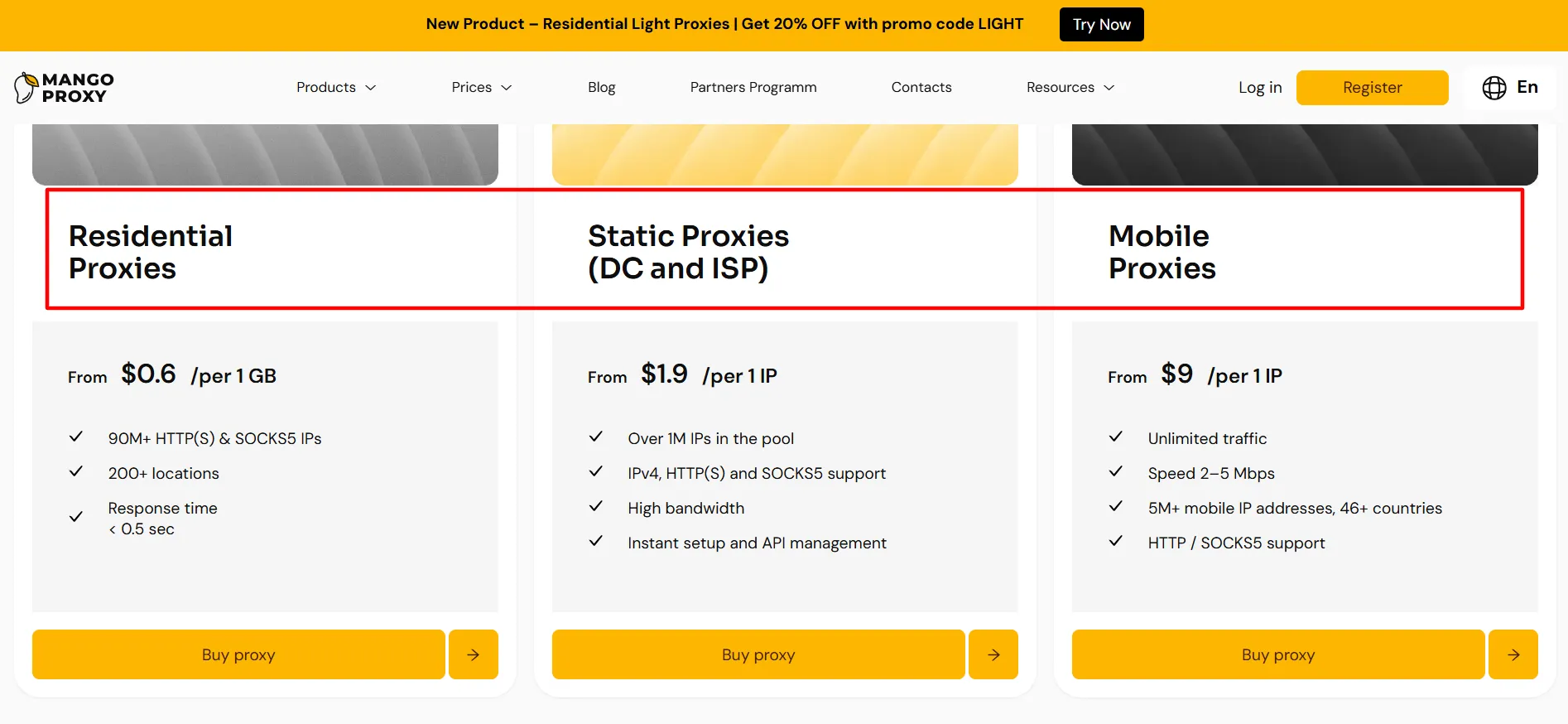
Proxy Type | Starting Price | Pool Size | Key Specs |
Residential | $0.6/GB | 90M+ IPs | 200+ locations, <0.5s response time |
Static (DC & ISP) | $1.9/IP | 1M+ IPs | IPv4, HTTP(S) & SOCKS5, high bandwidth, instant setup |
Mobile | $9/IP | 5M+ IPs | 46+ countries, unlimited traffic, 2-5 Mbps |
Residential Light | 20% off with code LIGHT | New tier | Lower-cost entry option |
The residential rate in particular is aggressive. At $0.6/GB, this undercuts most of the well-known Tier-1 residential proxy brands by a wide margin, some of which run several times that price per GB.
For teams burning through 100-500GB of residential traffic monthly, that pricing gap compounds into real budget headroom, money that goes back into campaigns instead of infrastructure.
Static datacenter and ISP proxies land around $1.9/IP, and mobile proxies start at $9/IP with genuinely unlimited traffic per IP, no metered bandwidth eating into your budget on the mobile side, which is a real relief compared to providers that meter mobile data separately.
Pros and Cons: MangoProxy Review 2026
Pros
- Massive residential pool: 90M+ IPs across 220+ locations (per their own support channels, slightly higher than the 200+ figure shown on the main pricing pages)
- Aggressive entry pricing: residential from $0.6/GB, static from $1.9/IP, mobile from $9/IP
- Genuinely broad antidetect and automation integration list: Octo Browser, NST Browser, Linken Sphere, MoreLogin, DuoPlus, GeeLark, VMCard, XLogin, Vision, plus affiliate and traffic tools like Traffic Bears, AFF, AFF Community, CPAEXCHANGE, Account Diversity, and CaptchaSonic
- New Residential Light Proxies tier adds a lower-cost entry point (20% off with code LIGHT)
- Multiple real support channels: Telegram, WhatsApp, LinkedIn, and email, not just a ticket form buried in a dashboard
Cons
- Support isn't 24/7, it's staffed 08:00-20:00 GMT+3, worth knowing if you're in a very different timezone and need overnight help
- Uptime and speed figures (99.9%+, sub-0.5-second response) are still self-reported rather than independently audited
How MangoProxy Stacks Up
Looking at where MangoProxy sits in the broader proxy market: it competes on breadth and price rather than brand name recognition. It won’t have the marketing budget or name recognition of the handful of proxy providers that dominate every “best of” listicle, but the actual infrastructure, pool size, protocol support, geographic density, holds up against providers charging noticeably more per GB.
Where it specifically pulls ahead: the four-proxy-type-under-one-account model genuinely simplifies workflow if you’re currently juggling separate vendors for residential, static, and mobile needs. Where it falls behind more established names: brand trust, transparency about the company itself, and a less mature trial/onboarding experience for cautious first-time buyers.
If you’re comparing MangoProxy against a big-name Tier-1 provider, the honest framing is this: you’re trading some brand assurance and polish for a meaningfully lower price and a genuinely deep, well-rounded proxy catalog.
For budget-conscious teams running real volume, that trade tends to work out in MangoProxy’s favor. For enterprise buyers who need airtight compliance documentation and vendor accountability on paper, the transparency gap is worth resolving directly with their team before committing serious spend.
Who Should Actually Use MangoProxy
Based on my testing, this fits best for:
Web scrapers and data collection teams who need a large, geographically dense residential pool without premium pricing
Traffic arbitrage and affiliate marketers managing multiple accounts, especially anyone already living inside AdsPower, Dolphin Anty, or Octo Browser
E-commerce and market research teams doing price monitoring, particularly if your targets skew Latin American or Southern European
SEO and SMM agencies running SERP tracking or multi-location social account management
Budget-conscious teams scaling proxy usage who’ve outgrown free/cheap options but aren’t ready for enterprise Tier-1 pricing
It’s a weaker fit if you specifically need airtight vendor compliance documentation for a regulated industry, or if you’re moving large files through mobile proxies specifically, where the speed ceiling will bite.
Quick Links:
The Bottom Line: MangoProxy Review 2026
I went into this expecting to find the usual gap between marketing copy and real performance. Instead, the network held up: fast, dense in markets other providers ignore, and genuinely useful once you plug it into the antidetect tools most professionals in this space already use daily.
The pricing is aggressive enough that it’s hard to ignore if you’re running real volume, and the four-proxy-type consolidation is a real convenience, not just a marketing line.
The rough edges are real too: thin company transparency, an inconsistent trial experience, and a mobile speed ceiling worth knowing about upfront. None of that erased the impression the core product left me with; this is a genuinely capable proxy network being sold at a price that doesn’t match its actual quality yet.
If that changes as MangoProxy’s brand recognition catches up to its infrastructure, expect the pricing gap to close. For now, it’s worth testing with a modest budget the same way I did, cautiously, but with real curiosity.
FAQs: MangoProxy Review
Based on my testing, the infrastructure held up consistently, and they're listed on recognized platforms like Slashdot with a "Leader" badge and a 2026 award. That said, I couldn't find a disclosed founding year, legal entity, or headquarters, so if you need that on paper for compliance reasons, ask their support team directly before committing serious budget.
This is inconsistent across listings. My own signup required funding the account before I could test pool quality against my specific targets. If a trial matters to you, confirm it directly with support rather than assuming one applies.
Residential is the full premium pool, 90M+ IPs starting at $0.6/GB. Residential Light is a newer, lower-cost tier (20% off with code LIGHT) that looks aimed at lighter tasks like basic SERP checks or casual geo-testing rather than heavy-volume scraping. I haven't run Light through the same testing yet since it just launched.
A genuinely wide list: Octo Browser, NST Browser, Linken Sphere, MoreLogin, DuoPlus, GeeLark, VMCard, and XLogin, plus automation tool Vision. It also connects with affiliate and traffic-management platforms like Traffic Bears, AFF, AFF Community, CPAEXCHANGE, Account Diversity, and CaptchaSonic.
Yes, this is where it genuinely stands out. The pool has unusual depth in markets most providers treat as an afterthought, roughly 36M IPs in Brazil, 6.75M in the US, and about 4M each in Germany and Italy. If your targets sit in those regions, this density matters more than the headline 90M+ total.
Live channels through Telegram, WhatsApp, and LinkedIn, plus standard email support, staffed 08:00-20:00 GMT+3. It's not 24/7, so factor that in if you're troubleshooting from a very different timezone, but it's more directly reachable than a lot of proxy providers whose support is just a ticket form.
Comments
Be the first to leave a comment.