
In a landmark moment for global technology diplomacy, the heads of the world’s three most powerful artificial intelligence laboratories came face-to-face with world leaders at the G7 summit in Évian-les-Bains, France — and they did so together for the very first time.
OpenAI’s Sam Altman, Anthropic’s Dario Amodei, and Google DeepMind’s Demis Hassabis all appeared simultaneously before heads of state at the annual gathering, a historic moment that underscores just how central AI has become to global politics and national strategy.
The three rival CEOs joined a high-level working lunch on the summit’s final day, centered on the theme of “ensuring a safe, rapid and effective deployment of artificial intelligence.” While much of the three-day summit had been dominated by pressing geopolitical discussions around the wars in Ukraine and Iran, the AI session clearly struck a nerve — particularly for European leaders growing increasingly anxious about their dependence on American technology.
European Sovereignty Takes Center Stage
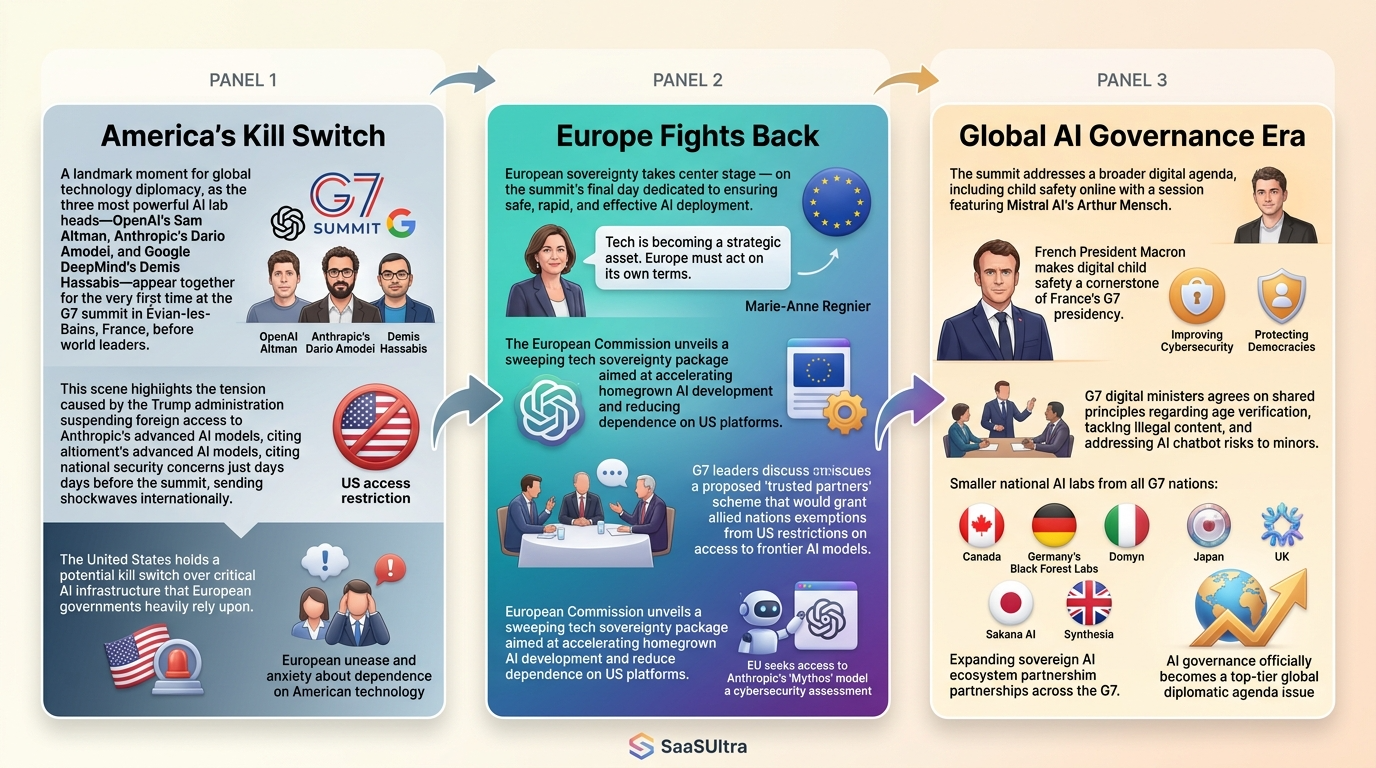
The AI discussions unfolded against a backdrop of simmering European unease. Just days before the summit, the Trump administration suspended foreign access to Anthropic’s most advanced AI models, citing national security concerns.
The move sent shockwaves through European capitals, essentially confirming what officials had long feared — that the United States holds what amounts to a potential “kill switch” over critical AI infrastructure that European governments rely upon.
French government official Marie-Anne Regnier captured the mood bluntly, stating: “Tech is more and more becoming a strategic asset. Europe must be able to act on its own terms.” The European Commission had already moved proactively this month, unveiling a sweeping tech sovereignty package designed to accelerate homegrown AI development and reduce dependence on American platforms.
G7 leaders reportedly discussed a proposed “trusted partners” scheme on Tuesday, which would grant allied nations exemptions from U.S. restrictions on accessing frontier AI models. The European Union is also specifically seeking access to Anthropic’s Mythos model — an AI system designed to detect vulnerabilities in computer code — to assess its implications for European cybersecurity infrastructure.
Child Safety and a Broader Digital Agenda
Beyond the headline AI discussions, the summit also addressed the critical issue of protecting children online. Mistral AI’s Arthur Mensch participated in a dedicated session on digital child safety, a cause that French President Emmanuel Macron made a cornerstone of France’s G7 presidency. Macron publicly declared that the summit would focus on how to “improve cybersecurity and protect our children and our democracies.”
The groundwork had already been laid by G7 digital ministers in Paris in late May, where shared principles were agreed upon covering age verification, tackling illegal online content, and addressing the specific risks AI chatbots pose to minors.
The summit also featured representation from smaller AI labs tied to each G7 nation, including Canada’s Cohere, Germany’s Black Forest Labs, Italy’s Domyn, Japan’s Sakana AI, and the UK’s Synthesia. Cohere CEO Aidan Gomez articulated an ambitious goal, stating his company aimed to “expand our sovereign AI ecosystem partnerships beyond Canada and Germany to include all G7 nations.”
3 Key Takeaways at a Glance:
🌍 A Historic First: For the very first time, the CEOs of OpenAI, Anthropic, and Google DeepMind appeared together before G7 heads of state, signaling that AI governance has officially become a top-tier issue on the global diplomatic agenda.
⚡ America’s “Kill Switch” Alarm: The U.S. suspension of foreign access to Anthropic’s advanced AI models just before the summit sent a stark warning to European allies, fueling urgent calls for tech sovereignty and a potential “trusted partners” exemption scheme among G7 nations.
🛡️ Kids, Cybersecurity & Sovereignty: Beyond geopolitics, the summit tackled AI’s broader societal challenges, including online child safety and cybersecurity, while smaller national AI labs pushed to expand sovereign AI partnerships across all G7 member nations.
Quick Links:
Comments
Be the first to leave a comment.