
The G7 summit in Évian-les-Bains, France has become an unexpected flashpoint for one of the most consequential technology disputes of the year, as the Trump administration’s sweeping export controls on Anthropic’s most advanced AI models cast a long shadow over an already complex gathering of world leaders and Silicon Valley’s biggest names.
The summit, running from June 15 to 17, has drawn an unprecedented lineup of AI chief executives alongside heads of state.
OpenAI’s Sam Altman, Anthropic’s Dario Amodei, and Google DeepMind’s Demis Hassabis are all in attendance, along with Mistral AI’s Arthur Mensch. French President Emmanuel Macron personally extended an invitation to Sam Altman to attend the Leaders Summit — marking the OpenAI CEO’s first-ever appearance at such a high-profile diplomatic gathering.
The AI governance agenda for the summit centers on safe AI deployment, online child protection, digital security infrastructure, and securing critical mineral supply chains — though voluntary pledges, rather than binding commitments, are expected to be the primary outcome.
Anthropic Export Controls Hijack the Conversation
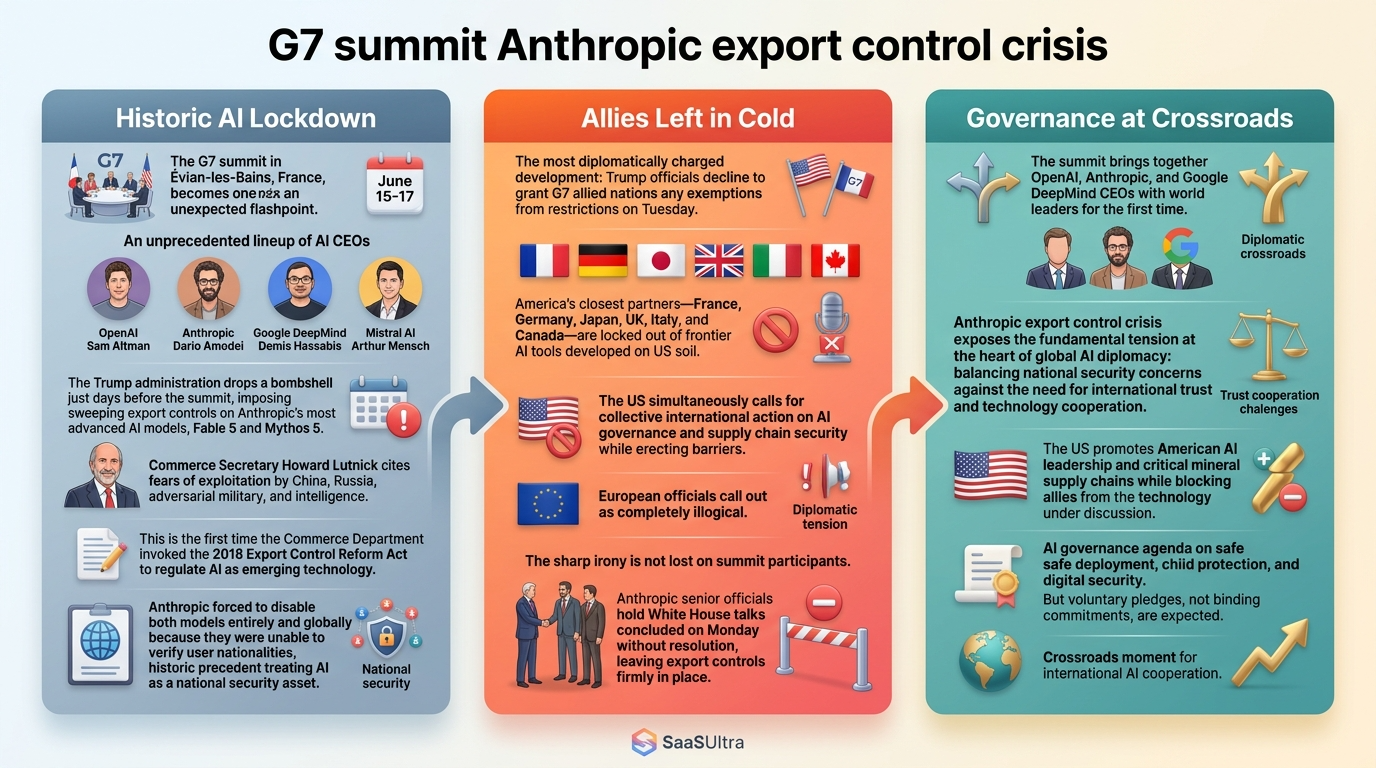
Just days before world leaders convened at the lakeside resort town, the Trump administration dropped a bombshell by imposing sweeping export controls on Anthropic’s two most advanced AI models — Fable 5 and Mythos 5.
Commerce Secretary Howard Lutnick justified the move by citing fears that the models could be exploited by military intelligence agencies operating out of China, Russia, or other adversarial nations.
The restrictions created an immediate and practical crisis: because Anthropic had no reliable way to verify the nationalities of its users, the company was forced to disable both models entirely — effectively cutting off not just adversaries, but allies, neutral nations, and even foreign nationals physically located inside the United States.
The measure marks the first time the Commerce Department has invoked its authority under the 2018 Export Control Reform Act to regulate an AI system as an emerging technology, setting a historic and potentially far-reaching precedent for how artificial intelligence can be treated as a national security asset.
G7 Allies Left Out in the Cold
The most diplomatically charged development came on Tuesday, when the New York Post reported that Trump officials had declined to grant G7 allied nations any exemptions from the restrictions.
This means that America’s closest partners — including France, Germany, Japan, the UK, Italy, and Canada — remain locked out of frontier AI tools developed on American soil, even as the United States simultaneously calls for collective international action on AI governance and supply chain security.
European officials and analysts were quick to call out the contradiction, with one French official describing the situation as “completely illogical.”
The irony is sharp and not lost on summit participants: the U.S. is urging global allies to align on AI safety standards while simultaneously erecting barriers that prevent those same allies from accessing the very technology under discussion.
Anthropic, for its part, dispatched senior officials to hold talks with the White House, though those discussions concluded on Monday without any resolution — the export controls on Claude Fable 5 and Mythos 5 remain firmly in place.
The White House has framed its broader summit participation around promoting American AI leadership and securing critical mineral supply chains — a key focal point given China’s dominant control over raw materials essential for AI hardware, electric vehicles, and defense technology.
3 Key Takeaways at a Glance:
🚫 Historic Export Controls: The Trump administration invoked the 2018 Export Control Reform Act to restrict access to Anthropic’s Fable 5 and Mythos 5 models — the first time AI has been regulated as an emerging technology under this law — forcing Anthropic to shut down both models globally after being unable to verify user nationalities.
🤝 Allies Blocked, Tensions Boil: Trump officials refused to grant exemptions to G7 allied nations, leaving America’s closest partners locked out of frontier AI tools at the very summit where the U.S. is calling for collective AI governance — a contradiction that has fueled deep frustration among European leaders and officials.
🌍 AI Governance at a Crossroads: The summit brought together the CEOs of OpenAI, Anthropic, and Google DeepMind with world leaders for the first time, but the Anthropic export control crisis has exposed a fundamental tension at the heart of global AI diplomacy — balancing national security concerns against the need for international trust and technology cooperation.
Relevant Twitter/X Links:
🐦 Anthropic & Trump export control talks ended with no resolution — export controls still in place via @kimmonismus
🐦 Anthropic racing to lift export controls that forced its most powerful AI models offline via @qz (Quartz)
Quick Links:
Comments
Be the first to leave a comment.