

Chatbots have moved from novelty to necessity. In 2026, nearly a billion people use AI chatbots worldwide, businesses are saving billions in operational costs, and the technology powering these conversations has changed dramatically thanks to generative AI. Whether you are a business owner, marketer, or someone trying to understand where this industry is headed, this guide brings together the most comprehensive and up-to-date chatbot statistics available — all in plain English.
The Big Picture: Chatbot Market Size and Growth
The numbers are hard to ignore. The global chatbot market has grown at a pace few industries match, and the trajectory through 2030 shows no sign of slowing down.
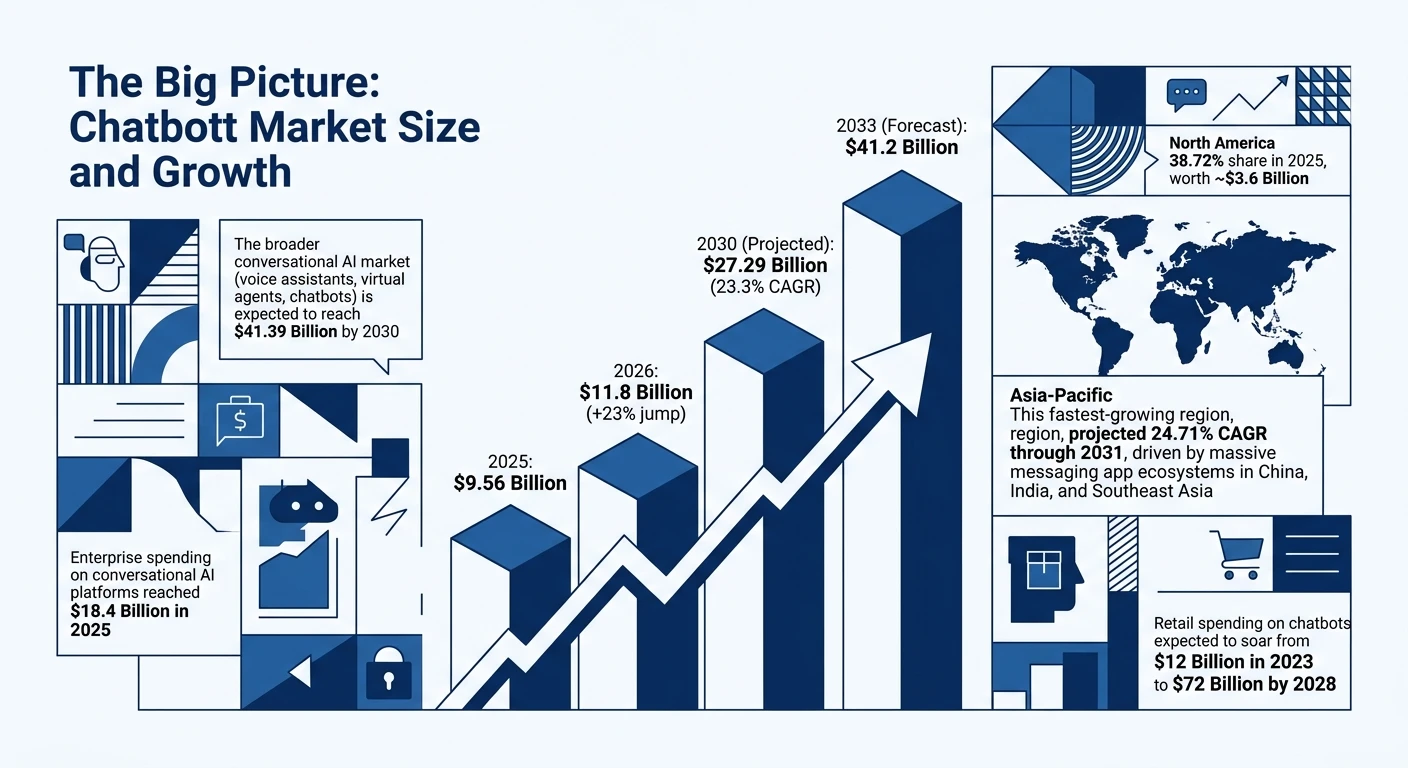
The global chatbot market reached approximately $11.8 billion in 2026, up from $9.56 billion in 2025 — a 23% jump in a single year (Grand View Research)
The market is projected to hit $27.29 billion by 2030, growing at a compound annual growth rate of 23.3% (Grand View Research)
By 2033, some forecasts put the chatbot market at $41.2 billion — nearly four times the 2026 valuation
The broader conversational AI market — which includes voice assistants, virtual agents, and chatbots — is expected to reach $41.39 billion by 2030 (Grand View Research)
North America leads the global chatbot market with a 38.72% share in 2025, worth approximately $3.6 billion (Mordor Intelligence)
Asia-Pacific is the fastest-growing region, with a projected CAGR of 24.71% through 2031 (Mordor Intelligence), driven by massive messaging app ecosystems in China, India, and Southeast Asia
Enterprise spending on conversational AI platforms reached $18.4 billion in 2025 (Gartner)
Retail spending on chatbots is expected to soar from $12 billion in 2023 to $72 billion by 2028 (Botpress)

Year | Global Chatbot Market Size |
2024 | ~$8.7 billion |
2025 | ~$9.56 billion |
2026 | ~$11.8 billion |
2027 | ~$14.55 billion |
2028 | ~$17.95 billion |
2030 | ~$27.29 billion |
How Many People Use Chatbots in 2026?
Chatbot adoption has crossed a threshold that makes it impossible to call a niche technology anymore.
More than 987 million people now use AI chatbots worldwide — nearly one billion users (DemandSage)
Over 1 billion people use AI tools of some kind every month
80% of consumers have interacted with a chatbot at least once (Route Mobile)
67% of consumers worldwide used a chatbot in the past 12 months
91% of businesses with 50+ employees now use AI chatbots somewhere in the customer journey (Tidio)
Among Fortune 500 companies, the adoption rate of large language models is 92%
74% of businesses are now using or piloting generative AI chatbots, up from just 23% in early 2023 (McKinsey)
Enterprise generative AI chatbot adoption grew 340% between Q1 2023 and Q1 2026 (Gartner)
78% of CIOs plan to increase chatbot and conversational AI budgets in 2026 (Gartner)
64% of small businesses plan to adopt chatbots by the end of 2026
AI Chatbot Market Share: Who’s Winning in 2026?
The biggest story in AI chatbots in 2026 is not just growth — it is the dramatic shift in who owns the market.
ChatGPT dominated the space for most of 2024 and early 2025, but competition has arrived at scale.
ChatGPT holds approximately 79.79% of the global AI chatbot market share as of early 2026 (StatCounter)
In the United States specifically, ChatGPT’s share is 75.91%, followed by Microsoft Copilot at 9.35%
In Europe, ChatGPT holds 80.02% of AI chatbot market share
ChatGPT now has 900 million weekly active users — more than double the 400 million reported in February 2025
ChatGPT recorded 5.35 billion monthly visits in February 2026
Users send 2.5 billion prompts per day on ChatGPT
The ChatGPT mobile app reached its highest monthly downloads ever at 73.4 million in December 2025
Total ChatGPT app downloads have reached 1.44 billion since May 2023
Google Gemini has grown rapidly, with monthly visits jumping from 267.7 million to 2 billion — a 647% increase year over year
Microsoft Copilot holds around 9.35% of the U.S. market
Other notable players include DeepSeek (4%), Perplexity (2%), and Claude (2%)
AI Chatbot | Global Market Share (2026) |
ChatGPT | ~79.79% |
Google Gemini | ~8–18% (growing fast) |
Microsoft Copilot | ~9.35% (US) |
DeepSeek | ~4% |
Perplexity | ~2% |
Claude (Anthropic) | ~2% |
Business Adoption: How Companies Are Using Chatbots
Chatbot adoption has gone from experimental to essential across nearly every business function.
58% of B2B companies and 42% of B2C companies have integrated chatbot technology into their operations
By 2027, 25% of organisations will use chatbots as their primary customer service channel (Gartner)
Salesforce reports that 30% of service cases are now resolved entirely by AI, with a projection of 50% by 2027
69% of service professionals say their organisation uses at least one form of AI
By 2026, 40% of enterprise applications will feature task-specific AI agents
83% of new enterprise chatbot deployments in 2026 use some form of large language model (LLM) technology (Forrester)
Chatbot adoption across businesses grew roughly 4.7 times between 2020 and 2025 (Fullview)
92% of HR departments guide new employees to chatbots for accessing company information
Career sites that use chatbots report 95% more leads, 13% more clicks on job listings, and 40% more completed applications
62% of people use virtual assistants to satisfy their HR needs
The Money Side: Cost Savings and ROI
This is where chatbots make the strongest business case. The numbers on cost savings and return on investment are striking.
A chatbot interaction costs $0.50 to $0.70 compared to $6 to $15 for a human agent interaction — a difference of 12 times or more
Businesses report an average of $8 returned for every $1 invested in chatbot technology (Botpress)
Companies save an average of $2.5 million annually through chatbot implementation (IBM)
Chatbots have collectively saved businesses 2.5 billion working hours globally (DemandSage)
Gartner projects $80 billion in contact centre labour cost reductions by the end of 2026
First-year ROI from chatbot implementation averages 340%, with leading implementations reaching up to 533% within nine months (Juniper Research)
57% of businesses report significant ROI within the first year of deployment
AI chatbots reduce customer service costs by 30–40% by handling routine enquiries (McKinsey)
Businesses with high inquiry volumes — 100+ per day — see the most significant savings from automation
Banks alone are projected to save $11 billion cumulatively between 2025 and 2028 through chatbot deployment (CoinLaw)
Customer Preferences and Satisfaction
Do customers actually like chatbots? The picture is more nuanced than a simple yes or no.
When customers prefer chatbots:
75% of customers prefer chatbots for simple enquiries like order tracking, FAQs, and account questions (Dante AI)
62% prefer a chatbot over waiting for a human agent when the wait would be long
82% of customers expect instant responses to their enquiries (Salesforce), and chatbots deliver this 24/7
The average chatbot response time is just 1.1 seconds, compared to 4+ hours for email or 10+ minutes on phone queues
59% of customers expect a chatbot to respond within 5 seconds, and modern chatbots consistently deliver
80% of consumers report positive experiences with AI chatbots overall
Chatbot-powered journeys average an 80% customer satisfaction (CSAT) score
When customers prefer humans:
54% say they would rather wait for a human agent than deal with a bot when given a direct choice
60% of consumers worry that chatbots cannot understand their queries accurately
49% still prefer human support for complex or emotional issues
72% of consumers are concerned about chatbots spreading misinformation
The honest reading: chatbots excel at speed, availability, and routine tasks. They still struggle with emotional nuance and complex problem-solving. The smartest implementations use AI to handle the simple stuff and seamlessly hand over to humans when things get complicated.
Chatbot Performance Statistics
The average chatbot response rate for high-quality implementations is 80–90% (IBM)
Modern AI chatbots achieve up to 94% accuracy in understanding and responding to customer enquiries
LLM-powered chatbots show 42% higher intent recognition accuracy than traditional rule-based systems (Gartner)
Customer satisfaction with AI chatbots increased 23 percentage points after GPT-4 level models were deployed (Intercom)
Resolution rates improved from 52% to 78% when companies migrated from rule-based to LLM-powered systems (Salesforce)
Chatbots reduce first-response time by up to 95% compared to human-only support
AI chatbots improve lead qualification accuracy by 45%, resulting in higher-quality sales opportunities
Chatbots by Industry
eCommerce and Retail
Retail and eCommerce leads all industries with 30.34% of the total chatbot market (Emulent)
83% of eCommerce companies use chatbots for customer support and sales
Chatbots reduce cart abandonment by 20–30% by re-engaging customers who leave before completing a purchase
eCommerce stores using chatbots see a 36% increase in repeat purchases through automated post-sale engagement (Gorgias)
Websites using chatbots see a 23% increase in conversion rates overall
eCommerce businesses report up to a 67% increase in sales after chatbot deployment
Banking and Finance
88–92% of North American Tier 1 banks have integrated AI chatbots
110.9 million banking chatbot users are expected in the US by 2026, up from 98 million in 2022
Banking chatbots save $0.50–$0.70 per interaction, totalling approximately $7.3 billion in global savings annually
Banks can automate up to 90% of customer interactions using well-implemented chatbots
Banking chatbots improve first-call resolution rates by 20% — from 50% to 70%
Banks using digital assistants see up to a 25% revenue increase from improved customer engagement
43% of banking customers in the USA prefer to resolve issues through a chatbot
Healthcare
The healthcare chatbot market is projected at $543.65 million in 2026, expected to reach $943.64 million by 2032 at a 19% CAGR
68% of healthcare organisations are incorporating AI and chatbots into their operations
52% of patients use healthcare chatbots for appointment scheduling, medication reminders, and symptom checking
AI can reduce routine administrative tasks by up to 70% of healthcare practitioners’ time (McKinsey)
Healthcare AI adoption is growing at a 36.8% CAGR — the highest compound annual growth rate of any industry
Chatbots and Sales: The Lead Generation Impact
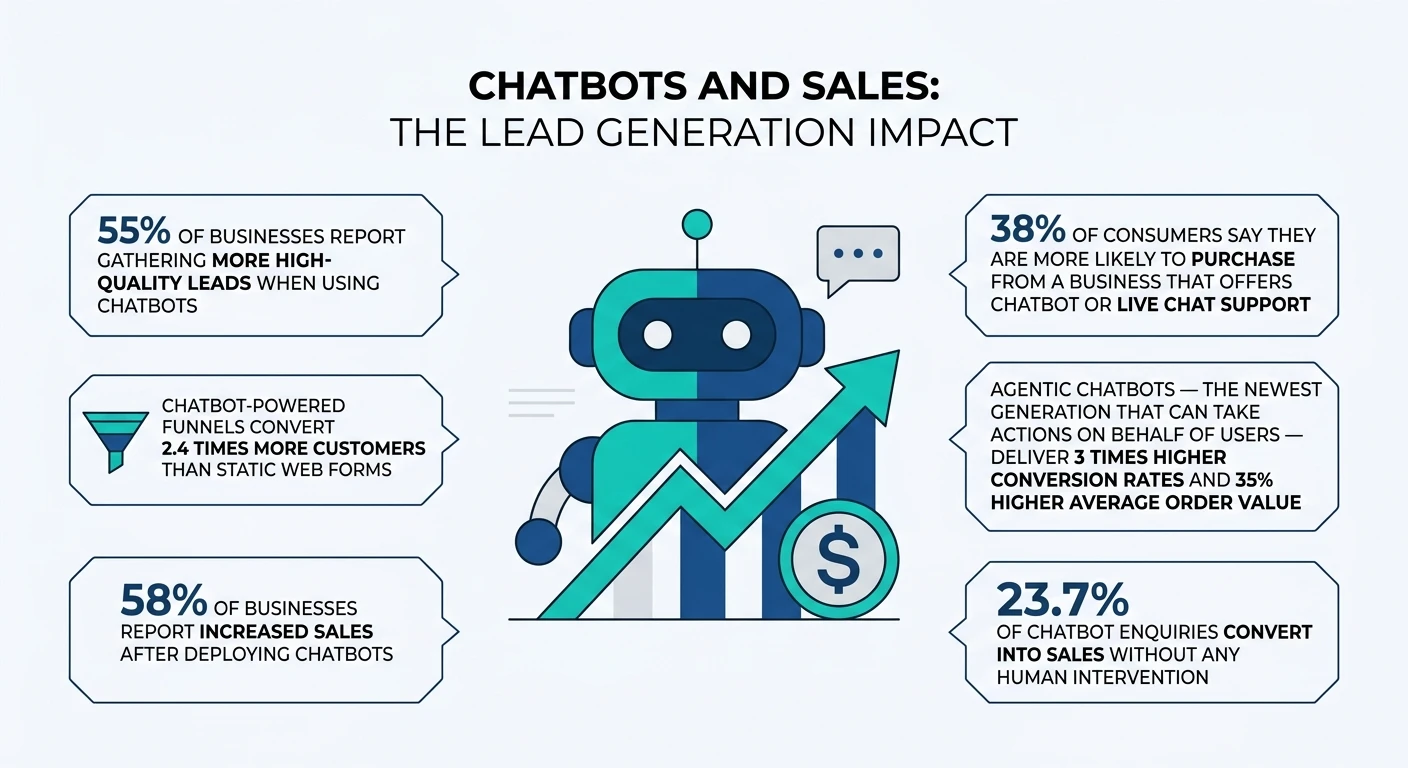
55% of businesses report gathering more high-quality leads when using chatbots
Chatbot-powered funnels convert 2.4 times more customers than static web forms
58% of businesses report increased sales after deploying chatbots
38% of consumers say they are more likely to purchase from a business that offers chatbot or live chat support
Agentic chatbots — the newest generation that can take actions on behalf of users — deliver 3 times higher conversion rates and 35% higher average order value
23.7% of chatbot enquiries convert into sales without any human intervention
The Challenges: What’s Still Holding Chatbots Back
23% of businesses report hallucination issues with generative AI chatbots, where the bot confidently gives incorrect information (McKinsey)
63% of banks report difficulty integrating chatbots with legacy core systems
85% of leaders say they struggle to trust AI-based productivity, creating resistance to full deployment
The average enterprise chatbot implementation costs between $50,000 and $500,000 depending on complexity (Forrester)
SMB chatbot solutions average $50–$500 per month for SaaS platforms (Capterra)
67% of implementations include a human-in-the-loop design to catch errors before they reach customers
The Future of Chatbots: What’s Coming Next
By 2027, 25% of organisations will have chatbots as their primary customer service channel (Gartner)
The financial industry chatbot market is expected to reach $7 billion by 2030
Generative AI spending in banking alone is forecast to hit $85 billion by 2030 at a 55% CAGR
Predictive banking chatbots capable of financial coaching are expected to be in 44% of apps by end of 2026
The voice commerce market — where chatbots and voice assistants process purchases — is forecast to surpass $100 billion by 2026
By 2030, the broader conversational AI market will reach $41.39 billion
Patent applications for chatbot and voice AI technologies are rising, signalling rapid continued development
42% of organisations expect to hire for AI-focused customer experience roles by end of 2026 (Gartner)
Chatbot Statistics at a Glance
Statistic | Number |
Global chatbot market size (2026) | ~$11.8 billion |
Global chatbot users | 987 million |
Businesses with 50+ employees using chatbots | 91% |
Average ROI from chatbot implementation (year 1) | 340% |
Cost per chatbot interaction | $0.50 |
Cost per human agent interaction | $6.00 |
ChatGPT weekly active users | 900 million |
Google Gemini monthly visits growth YoY | +647% |
Gartner’s projected contact centre savings by 2026 | $80 billion |
Projected market size by 2030 | $27.29 billion |
Frequently Asked Questions
How big is the chatbot market in 2026?
The global chatbot market reached approximately $11.8 billion in 2026, up from $9.56 billion in 2025. It is projected to grow to $27.29 billion by 2030 at a compound annual growth rate of 23.3%.
How many people use AI chatbots worldwide?
More than 987 million people — nearly one billion — use AI chatbots worldwide in 2026. Over 1 billion people use some form of AI tool every month.
Which AI chatbot has the most users?
ChatGPT leads with approximately 79.79% of global AI chatbot market share and 900 million weekly active users. Google Gemini is the fastest-growing competitor, with monthly visits surging 647% year over year to 2 billion.
Do chatbots actually save businesses money?
Yes, significantly. The average chatbot interaction costs $0.50 versus $6 for a human agent. Businesses report an average of $8 returned for every $1 invested. Companies save an average of $2.5 million annually through chatbot implementation, and Gartner projects $80 billion in industry-wide contact centre savings by 2026.
Do customers like chatbots?
It depends on the use case. 75% of customers prefer chatbots for simple, routine tasks like order tracking and FAQs. 62% prefer a chatbot over a long wait for a human agent. However, 54% still prefer human support when given a direct choice, and 60% worry about chatbots misunderstanding them. The best results come from smart AI-to-human handover systems.
Comments
Be the first to leave a comment.