
I’ve lost count of how many SEO tools I’ve tested over the years, usually right after a client asks “why isn’t this ranking” and I realize my current tool can’t actually answer that question.
That’s the real test of an SEO platform: not how many features it lists on its homepage, but whether it gives you a straight answer when something’s actually wrong.
I put together this list after going through pricing pages, feature sets, and real usage patterns for seven of the most-used tools in the industry, and Semrush comes out as the strongest overall pick, with the other six each earning their spot for a specific job.
Quick tip: if you only need one tool and you’re not sure where to start, Semrush’s SEO tier at $117.33/mo (billed annually) covers keyword research, site audits, and rank tracking in one place, which makes it the safest first purchase on this list.
8 Best SEO Tools At a Glance in 2026
| Tool | Best for | Starting price |
| Semrush | All-in-one SEO, content, PPC, and AI visibility | $117.33/mo (annual) |
| Ahrefs | Backlink data and link building | $129/mo, or $29/mo Starter |
| Moz Pro | Beginners and Domain Authority tracking | ~$49/mo (annual) |
| SE Ranking | White-label reports for agencies | ~$103.20/mo (annual) |
| Serpstat | Budget-friendly all-rounder | ~$50-69/mo |
| SpyFu | Competitor PPC and keyword spying | $39/mo |
| Ubersuggest | Cheapest entry into a full platform | $29/mo |
7 Best SEO Tools For 2026
Here are some top picks for the Best SEO Tools.
1. Semrush (the best overall pick)
Semrush tops this list because it’s the one tool here that genuinely replaces several separate subscriptions instead of just doing one thing well.
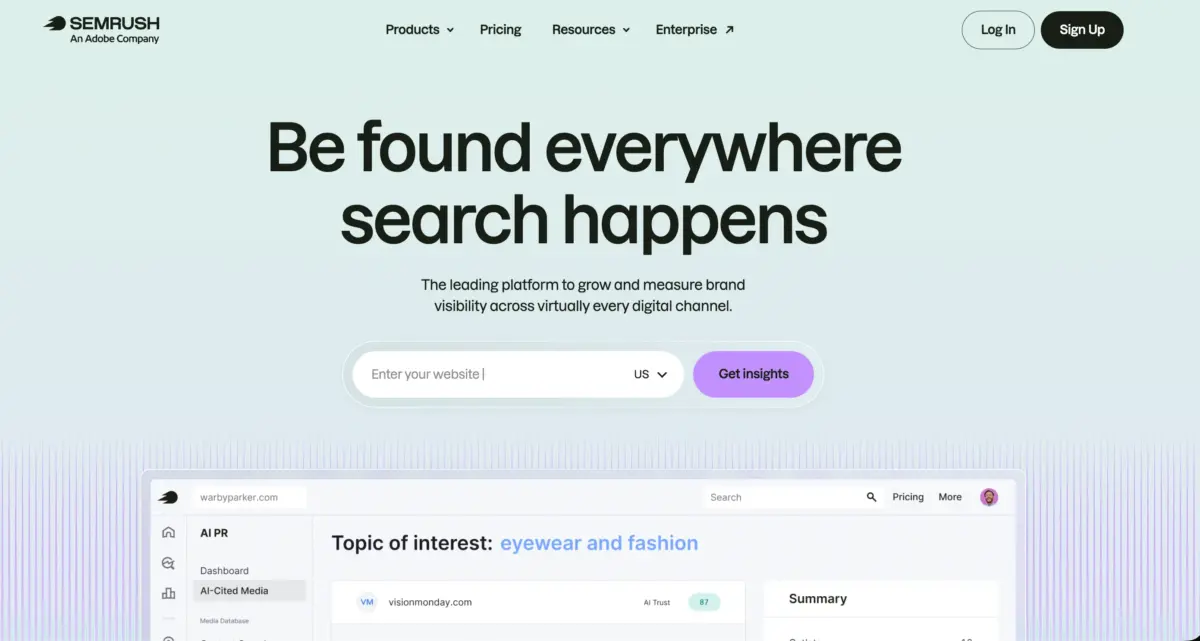
It covers SEO, content planning, PPC research, social media management, local SEO, and now AI search visibility tracking through its Semrush One platform, all under one login.
What makes it different: it’s the only tool on this list that treats AI search visibility (how you show up in ChatGPT, Gemini, and Perplexity answers) as a first-class feature rather than an afterthought, bundled into three of its four core tiers.
Best for: agencies and businesses that want one platform covering the full marketing workflow, not just backlink checking or keyword research in isolation.
Highlights:
- Keyword database covering roughly 26 to 27 billion keywords, with strong US-specific volume
- Daily rank tracking included from the entry tier, including local pack and multi-location tracking
- Built-in content tools (Topic Research, SEO Writing Assistant) for planning and optimizing content
- A dedicated Local Toolkit for managing Google Business Profiles, listings, and reviews
- AI Search visibility tracking across ChatGPT, Gemini, and Perplexity on Starter tier and above
What you pay: $117.33/mo for the SEO tier (billed annually, $139/mo monthly), scaling to $165.17/mo for Starter, $248.17/mo for Pro+, and $455.67/mo for Advanced.
Pros
- Cheapest entry tier of any major all-in-one platform on this list
- Covers SEO, content, PPC, and social in one subscription
- Strong, actively-developed AI visibility tracking
Cons
- The cheapest tier doesn't include AI Search tracking, that starts at Starter
- Interface has a real learning curve given how many tools live inside it
- Extra add-ons (Local Toolkit, Social Toolkit) cost more on top of your base plan
Why it’s #1: no other tool on this list matches its combination of price, breadth, and how seriously it’s investing in AI search visibility, which is quickly becoming a core part of the job for every SEO.
2. Ahrefs (best for backlink data)
Ahrefs earns the #2 spot because it does one thing better than anyone else here: backlink analysis.
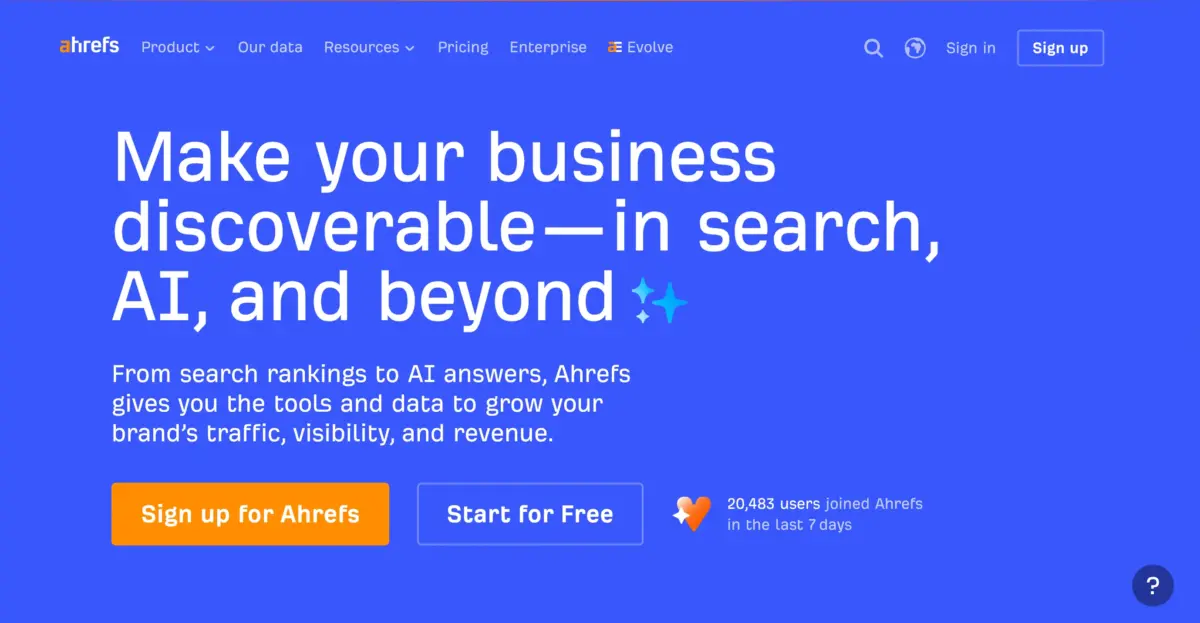
If your job involves link building, competitor backlink research, or cleaning up a toxic link profile, Ahrefs’ data is the industry standard.
What makes it different: its backlink index refreshes every 15 to 30 minutes for active URLs, far faster than most competitors, and its Domain Rating (DR) score is the most widely cited authority metric in the SEO industry.
Best for: link builders, agencies doing heavy competitive backlink research, and anyone who wants the freshest possible link data.
Highlights:
- Referring domain index around 500 million domains, the largest on this list
- Domain Rating (DR), the industry-standard authority metric
- Content Explorer for finding proven, high-performing content by topic
- AI prompt tracking now included from its cheapest Lite tier
- Clean, fast interface with a genuinely gentle learning curve
What you pay: Lite starts at $129/mo, with a cheaper Starter tier reported around $29/mo for single-site use. Standard runs $249/mo, and Advanced runs $449/mo.
Pros
- Best backlink data on the market, full stop
- Fast, clean interface that's easy to pick up
- AI prompt tracking included even on the cheapest tier
Cons
- More expensive than Semrush at every comparable tier
- No meaningful PPC research tools
- Rank tracking is weekly on the entry tier, not daily
Why it’s here: if backlink work is your actual job, Ahrefs is worth the higher price. For everything else, Semrush’s broader platform usually wins.
3. Moz Pro (best for beginners)
Moz Pro has been around since the early days of SEO, and it’s still one of the friendliest tools for someone just learning the basics.
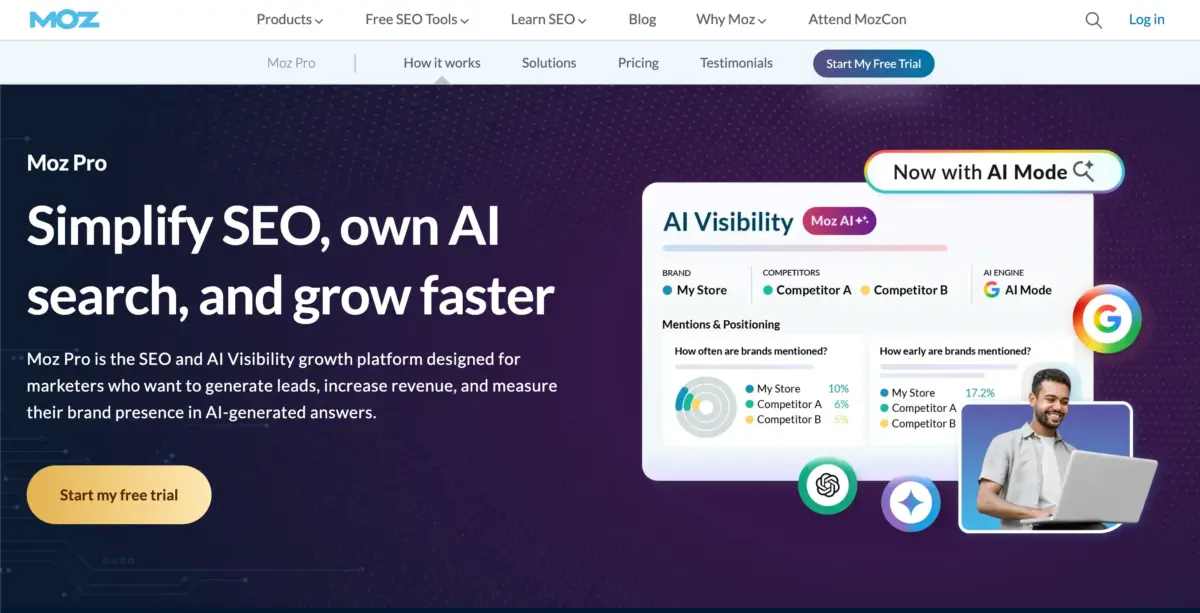
Its Domain Authority (DA) metric, while not identical to Ahrefs’ DR or Semrush’s Authority Score, remains widely recognized and easy to explain to clients who aren’t SEO experts.
What makes it different: its interface and reporting are built with simplicity in mind, making it a genuinely good starting point if you’ve never used an SEO tool before.
Best for: beginners, solo consultants, and small agencies that want straightforward reporting without a steep learning curve.
Highlights:
- Domain Authority (DA), a widely recognized (if imperfect) authority score
- Site audits with clear, actionable fix recommendations
- Rank tracking and keyword research bundled into every tier
- A free trial to test the platform before committing
- Simple, uncluttered dashboard
What you pay: pricing varies by source and billing cycle, generally starting around $49/mo on annual billing for the Starter plan, up to $299/mo for the Large plan.
Pros
- Genuinely easy to learn for total beginners
- Domain Authority remains a widely recognized metric
- Reasonable entry price for a full SEO suite
Cons
- Keyword and crawl limits on the entry tier are fairly restrictive
- Backlink index and keyword database are both smaller than Semrush or Ahrefs
- Less depth for advanced technical SEO work
Why it’s here: for someone doing their first real SEO work, Moz Pro’s simplicity is a genuine advantage, not just a lesser version of the bigger platforms.
4. SE Ranking (best for agency white-label reports)
SE Ranking has built a strong reputation specifically among agencies that need to hand polished, client-facing reports to people who don’t care about the underlying data, just the results.
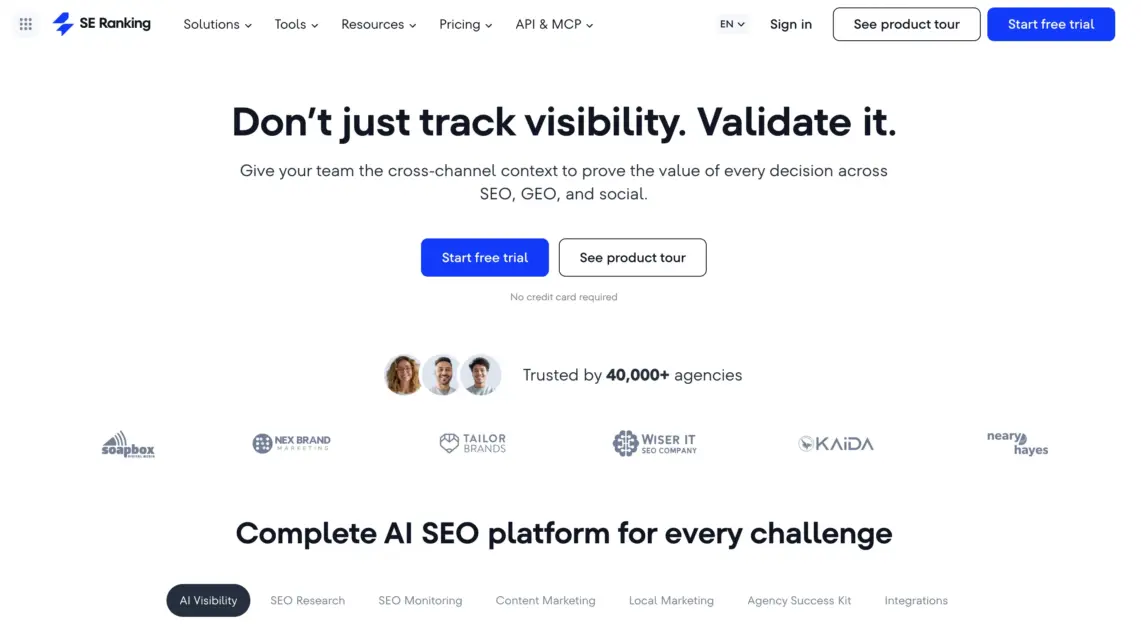
What makes it different: white-label reporting that lets agencies present SE Ranking’s data under their own brand, without the client ever seeing the SE Ranking name.
Best for: agencies managing multiple clients who need professional, brandable reporting without building it themselves.
Highlights:
- White-label reports and a client-facing dashboard
- Around 2,000 tracked keywords on its core tier
- Site audit, backlink checker, and rank tracking bundled together
- Generally rated highly for ease of use and support quality
- 14-day free trial to test before committing
What you pay: pricing has shifted across sources, generally landing somewhere between $65 and $129/mo depending on billing cycle and which snapshot you’re checking, with an annual Core rate around $103.20/mo reported recently.
Pros
- Strong white-label reporting for agencies
- Generally well-reviewed for support and ease of use
- Competitive keyword tracking allowance at its price point
Cons
- Pricing has changed enough recently that it's worth confirming the current number directly before buying
- Backlink and keyword databases are smaller than Semrush or Ahrefs
- Less brand recognition than the bigger names on this list
Why it’s here: if white-label agency reporting is your priority, SE Ranking is built specifically for that job in a way the bigger platforms aren’t.
5. Serpstat (best budget all-rounder)
Serpstat positions itself as a lower-cost alternative that still covers most of the bases: keyword research, backlink analysis, site audits, and PPC research, without the price tag of the bigger names.
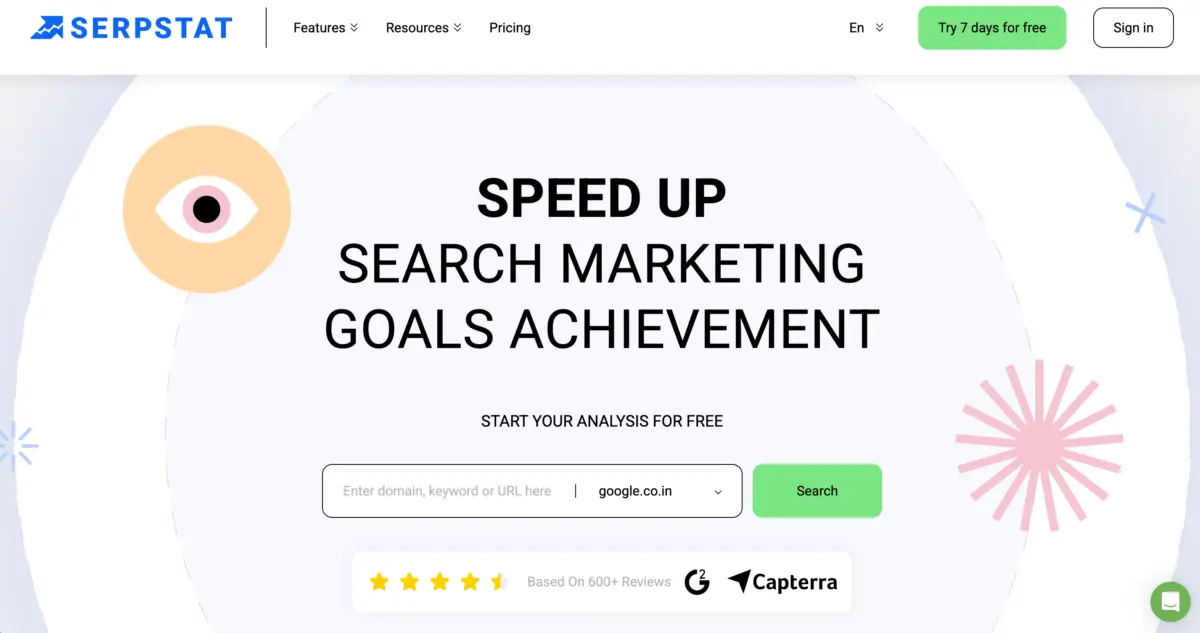
What makes it different: it covers a genuinely wide feature set (SEO, PPC, and content) at a noticeably lower price than Semrush or Ahrefs, without cutting as many corners as some other budget tools do.
Best for: budget-conscious marketers and small agencies who want broad coverage without paying premium prices.
Highlights:
- Covers SEO, PPC, and content research in one platform
- Query-based limits rather than strict keyword caps on some plans
- Backlink analysis and site audit tools included at every tier
- 7-day free trial
- Generally strong user satisfaction ratings relative to its price
What you pay: reported starting prices vary by source, generally between $50/mo (Individual, annual) and $69/mo (monthly), which still undercuts Semrush and Ahrefs meaningfully.
Pros
- Genuinely broad feature set for the price
- Covers PPC research, which cheaper tools often skip
- Strong value relative to cost, per user reviews
Cons
- Backlink and keyword databases are noticeably smaller than the big two
- Less name recognition, which can matter when reporting to clients
- Interface isn't as polished as Semrush or Ahrefs
Why it’s here: if your budget genuinely can’t stretch to Semrush or Ahrefs, Serpstat gives you the broadest feature set for the money on this list.
6. SpyFu (best for competitor PPC research)
SpyFu built its name on one specific angle: showing you exactly what your competitors are doing in paid search, down to the actual keywords they’re bidding on and the ad copy they’re running.
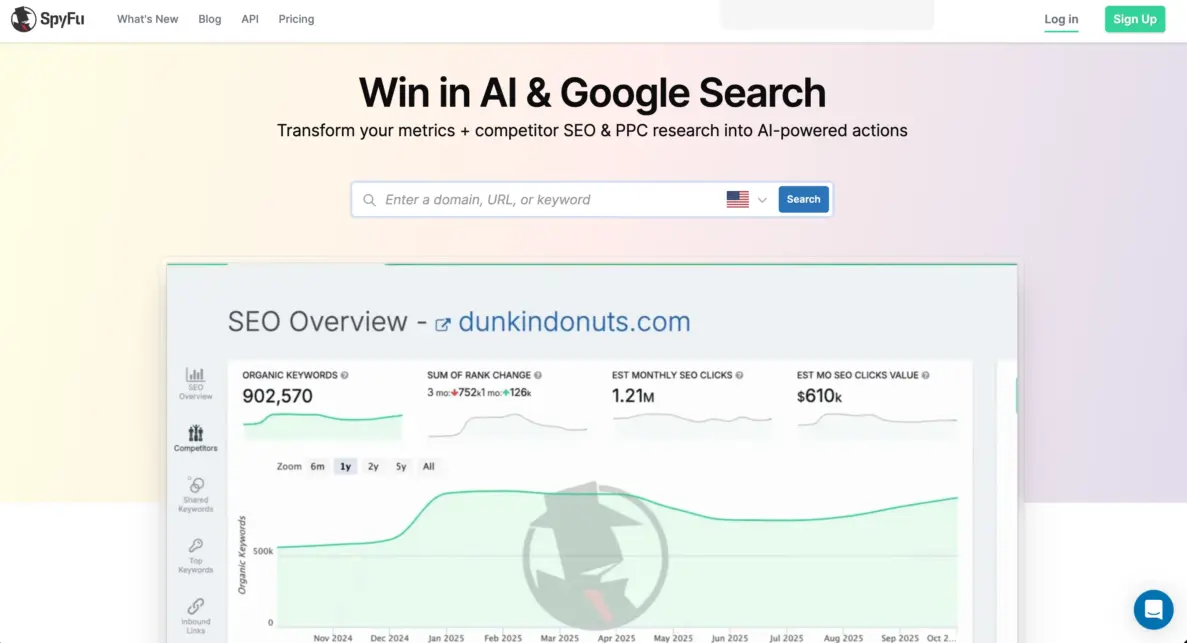
What makes it different: its competitor PPC and keyword-spying features go deeper than what you get bundled into most general SEO platforms.
Best for: marketers whose job involves competitive PPC intelligence specifically, not general SEO work.
Highlights:
- Deep competitor PPC history, including past ad copy and keyword bids
- Domain-level competitor comparison tools
- Keyword research with a PPC-focused lens (CPC, competition data)
- Reasonable entry price relative to its specific specialty
- Strong user ratings for ease of use
What you pay: Basic starts at $39/mo.
Pros
- Genuinely strong for competitor PPC research specifically
- Affordable relative to the bigger all-in-one platforms
- Easy to use without a steep learning curve
Cons
- Not built for general SEO work the way Semrush or Ahrefs are
- Backlink data is thinner than the dedicated SEO-first tools
- Content and social features are essentially nonexistent
Why it’s here: if PPC competitor research is specifically what you need, SpyFu does that one job better than tools trying to do everything at once.
7. Ubersuggest (best cheap entry point)
Ubersuggest, built by Neil Patel, is the cheapest way to get a genuinely usable SEO platform rather than a stripped-down free tool.
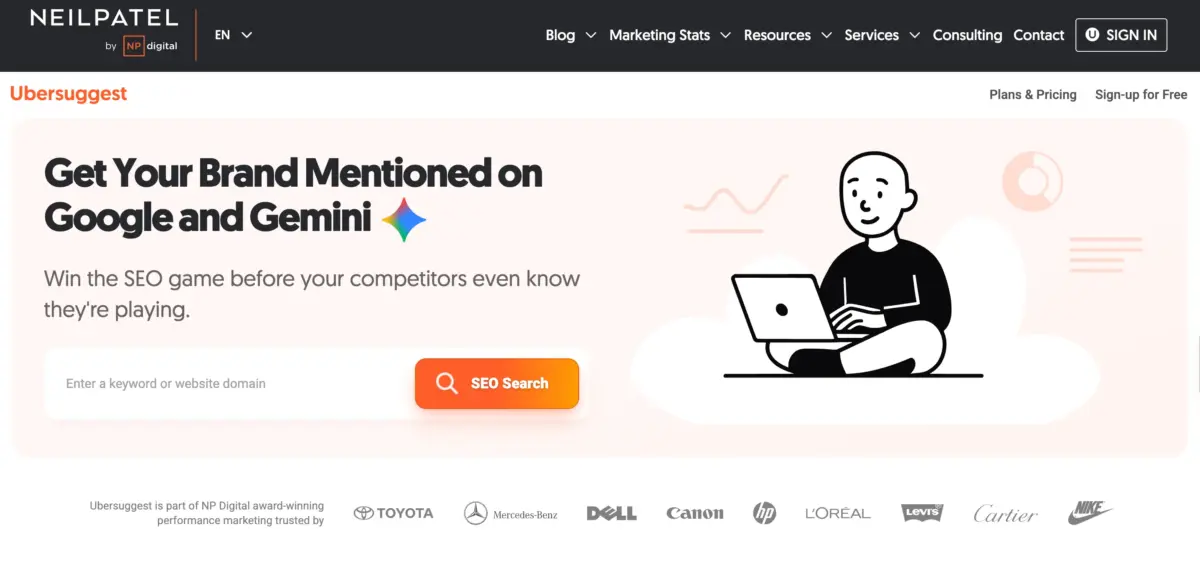
It won’t replace Semrush or Ahrefs for serious agency work, but for a solo blogger or small business, it covers the essentials.
What makes it different: at $29/mo, it’s the lowest-priced tool on this list that still gives you keyword research, site audits, and rank tracking in one place, rather than just one of those things.
Best for: solo bloggers, small businesses, and anyone just starting out who needs the basics without a big monthly bill.
Highlights:
- Keyword research, site audit, and rank tracking bundled at a low price
- Simple, beginner-friendly interface
- Backlink data, though noticeably thinner than the bigger platforms
- 7-day free trial on monthly plans
- Content ideas feature for basic topic research
What you pay: Personal plan starts at $29/mo.
Pros
- Cheapest full platform on this list, not just a limited free tool
- Simple enough for total beginners to pick up quickly
- Covers the core basics: keywords, audits, and tracking
Cons
- Keyword tracking limits are tight (around 125 keywords on the entry tier)
- Backlink and keyword databases are the smallest on this list
- Not built for serious agency or enterprise-level work
Why it’s here: for someone who just needs the basics covered without spending $100+ a month, Ubersuggest is the most practical starting point.
FAQs: Best SEO Tools 2026
Semrush, for most people. It covers the widest range of work (SEO, content, PPC, local, and AI visibility) at a lower entry price than Ahrefs, which is the next most complete option.
Ahrefs, by a clear margin. Its referring domain index is the largest here, and its backlink refresh speed is the fastest.
Ubersuggest at $29/mo or Ahrefs' Starter tier, also reported around $29/mo, are the lowest-priced genuinely usable options on this list.
SE Ranking, for its white-label reporting, or Semrush, if the agency needs to cover content and PPC alongside SEO for clients.
Some agencies do run two, commonly Semrush or Ahrefs for the core SEO work plus SpyFu specifically for PPC competitor research. Most individuals and small businesses only need one.
Yes, particularly for beginners. Its Domain Authority metric remains widely recognized, and its interface is genuinely easier to learn than the larger platforms, even though its databases are smaller.
Quick Links:
- 27 Best Marketing Automation Tools to Convert More Leads
- 15 Best AI Writing Tools for Content Creators and Marketers
- Best SaaS Tools for Remote Teams: Collaboration and Productivity
- Top 10 Best AI Content Detectors to Avoid Content Plagiarism
Final thoughts: Best SEO Tools 2026
Semrush is the strongest overall pick on this list because it covers more ground at a lower starting price than any other true all-in-one platform here.
Ahrefs remains the right call if backlink work is your main job.
The other five tools each solve a narrower problem well: Moz Pro for beginners, SE Ranking for agency reporting, Serpstat for budget-conscious full coverage, SpyFu for PPC competitor research, and Ubersuggest for the lowest-cost real platform on the market. Start with what your actual work needs, not with the longest feature list.
Comments
Be the first to leave a comment.