


Zendesk is a powerful, scalable platform with strong AI features, making it ideal for growing teams and enterprise-level customer support.
- Powerful all-in-one platform
- Strong AI automation features
- Scales with business growth
- Advanced reporting and analytics
- Wide integration ecosystem
- Expensive for small teams
- Complex initial setup
- Higher-tier features costly
Price: $19/agent/month
I have spent time inside Zendesk across different team sizes — a 4-person startup, a 20-person SaaS company, and a large enterprise with 80+ agents. The experience is completely different in each context. And that difference is exactly why this review exists.
Most Zendesk reviews will tell you it is powerful. That is true. What they will not tell you is that “powerful” and “worth it for your team” are two very different things.
This review tells you exactly when Zendesk earns its price tag and when it absolutely does not.
What Zendesk Actually Is in 2026
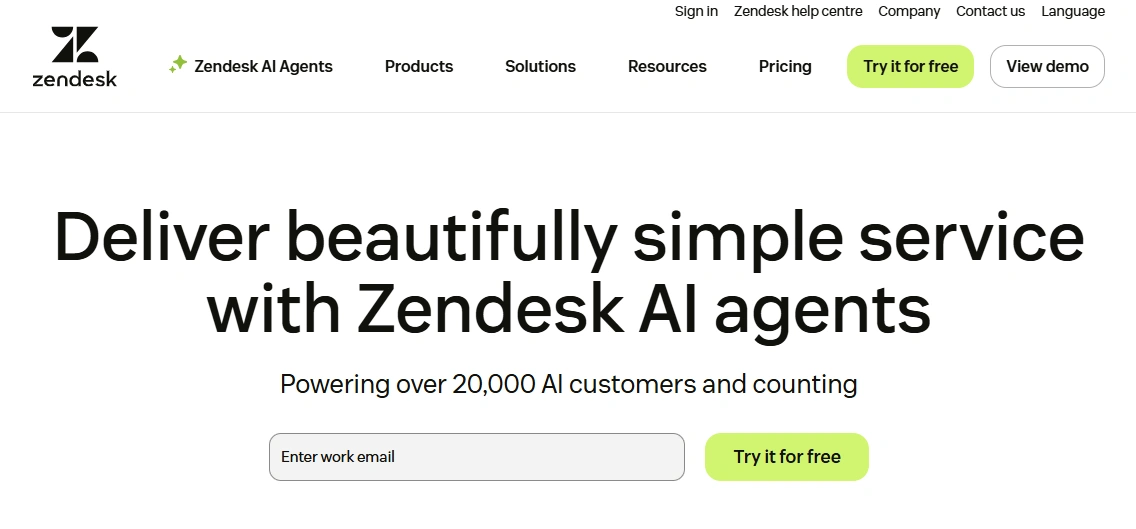
Zendesk started in Copenhagen in 2007 and has grown into the most recognisable customer service platform on the planet. In 2026 alone, 1.7 billion people — roughly one in five people worldwide — used Zendesk to connect with a business, employer, or government.
That scale tells you something important. Zendesk is not a niche tool. It is infrastructure. And like most infrastructure, it is excellent when you have the team to use it properly and overkill when you do not.
At its core, Zendesk converts every customer interaction — email, chat, phone, social media, WhatsApp — into structured tickets that move through defined stages: open, pending, solved. Agents work from a queue. Managers route, track, and report. AI assists where it can.
Think of it as the mission control for your support team.
Also read about: Best Customer Support Software
Zendesk Pricing in 2026: The Full Picture
💼 Zendesk Plans (Annual Billing)
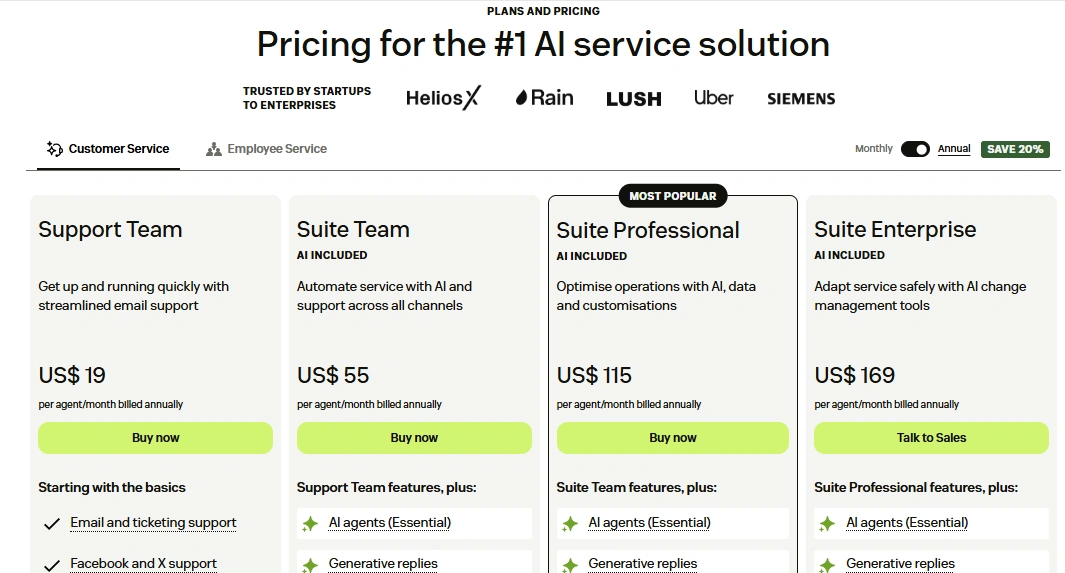
| Plan | Price (Per Agent/Month) | Key Features |
|---|---|---|
| Support Team | $19 | Email & ticketing, social support, automations, analytics |
| Suite Team | $55 | AI agents, live chat, social messaging, phone support, 1 help center |
| Suite Professional | $115 | Copilot AI, advanced reporting, SLA, IVR, 5 help centers |
| Suite Enterprise | $169 | 300 help centers, sandbox, audit logs, advanced security |
📅 Zendesk Plans (Monthly Billing)
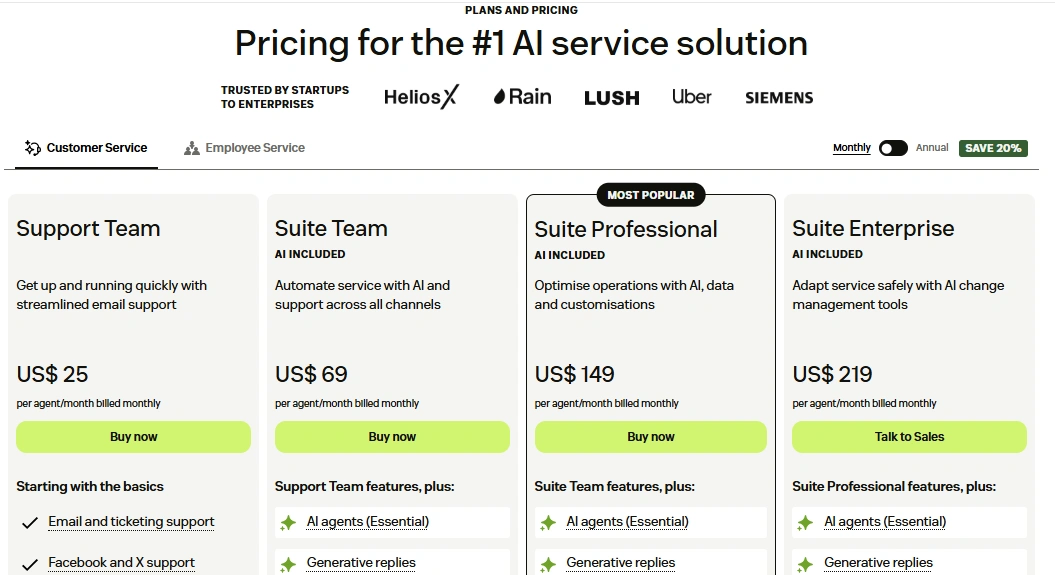
| Plan | Price (Per Agent/Month) |
|---|---|
| Support Team | $25 |
| Suite Team | $69 |
| Suite Professional | $149 |
| Suite Enterprise | $219 |
👉 Annual billing saves ~20–25%, making it the better option for most businesses.
🤖 What Changed in 2026 (Important)
- AI is now included in all Suite plans (no separate $50 add-on needed)
- Features like:
- AI agents
- Generative replies
- Copilot writing tools (Professional+)
are built into pricing, reducing surprise costs
💸 Real Cost Examples
Small Team (5 Agents):
- Suite Team (Annual): $55 × 5 = $275/month
- AI already included → No extra AI cost
👉 Much more predictable vs older pricing
Growing Team (25 Agents):
- Suite Professional (Annual): $115 × 25 = $2,875/month
👉 Previously this could exceed $6,000+ with add-ons
👉 Now significantly more transparent
⚠️ The Hidden Cost Reality (Still Matters)
Even with AI included, costs can rise due to:
- Higher-tier upgrades (for SLA, reporting, compliance)
- Enterprise-only features (sandbox, audit logs)
- Scaling agent count
👉 Zendesk is still premium-priced, especially for larger teams.
What Zendesk Does Well: The Genuine Strengths
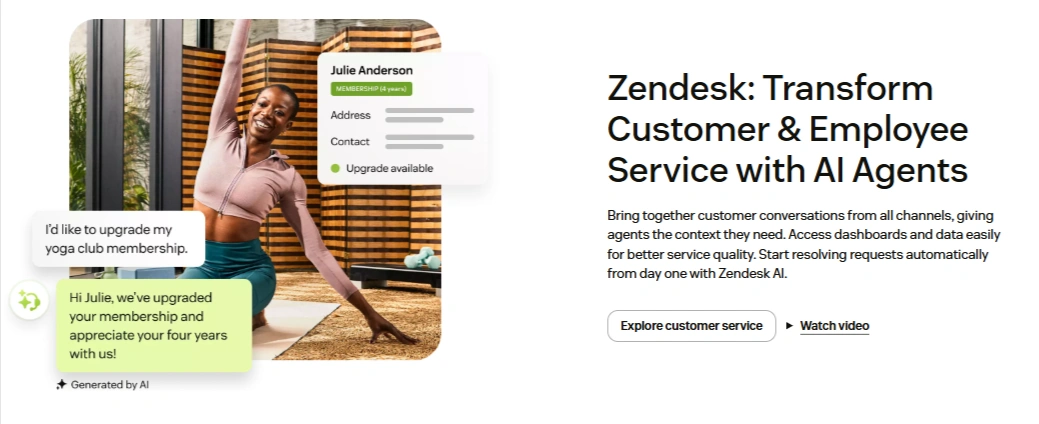
After spending real time inside the product, here are the things Zendesk does better than almost every competitor.
1. Ticket Management at Scale
Zendesk’s ticket workflow is genuinely best-in-class. You can build complex routing rules that assign tickets based on agent skill, workload, language, product area, or priority.
For a 30+ agent team handling multiple product lines, this automation is valuable — it means no ticket gets stuck in the wrong queue and no team member gets overloaded.
Zendesk excels in handling high volumes of complex support requests across email, phone, chat and social channels with extensive customization options.
2. Reporting and Analytics
Zendesk Explore (their analytics tool) is one of the most powerful reporting systems in the category.
You can build custom dashboards, track SLA compliance across teams, measure CSAT by channel and agent, and export data for external analysis. It is the kind of reporting that a VP of Support actually wants to look at.
3. The Marketplace
Zendesk’s marketplace offers over 1,500 integrations — from Salesforce and Slack to Shopify and GitHub. If you have a specific workflow that needs connecting, there is almost certainly a Zendesk integration for it.
4. AI That Actually Helps Agents
Zendesk’s Agent Copilot helps agents by proposing replies, summarising long threads, and doing live sentiment analysis to flag potential blow-ups. Its AI triage (automatic ticket sorting) is very reliable.
The key distinction here: Zendesk’s AI is built to help agents work faster. It is not built to replace agents. If your goal is autonomous ticket resolution, Zendesk’s AI delivers about 40% to 55% resolution rate with the AI add-on — solid but not market-leading.
What Zendesk Does Badly: The Real Frustrations
I will not gloss over the problems. These are real and they affect real teams.
1. The Setup Complexity
Zendesk is powerful but complex. Teams that want something working well out of the box should look elsewhere. If you do not have time or resources for setup and training, Zendesk’s power becomes a liability.
Setting up Zendesk properly — building routing rules, configuring SLA policies, connecting integrations, building a knowledge base — takes weeks for a competent admin. Without a dedicated person owning the configuration, teams use maybe 30% of what they are paying for.
2. The Cost Creep
Most useful features that teams actually need — automation, QA, AI assistance, and analytics — sit behind higher-priced tiers and costly add-ons.
Teams consistently report starting on a lower tier thinking it will cover their needs, then gradually activating add-ons over 6 to 12 months. By month 12 they are often paying significantly more than their initial budget.
3. The Interface Problem
In 2026, Zendesk’s interface still feels outdated and clunky, heavily relying on marketplace and custom apps that can add extra costs and result in a less-than-ideal user experience.
Agent-facing interfaces in Intercom, Front, and even Help Scout feel more modern and less cognitively demanding than Zendesk’s default view. For support agents spending 6 to 8 hours a day in the tool, UI quality is not a trivial concern.
4. Their Own Support
The most ironic problem with Zendesk: Zendesk’s own customer support is hit or miss, especially on lower tiers.
Multiple independent reviews cite slow response times and low-quality resolutions from Zendesk’s own support team. For a company selling support software, this lands badly.
Is Zendesk Worth It for Small Teams?
This is the central question and I want to give you a direct, honest answer.
- Under 5 agents: No. Zendesk is overkill and overpriced. A well-configured Help Scout, Freshdesk, or even Tidio will handle your actual needs at a fraction of the cost.
- 5 to 15 agents: It depends. Once you have a team of 15 or more people handling customer inquiries, the organisational structure Zendesk provides starts justifying the cost and complexity. Below that threshold, you are often paying for features you do not need.If your product is complex, your ticket types are varied, and you have someone who can own the configuration, Zendesk can work in this range. If those conditions are not all true, look at Freshdesk or Intercom first.
- 15 to 50 agents: This is where Zendesk genuinely earns its price. The routing capabilities, SLA management, reporting depth, and omnichannel coordination become real operational advantages at this scale.
- 50+ agents: Zendesk is the default choice. The platform was built for this context. The investment in setup and configuration makes sense, and the enterprise features — advanced security, multiple help centres, custom roles, sandbox — become genuinely necessary rather than nice-to-have.
Zendesk vs the Alternatives at Each Team Size
| Team Size | Recommended First Look | Why Not Zendesk Yet |
| 1–5 agents | Help Scout or Tidio | Too expensive; too complex to configure |
| 5–15 agents | Freshdesk Pro | 50% cheaper; 80% of the features |
| 15–50 agents | Zendesk Suite Growth | Starts to earn its cost here |
| 50+ agents | Zendesk Suite Professional | Best fit for this scale |
| B2B high-touch | Front | Relationship-driven model fits better |
Who Should Actually Buy Zendesk in 2026
Buy Zendesk if:
- You have 15+ agents and multiple support channels
- You have a dedicated admin who can own configuration
- You need enterprise-grade reporting and SLA management
- You have multi-brand or multi-language support requirements
- You are already in the Zendesk ecosystem and switching costs are high
Do not buy Zendesk if:
- You have under 10 agents and a tight budget
- You want something up and running in a day
- Your primary goal is AI-driven autonomous resolution
- You cannot afford the add-ons for AI and workforce management
- You need voice-first or phone-heavy support at low cost
The Hidden Startup Programme Worth Knowing
Startups can apply for the Zendesk for Startups programme, which gives qualified companies six months of free access to Zendesk Suite.
If you are an early-stage company and Zendesk is on your radar, apply for this before paying. Six months of free access lets you validate whether the platform fits your team before you commit to annual billing.
Real User Ratings (2026)
| Platform | G2 Rating | Capterra Rating | Trustpilot |
| Zendesk | 4.3/5 (13,000+ reviews) | 4.4/5 | 3.8/5 |
The G2 and Capterra ratings are strong and reflect genuine platform capability. The lower Trustpilot score consistently reflects billing and customer support complaints — not product quality complaints.
Key Takeaways
- Zendesk is a solid choice for established companies with 50+ employees and 15+ support agents. For growing companies with 10 to 50 employees, consider starting with Freshdesk or Help Scout and migrating to Zendesk later. ScienceSoft
- The real monthly cost is significantly higher than the advertised plan price once AI, WFM, and QA add-ons are included
- Zendesk AI is excellent for agent-assist; Intercom’s Fin AI beats it for autonomous resolution rate
- The Zendesk for Startups programme offers 6 months free — always apply before paying
- No free plan exists; only a 14-day trial with full Suite Professional features
Frequently Asked Questions
1. Is Zendesk worth it for a team of 5 people?
Honestly, no. The configuration complexity and per-agent cost do not make sense at this scale. Freshdesk’s free plan or Help Scout’s Standard tier gives you 80% of what you actually need at a fraction of the price.
2. What does Zendesk actually cost for a 10-agent team?
On Suite Team, the base cost is $550/month. Add AI Copilot ($500/month), WFM ($250/month), and QA ($350/month) and you reach $1,650/month. This is before any enterprise features or additional integrations.
3. Does Zendesk have a free plan?
No. Zendesk has no permanent free plan. There is a 14-day free trial and a startup programme for qualifying early-stage companies that offers 6 months free.
4. What is the main difference between Zendesk Suite Team and Suite Professional?
Suite Team is an entry point with basic AI and one help centre. Suite Professional adds custom reporting, HIPAA compliance, advanced routing, and up to 5 help centres. Most teams outgrow Suite Team within 6 to 12 months.
What are the best alternatives to Zendesk for small teams?
Freshdesk Pro at $49/agent is the closest feature match at a significantly lower price. Help Scout is better for teams prioritising simplicity and human-first support. Intercom is better for SaaS companies that want aggressive AI automation.
Also Read:
- Anstrex Review 2026
- Scalenut Review 2026
- Oxylabs Review 2026
- Genesis Framework Review 2026
- Kajabi Review 2026
Conclusion
Zendesk is a powerful and reliable customer support platform, but it is not for everyone. It works best for mid-sized to large teams that need advanced features, automation, and detailed reporting.
For small teams, it can feel too complex and expensive compared to simpler tools like Freshdesk or Help Scout.
The key takeaway is simple:
👉 Zendesk is worth the cost only when your team is big enough to fully use its features.
If used in the right situation, it can greatly improve support operations. But if not, you may end up paying more for tools you do not really need.
Comments
Be the first to leave a comment.